Abandoning the Hindrances


Whoever has gained release from the world, is gaining release, or will gain release, all of them have done so by abandoning the five hindrances, the mental impurities that weaken wisdom, and by firmly establishing their minds in the four abidings of mindfulness, and by developing the seven factors of enlightenment as they really are. This is how they have gained release from the world, are gaining release, or will gain release.
AN10.95
Abandoning the Hindrances: Introduction
The practice of Abandoning the Five Hindrances is the purification of the mind-stream from the mental impurities that obstruct wisdom. The hindrances are habitual tendencies that prevent sustaining Right Mindfulness, dwelling in the Four Dwellings of Mindfulness, and maintaining a collected and concentrated mind.
They obscure subtle states of mind, hinder entry into and abiding in jhāna, and ultimately block advancement on the path to liberation.
At this stage of the Gradual Training, the hindrances are abandoned through the cultivation of the Seven Factors of Enlightenment. These factors balance and clarify the mind, enabling it to perceive and penetrate all phenomena with wisdom and equanimity. When fully developed, they lead to nibbāna, the complete knowing and ending of suffering.
The Aim of This Stage of the Practice
The aim of abandoning the hindrances and developing the seven factors is practical and direct: the cultivation of the “higher mind.” This is a pliable mind because it is no longer weighed down by distractions and fixations that arise from being bound to the physical domain. Freed from these constraints, the mind becomes flexible, responsive, and capable of subtle refinement.
Dwelling in this higher mind, the mind’s innate capacities become accessible. We can abide in different modes, such as joy, tranquility, or equanimity, through intention alone. This pliancy does not arise through fabrication but through the steady nourishment of the Seven Factors of Enlightenment, which deprive the hindrances of the energy that keeps the mind brittle and reactive.
For this reason, this stage is essential for further development in the Gradual Training. The hindrances are not mere distractions; they are active distortions that bind the mind to tension, restlessness, and doubt, obscuring the clarity required for deeper knowing. The Seven Factors work directly against these distortions. As they mature, the hindrances lose their grip and fade, revealing a mind that is unified and ready for Right Concentration, the next stage of the Gradual Training.
It’s important to keep in mind that although the hindrances are temporarily abandoned at this stage, their deeper roots remain intact. What is being developed here is only the degree of purity required to consistently enter Right Concentration. Only when Right Concentration is established and mastered does the mind become subtle enough to directly see the taints and bring them to an end at their source.
The Purification of the Mind-Stream
As we practice Abandoning the Hindrances and developing the Seven Factors of Enlightenment, craving energy, instead of landing and taking form as a hindrance, is released, and the mind-stream becomes purified.
While the practice is simple in principle, its application requires consistent, moment-to-moment persistence.
As we practice dwelling Mind in Mind, we start to see the mechanics of how craving energy attempts to land and take hold, noticing how it leans toward an object, tightens around an idea, or begins to gather into a specific hindrance. As we fully see this movement and stop feeding it, the energy loses its power to become a hindrance.
Through this practice of seeing without feeding, craving energy loses its momentum. The agitation it once generated settles on its own, and a natural ease takes its place. We experience this relief not as something we created, but as the direct result of releasing strain in both body and mind.
As the tension of clinging dissolves, the energy that was previously bound up in the hindrances is liberated. From this freed energy, joy (pīti) arises naturally, not as a restless excitement, but as a quiet, steady gladness born of being unburdened.
By actively applying mindfulness, investigation, and energy, the mind naturally inclines toward balance. As we dwell Mind in Mind, the mind settles into a state of calm, steadiness, and clarity, allowing tranquility and concentration to mature through our practice.
This is how the energy that hindered the mind is reclaimed and stabilized. What previously fueled disturbance is purified through knowing and becomes the foundation for a contented, unified mind. Gathered and purified, the energy that once fed the hindrances is now ready to be directed toward their permanent ending.
Abandoning the Hindrances: Prerequisites
Reaching this stage of practice requires us to dwell Feelings in Feelings until the “sign of the mind” becomes clear. As clarity develops, our practice naturally inclines toward the source of experience itself: Dwelling Mind in Mind.
Although the Four Dwellings of Mindfulness are often taught as distinct categories, in our practice they function as a single, unified experience seen with increasing refinement. Each dwelling is not a separate practice but a more precise way of discerning what is already present. This is the development of increasingly subtle attention, allowing us to contemplate experience closer to its roots. We do not leave the earlier practices behind; we are still attending to bodily, verbal, and Mental Formations, but we are now contemplating them at their point of origin.
Body as the Ground
We maintain mindfulness of the body as our essential grounding. At this stage of the practice, instead of dwelling in the physical body, we start to dwell in the mental body. From this subtle dwelling, it becomes easier to observe how nāma constructs a representation of rupa, which is form, and how it habitually clings to it. Because nāma is the mind, dwelling Mind in Mind allows us to address this clinging directly at its source, seeing the "will-to-form" before it even crystallizes into physical tension.
Feelings as the Tone
Similarly, we remain sensitive to feeling-tone; this sensitivity does not take us away from the body, as we experience feelings arising through contact within the frame of the body. We are simply perceiving the same landscape with finer resolution, seeing how an entire world of personal identity is built from a simple pleasant, painful, or neutral tone.
As the feeling-tone becomes clearer, the inclinations behind it reveal themselves. Pleasantness brightens and "pulls" the mind, pain tightens and "pushes" it, and neutrality allows it to drift or steady. Detecting these subtle shifts in the mind’s "posture" is where we catch the energy of craving before it fully manifests. Recognizing this is the true beginning of Dwelling Mind in Mind.
The Mind as the Source
By Dwelling Mind in Mind, we address our bodily formations, feelings, and perceptions at their source. We have not moved to a different domain; we are simply seeing the “mechanics” behind the movements of form and feeling. From this vantage point, we don't just see the result of a hindrance; we see the quality of the mind as it begins to tilt toward greed or aversion. We feel the pressure of craving as a subtle inclination of the mind-stream, catching it before it gains the momentum of a full-blown hindrance.
Seeing Phenomena
As our practice matures, universal patterns and conditions become clear. This is dwelling in phenomena, the most transparent perspective within the Four Establishments of Mindfulness. We begin to discern the underlying conditions shaping intention, attention, contact, and perception.
Greed and aversion are no longer experienced as personal flaws, but as impersonal events arising and fading according to conditions. Energy and dullness, mindfulness and clarity, are recognized as natural movements of the mind—qualities that can be nourished or allowed to fade. The body is present, feelings are present, and the mind is known, but now the relationships linking them are directly seen.
It is important to keep in mind that this is not an absolute progression of the training. Depending on conditions and the strength of the hindrances present, it may be necessary to return to simply dwelling body as body or feelings as feelings.
In any case, this remains the direction of practice: to trace craving to its root, to see where this craving-force first lands in experience, and to use the clear light of the Seven Factors to discern the path leading to the end of suffering.
Abandoning the Hindrances: Right View
Before beginning the practice, it is essential that we first establish a clear foundation. Right View of several key principles is essential because they shape how our practice unfolds.
We need to know how to effectively redirect and purify craving energy, which is tainted by our past habits, and transform it into a purified mind-stream that can be used to destroy the taints.
These key principles include:
-
The Nature of the Hindrances as Craving Energy: Why it’s important for us to see the hindrances not as static descriptions but as craving energy seeking to establish itself and take root in our experience. We use the framework of Dependent Arising as our map to guide us in exactly where to look for this energy before it seeks to land and solidify.
-
The Manifestation of Energy: How this craving-force, when tainted by the subtle hindrances, manifests as a specific "flavor" or "pressure" in our immediate experience.
-
Abiding Mind in Mind: Why recognizing the Sign of the Mind and learning to abide Mind in Mind is the only vantage point high enough for us to see these subtle hindrances directly as they seek to land and solidify.
-
The Fabricated Mind-Stream: Understanding the nature of Mental Formations to see how our mind is being fabricated in real-time. By understanding this, we learn how to purify the flow of energy that has been shaped by our past habits.
-
Wise Attention: Why Wise Attention is the specific alchemical tool we use to redirect the mind's focus and release the grip of craving before it crystallizes.
-
The Mechanics of Clinging: Why Perception is the key aggregate we work with, the lens that determines whether the pressure of craving "lands" on our experience and sticks, or simply passes through.
-
The Nutriments of Craving: What the specific nutriments are that feed this craving energy, allowing us to starve the hindrances at their source.
-
The Alchemy of the Mind: How we systematically develop the Seven Factors of Enlightenment to transform hindered, heavy energy into the liberated, refined energy required for liberation.
The aim of this stage of practice is to abandon the hindrances and purify the mind-stream so that it naturally leads into the stability of Right Concentration, where the purified mind becomes malleable and bright and ready to destroy the taints.
Again, while an initial understanding of these concepts is important, there is no need for us to hold on to them tightly. A simple familiarity is enough at the start to ensure that when we encounter these states in practice, we recognize them not as "me," but as an impersonal, flowing process to be purified and released.
Let us now look at each of these key concepts in sequence.
Abandoning the Hindrances: The Five Hindrances
Let’s begin with a brief review of how the Five Hindrances are traditionally described:
-
Sensual Desire: This is craving to satisfy the senses, the desire for sensual gratification and clinging to pleasurable sensory experiences, sights, sounds, smells, tastes, and physical sensations. The mind becomes entangled in longing and attachment.
-
Ill-Will: This refers to aversion in its many forms, hostility, resentment, irritation, or anger—directed toward ourselves, others, situations, or states of being.
-
Sloth and Torpor: Sloth is a dullness or sluggishness of mind, while torpor is both physical and mental inertia, manifesting as drowsiness, heaviness, or a lack of energy.
-
Restlessness and Worry: This is a state of mental agitation, where the mind is unsettled by anxiety, regret, or unease. It involves being preoccupied with past or future events, which prevents inner stillness.
-
Doubt: This is the wavering of the mind—skepticism, indecision, or lack of confidence in the teachings, in the path, or in one’s own capacity to practice and awaken.
Despite their differences, all five hindrances share a common root: craving. In each case, the mind reacts to experience by craving pleasure, pushing away discomfort, or distracting itself from the present moment. This reactivity disrupts mindfulness and weakens concentration, obscuring the clarity needed for insight.
At this stage of the Gradual Training, the Five Hindrances no longer appear in their coarse forms. They show up instead as more subtle inclinations—residual currents of intention, reflexive movements of the mind, or preferences that lean experience in one direction or another.
Abandoning the Hindrances: The Gradual Training
As we advance through the stages of the Gradual Training, we address the hindrances in a systematic manner. At each stage, we cultivate specific skills to overcome the hindrances at their current level of manifestation.
-
The Practice of Sīla: We let go of desire, aversion, and attachment in our interactions by practicing Right Speech, Right Action, and Right Livelihood. We renounce expectations and assumptions, avoiding harmful interactions that disturb the mind while cultivating goodwill toward everyone.
-
Guarding the Sense Doors: We learn to avoid entanglement by not clinging to sensory signs or features that provoke greed, aversion, or delusion at the moment of contact.
-
Moderation in Eating: We practice restraint at the point of consumption, resisting the urge to delight in or crave flavors, ensuring the body is supported without the mind becoming burdened by indulgence.
-
The Practice of Wakefulness: We maintain a clear mind by guarding the sense-gates, ensuring we do not get lost in unwholesome thoughts triggered by external objects. At this stage, we address the hindrances as they manifest in these grosser thoughts through "external" corrective practices—such as the contemplation of body parts, the inevitability of death, and the sign of the unattractive—to neutralize the mind's initial "pull" toward the material realm.
-
Right Mindfulness: We establish ourselves in the Four Dwellings of Mindfulness, purposefully subduing greed and aversion for the "world."
At this more advanced stage of the Gradual Training, the Five Hindrances no longer appear in their coarse, narrative forms. Because the external "leaks" have been plugged through Sīla and Wakefulness, the mind’s sensitivity sharpens. We start to notice the hindrances not as "stories" or "thoughts," but as subtle currents in the mind’s stance toward experience.
All of these subtle hindrances share the same underlying quality: reactivity. The mind "leans" toward pleasantness, pulls away from discomfort, or drifts toward a false sense of safety. Each of these micro-movements disrupts the mind's pliancy and prevents the transition into Right Concentration.
By identifying these movements at their source, Dwelling Mind in Mind, we can apply the Seven Factors of Enlightenment to harmonize the mind-stream, shifting from a state of reactive "abandonment" to a state of mastered "stillness."
Abandoning the Hindrances: The Stages of Liberation
As we continue on the path to liberation, it's worth noting that the Five Hindrances can't be completely eliminated until we reach a stage of liberation. But with each step forward, we can weaken and overcome them enough to abide in jhāna.
As we advance through levels of liberation, some of the hindrances are permanently eliminated:
-
At the initial stage of liberation, Stream-entry, doubt is finally eliminated. We've got a clearer understanding of the path and our own abilities.
-
After the second stage of liberation, Once-returner, sensual desire, ill-will, and remorse are greatly weakened.
-
By the third stage, Non-returner, sensual desire, ill-will, and remorse are gone for good. These negative tendencies no longer hold us back.
-
And at Arahantship, the highest level of liberation, sloth and torpor, as well as restlessness, are completely eradicated.
Therefore, every step taken in weakening these hindrances brings us closer to liberation, where freedom from them becomes unshakable.
A person who has completely destroyed the taints, or mental intoxicants, sensual desire, existence, views, and ignorance, has developed and well-developed the Seven Factors of Enlightenment. This person is called an Arahant, a fully enlightened being.
Abandoning the Hindrances: Manifestations of Karmic Energy
As we begin the practice of abandoning the Five Hindrances, we need to see the subtle hindrances as manifestations of karmic energy.
Karma is essentially a form of mental energy. It possesses both momentum and volition, and it is deeply rooted in our past desires. These desires then manifest as intentions to fulfill those very desires.
This mental energy, which carries power behind it, is what drives our fundamental desire for existence itself. It is what creates the sense of "being," and importantly, the desire to take birth in a physical body, all to seek satisfaction out in the world. And this desire, in turn, manifests through our bodily, mental, and verbal actions, what the Tathāgata refers to as bodily, mental, and verbal formations.
Since karma is rooted in greed, aversion, and delusion, it shows up in the present moment as a restless, scattered mental energy. It is constantly seeking satisfaction, always seeking to "feed" on the objects of the world, which is what we call craving for sense satisfaction. This continual seeking and the underlying restlessness it causes result in a mind that is tainted and disturbed, clouded by ignorance, and ultimately, incapable of achieving liberation.
The Goal is Not Purification of Karma
The aim of developing the Seven Factors is not to purify karma, since past causes and conditions cannot be altered. The aim is to know karma completely, to see it as not-self, and to no longer become entangled in it. In this way, new karma is not created, the cycle of rebirth is brought to an end, and future suffering ceases.
As we move through the Gradual Training and develop the Eightfold Path, scattered mental energy begins to subside. The mind becomes more collected and settled, increasingly unified around the aim of liberation.
Yet even at this stage, restlessness still lingers. There remains a current of ingrained karmic momentum, continually seeking expression through the desire for existence, clinging to the Five Aggregates. This underlying agitation keeps the mind from fully coming to rest.
It is this unsettled condition that the discourses describe as the “five impurities of the mind.” When these are present, the mind is neither pliable, nor workable, nor radiant. Lacking these qualities, it cannot properly attain the concentration required for the destruction of the taints.
For this reason, genuine movement toward liberation depends on transforming this impure and scattered mental energy through the cultivation of the Seven Factors of Enlightenment. As these factors mature, the mind is refined into a steady stream of pliant, collected energy, unified and directed toward the ending of the taints.
Abandoning the Hindrances: Craving and Dependent Arising
When trying to understand craving, we need to see craving not as suddenly appearing after feeling, but as an energy inherent in the whole chain of dependent arising.
Craving is not a momentary occurrence; it is a current of karmic energy searching for a foothold. When it lands, it shapes the entire chain of dependent arising and our entire experience.
Ignorance
Ignorance gives craving a place to hide. When anything in experience is taken to be substantial, lasting, dependable, or satisfying, and when experience is framed as me, myself, or mine, craving finds its footing.
Because these views are assumed rather than examined, conditions are no longer seen clearly. We cannot distinguish between the simple arising of experience and the pull of craving. Drawn by that pull, we become lost in the very views we have constructed, unable to see that these same views are the cause of our suffering.
Volitional Formations
Volitional activity, which is past karma shaped by the pull of current experience, forms intentions around already existing inclinations and tendencies. These intentions already contain the energy of craving from past karmic volition, which is now searching for a foothold, trying to obtain satisfaction in existence.
This craving and the resulting intentions set the stage for action by shaping which possibilities we choose and which we avoid. This is craving taking shape before it is recognized as craving.
Consciousness
As consciousness meets experience, it continually seeks a foothold—the craving to establish the sense of “I am here.” It does not create a self from nothing; rather, driven by this craving energy and its preferences, it repeatedly re-establishes a position within the body and the “world.”
Name and Form
Name continually reshapes what comes through the six senses into mental images, forming a representation of a “world” and its objects. Sensations, perceptions, intentions, and the surrounding environment are organized into a coherent field of experience that supports the sense of being.
Depending on what arises, this field expands or contracts: a pain in the knee, for example, pulls attention inward and centers awareness around that sensation. Consciousness and name and form work together in this ongoing positioning, creating a lived world that feels immediate and personal, even before clinging solidifies a sense of self.
The Six Sense Bases and Craving
When the sense bases are active, craving is continually responding to conditions, searching for something to land on. With contact, feeling arises—pleasant, painful, or neutral—depending on the presence of craving. Here craving becomes more visible: the pleasant offers a way to continue becoming, the painful offers something to escape from, and the neutral offers something to ignore.
Yet even before we react, craving is already leaning. It tries to shape the next intention, the next interpretation, and the next idea of who we are in relation to what is happening. In other words, craving drives the experience.
Clinging
As the chain unfolds, this current of energy seeks to solidify itself. It looks for a form to inhabit and tries to gather a sense of identity from whatever it contacts. It wants a place to stand, a role to assume, and something to protect or enhance.
This movement carries on into clinging, where the mind tightens around a particular view, feeling, memory, or sense of self. That tightening is craving attempting to secure a foothold, to make its position feel stable and real.
Becoming
From there, becoming follows naturally. The volitional momentum has built enough force that the mind constructs a whole state of being around it. This may be a mood, a posture, a reactive identity, or a storyline that tries to complete itself.
Eventually birth takes shape, meaning the appearance of a fully formed state that feels personal. Aging and death represent the fading of that constructed state, followed by another cycle as craving searches for a new foothold.
Experience Itself is the Result of Craving
The key point is that craving is not just a reaction to feeling; everything in our experience can be seen as the result of craving. Experience itself is craving trying to become. Our practice is not to force this movement to stop but to understand how craving continually seeks to anchor itself in our experience, in each link of dependent arising.
When this is seen clearly over and over again, its momentum naturally weakens. It no longer finds the solid landing places it depends on. The chain still operates, but the inner drive that renews suffering begins to fade.
So to practice correctly, we need to see our experience as the direct expression of dependent arising and craving energy. Nothing is hidden; it is all right here for us to see.
Using our own experience as the laboratory, we learn to discern how craving moves through each moment, how it sustains bodily, mental, and verbal formations, and how it can gradually be released.
When we use Dependent Arising as a framework to guide our practice, we not only penetrate the core teachings more easily, but we also direct our efforts toward the heart of the problem itself.
Abandoning the Hindrances: The Manifestation of Craving Energy
Now that we have covered how craving energy tries to land in our experience based on Dependent Arising, let's turn our attention to how it manifests.
The energy of craving is persistent; when it no longer has “the world” to land on, it turns inward and latches onto the only thing left: the Five Aggregates. At this stage, the hindrances are no longer about external objects. They are craving energy, landing on the internal processes of the mind, on the very foundations of experience, on the intentions, attentions, perceptions, and feelings that we are observing.
Whether it is subtle greed for a pleasant feeling or subtle resistance to a neutral one, the hindrances form when the craving-force latches onto these internal flows. Let's look at some examples of how these subtle hindrances manifest.
Sensual Desire: The Demand for Satisfactory Experience
Even when gross craving has subsided, sensuality persists as a subtle desire for the internal landscape to be “just right.” It is the craving for experience itself to be satisfactory. This is nāma seeking to cling to its own activity, where craving energy manifests as a preference for certain pleasant internal feeling tones, such as ease in the breath or soft vibrations in the body.
We might catch the mind trying to solidify perception by prolonging a moment of peace, brightness, or spaciousness, attempting to “freeze” a favorable perception. This is often accompanied by a lusting for attention, where we treat a particular mode of attention as a possession because it feels smoother or more agreeable. Underneath it all is an expectation, a wish for our practice to unfold in a familiar or satisfying way, treating the aggregates as a “nest” for the self.
Ill-Will: Experiential Intolerance
In our practice, ill-will no longer appears as anger. It becomes a subtle resistance to the way phenomena present themselves, a craving to get rid of irritation and tension. We feel this as a "push", a tightening or shove in intention when a neutral or unpleasant sensation arises in the Form Aggregate.
There is often a background reluctance to tension, where we find ourselves treating a physical sensation as an error in the system rather than an impersonal event. This manifests as a shrinking away from dullness, heaviness, or mental fog, or as a subtle aggression toward the present moment because our perception does not match how we think the practice “should” be progressing.
Sloth and Torpor: Landing on the Neutral
These are not gross lethargy but nāma clinging to the comfort of the dim. Here, the pressure of craving lands on the Consciousness Aggregate to find safety in non-doing. We notice a sinking or a softening of alertness when the mind encounters something neutral, using that neutrality as a place to hide.
This shows up as a subtle preference for a pleasant haze or blurry perception rather than the sharp friction of clear, balanced attention. It is a withdrawal of effort that weakens our investigation, letting intention slump into an unproductive ease.
Restlessness: The Momentum of Becoming
Restlessness is a craving-force spinning within our volitional formations, unable to let the momentum of doing settle. We feel it as a continual "reaching" of the mind toward the next moment, where attention cannot stay with the current point of contact.
This creates an anticipatory energy; even when attention stabilizes, the mind is waiting for a result to happen. We might feel a background "hum" of unease, a subtle vibration of the “I” trying to manage our experience through constant, unnecessary readjustments of attention.
Doubt: The Clinging to Certainty
Doubt no longer appears as explicit questioning. It becomes craving energy landing on the whole process with a sense of insecurity. It manifests as a hesitation or a reluctance to abandon unskillful patterns because the groundless nature of nāma, unbound from rūpa, feels unsafe. We find ourselves mistrusting or second-guessing the quality of our own attention, looking for a conceptual guarantee rather than trusting our direct vision. There is often a tension over the outcome, where we watch the result of our practice with a managerial eye, as if checking whether the investment of practice is paying off.
While these are only a few examples of the subtler hindrances, understanding them as craving landing on the aggregates allows us to recognize them as impersonal patterns.
When we see the landing as it happens, through the immediate change in the sign of the mind, we can use the Seven Factors to release the grip, revealing a mind that is pliant, unified, and truly dwelling Mind in Mind.
Abandoning the Hindrances: Dwelling Mind in Mind
Now let’s turn our attention to how we work with craving and the hindrances by dwelling Mind in Mind.
At this point in the Gradual Training, we are not expected to dwell Mind in Mind in a complete or continuous way. The hindrances are still present, even if weakened. We are cultivating and have not yet perfected the Seven Factors of Enlightenment. What we are developing is the conditions for reliably dwelling Mind in Mind and staying in Right Concentration. This stage is about development, not mastery.
When we dwell Feelings in Feelings, something subtle begins to open. Feeling is no longer immediately taken up as something to pursue, resist, or ignore. In that clarity, the “sign of the mind” can be recognized. We begin to sense the quality, tone, and movement of the mind itself as it responds. What becomes visible is not a reactive mechanism but a living current shaped by the energy of craving.
The Mind has no Location
When trying to dwell Mind in Mind, it's important to understand that because the mind has no location in space, it cannot be found at any physical point or within any container. Anything that we experience in the physical domain is not the mind. To dwell Mind in Mind is therefore not to escape the body but to stop taking physical form, rūpa, as the basis for experience. It is to remain within nāma, the domain where experience is actually being shaped.
What we call “mind” is a living stream in which intention, attention, feeling, perception, and contact arise according to conditions. This stream is already charged by past habits of wanting and resisting. It leans and searches for a place to land. If it lands on the physical, it appropriates the body or another physical object, and we are no longer dwelling Mind in Mind.
Knowing the Mind
To dwell Mind in Mind is to meet this current before appropriation and propagation occur. Just as with feelings, we aim to remain with the mental movements of intention, attention, contact, feeling, and perception without letting them become “my body” or “my feelings.” In ordinary experience, these components immediately solidify into ownership and story. This is where the mind is swept away by its own fabrications.
When we dwell Mind in Mind:
-
Intention is felt as leaning energy before it becomes “I want.”
-
Attention is seen as the mind’s turning toward before it becomes “I am focused.”
-
Contact, feeling, and perception are known as the charged movements of the mind before they become “this is happening to me.”
By staying here, our attention does not rush outward into appropriation and propagation. The chain that normally crystallizes into bodily, mental, and verbal formations is seen in its earliest stirrings. The mind remains with its own movement. We stay with the current itself, seeing the “Sign of the Mind,” its urgency, its softness, its contraction, and its release, as it actually happens.
In this dwelling, appropriation and propagation find no footing. What ceases is creating stories. Feeling is just feeling. Perception is just perception. Mind is simply mind. Without appropriation and propagation, suffering has no place to take hold.
This is the doorway to Right Concentration, unification within the mind’s own domain.
Purifying the Mind: The Sign of the Mind
To abandon the hindrances and develop the Seven Factors of Enlightenment, the mind must first learn how to recognize its own state. This recognition is what the teachings call the "Sign of the Mind." Without this sensitivity, practice remains indirect; we stay unsure whether a subtle hindrance is lurking, whether it has truly faded, or if a factor is developing appropriately.
As agitation, dullness, desire, resistance, and doubt weaken, the mind begins to stand out from its objects. Experience no longer "lands" on external sights or sounds; instead, attention remains within the mental sphere. At this point, the mind becomes visible to itself—not as a physical thing, but as a quality. This is where the Sign of the Mind appears.
What is the Sign of the Mind
The Sign of the Mind is not a shape or a visual image. It is the distinctive pattern, texture, or tone of consciousness that becomes apparent once grosser distractions subside. It is the felt quality of the mind’s own activity—more precisely, it is volitional formation in action. When the mind intends, attention is shaped by past karma, and that "shaping" is the mark by which the state of the mind is known.
Because the mind has no physical location, it cannot be known as an object. Instead, it is known through its activity. When the mind is clear, its activity is luminous; when gathered, it is steady. When a hindrance is present, it appears immediately as a change in the tone, weight, or movement of attention itself. In this context, "sign" means the mark by which something is recognized. Even the earliest stirrings of craving can be detected as a subtle alteration in the sign, provided the mind is sufficiently secluded from sensory pull.
How is the Sign of the Mind Recognized
The ability to recognize the Sign of the Mind is the natural outcome of "dwelling feelings in feelings." As attention stops moving outward toward the senses, the clouding effects of the hindrances thin out.
With mindfulness of the body, bodily formations settle. With mindfulness of feeling, pleasant, painful, and neutral tones are known clearly without reaction. As reactivity diminishes, experience is no longer dominated by the "collision" of sensory contact. Attention shifts away from heavy, localized sensation toward the subtler movements of mind.
When the signs of body and feeling have quieted, the Sign of the Mind is uncovered. It appears simply as mind, known through its quality, as described in MN 10:
One knows the mind with craving as a mind with craving, the mind without craving as a mind without craving, the mind with aversion as a mind with aversion, the mind without aversion as a mind without aversion, the mind that is collected, the mind that is scattered, the mind that is exalted, the mind that is surpassed, the mind that is unsurpassed.
MN 10
The Sign emerges not because something new has been created, but because the noise of the senses is no longer loud enough to obscure it.
Hindrances Appear as Changes in the Sign
Before hindrances manifest as full-blown thoughts, they appear as shifts in the Sign of the Mind.
-
Agitation fragments and unsettles the texture of attention.
-
Desire draws attention outward, creating a "leaning" toward contact.
-
Dullness flattens and dims the mental field.
-
Resistance hardens attention with a sense of pressure.
-
Doubt destabilizes the sign, making it hesitant and murky.
By the time narratives arise, the sign has already changed. When you learn to recognize these early alterations, hindrances lose their concealment. They are abandoned not by arguing with their content, but by clearly knowing the altered quality of mind and no longer sustaining the underlying intention. Recognition itself weakens the tendency to continue.
Intention, Attention, and Perception
The Sign of the Mind is known through the functional movements of intention, attention, and perception. Intention is the subtle leaning that sets direction; attention gathers experience and holds it; perception labels and colors what is known.
Together, these shape the "texture" of consciousness. When intention leans toward acquiring or resisting, attention becomes tight and localized, and perception narrows. When intention is settled, attention steadies and perception clears. In this way, the Sign is seen as a dynamic process of conditioned activity rather than a static "self."
The Sign in Direct Practice
In direct experience, the Sign of the Mind is the quality of attention itself. You can find it by observing:
-
The Tone: Is attention brittle or soft? Tight or spacious?
-
The Location: If attention feels "fixed" in the head, this often reflects a localized volition or clinging to a physical anchor.
-
The Luminosity: Is awareness bright or dim?
-
Reflexivity: Are you absorbed in the content of a thought, or can you feel the quality of the attention giving rise to that thought?
Practice means resting with the intention and quality of attention. This is "knowing the mind" rather than being a "knower" located in the body.
Using the Sign to Abandon Hindrances and Develop the Factors
By attending to the Sign of the Mind, dependent arising is seen directly. The moment intention leans toward or away, the quality of attention shifts. This is craving known at its root, before it becomes emotion or story.
This sensitivity also guides the Seven Factors of Enlightenment. When the sign is dull, investigation and energy are required; when the sign is unsettled, tranquility and collectedness are needed to restore balance. Mindfulness is the continuous, clear-eyed knowing of the sign itself.
Finally, seeing the Sign of the Mind as a conditioned formation prevents the creation of a "refined observer." Even the clearest states are known as shaped and impermanent. There is knowing without ownership. When the Sign of the Mind is known in this way, the process of the mind is laid bare, allowing hindrances to fall away and the factors of enlightenment to mature.
Purifying the Mind: Understanding Mental Formations
To clearly recognize the Sign of the Mind, dwell Mind in Mind, and purify the mind-stream of the hindrances, we must first understand what this mind-stream actually is.
It is not a fixed entity flowing through time, nor a hidden self behind experience. The mind-stream is the ongoing flow of conditioned mental processes arising and passing moment by moment. It is the dynamic unfolding of contact, feeling, perception, intention, attention, and consciousness, all dependent on causes and conditions and shaped by past karma. Purification does not mean replacing this stream with something else; it means knowing it so clearly that ignorance no longer shapes it.
Dwelling Mind in Mind means knowing these processes rather than being lost in their contents. Instead of being absorbed in thoughts, emotions, identities, or narratives, we learn to recognize how the mind is operating.
What are Mental Formations?
Understanding Mental Formations is central to this purification. Mental Formations are the hidden architects behind every experience we have. They are not limited to obvious intentions or deliberate choices but include the deeper volitional currents of the mind rooted in intention. They are the way intention unfolds into lived experience.
Mental Formations are shaped by karma, with intention as their core. Karmic intention is the initial leaning of the mind, the choice to resist, pursue, or release. Mental Formations are how this intention propagates into our lived experience, unfolding in dependence on present causes and conditions.
For example, when an unpleasant sound is heard and an unpleasant feeling arises, karmic intention appears as the impulse to react or resist. Mental Formations then carry that impulse forward, tightening our attention, labeling the sound as “disturbing,” and generating habitual patterns of commentary and response. In this way, intention sets the direction, and Mental Formations elaborate and sustain that direction, organizing our experience moment by moment within dependent arising.
These formations include tendencies to aim, resist, pursue, hold, or release. They are not passive events. They actively structure our experience by directing attention, shaping perception, and organizing responses. In this way, they give continuity and momentum to the mind-stream and quietly condition consciousness, action, and future experience.
What is Clear Knowing?
Clear knowing is our direct recognition of contact, feeling, perception, intention, attention, and consciousness as they arise. Whatever goes beyond this immediate knowing is proliferation. The teachings emphasize staying with these processes because they reveal fabrication at its source. This is what it means for us to dwell “Mind in Mind.”
Intention shows where the mind is leaning. Attention reveals what is being sustained. Feeling reveals the tone of pleasant, unpleasant, or neutral. Perception shows how experience is marked and recognized. Consciousness is the knowing of an object itself. Dwelling Mind in Mind means remaining with this knowing without adding narrative, justification, or identity.
When we stay with bare knowing of contact, feeling, perception, and intention, experience is known before it solidifies into fabrication. This direct, non-elaborated presence is what is meant by knowing.
Simply understanding Mental Formations is not enough. We must know them directly, see how they arise, recognize the views that condition them, and understand their true nature as impermanent, conditioned, and not-self. When this is seen clearly, again and again, the craving-force loses its grip and the momentum of saṁsāra begins to loosen.
Purifying the Mind: The Process of Purifying Gold

The discourses compare the abandoning of the Five Hindrances to the process of purifying gold. Just as a goldsmith removes impurities, like iron, copper, tin, and lead, from raw gold through repeated smelting and refining, so too does a disciple remove sensual desire, ill will, sloth and torpor, restlessness and remorse, and doubt through diligent practice.
As the impurities vanish, the mind becomes bright, malleable, and ready for work, just as purified gold is fit for crafting exquisite ornaments. In this purified state, the mind can penetrate higher wisdom for the destruction of the taints.
Disciples, these five impurities of gold, which, when present in gold, make it neither pliable, workable, nor radiant, and it does not properly come to fulfillment in any craftsmanship. What are the five?
Iron, copper, tin, lead, and silver: these are the five impurities of gold, which, when present in gold, make it neither pliable, workable, nor radiant, and it does not properly come to fulfillment in any craftsmanship.
But when gold is freed from these five impurities, it becomes pliable, workable, and radiant; it is not brittle and properly comes to fulfillment in any craftsmanship. Whatever ornament one wishes to make from it—whether a ring, earrings, a necklace, or a golden chain—it serves that purpose.
Similarly, these are the five impurities of the mind, which, when present in the mind, make it neither pliable, workable, nor radiant, and it does not properly attain concentration for the destruction of the taints. What are the five?
Sensual desire, Ill-will, Sloth and Torpor, Restlessness and Worry, and Doubt: these are the five impurities of the mind, which, when present in the mind, make it neither pliable, workable, nor radiant, and it does not properly attain concentration for the destruction of the taints.
But when the mind is freed from these five impurities, it becomes pliable, workable, and radiant; it is not brittle and properly attains concentration for the destruction of the taints.
AN5.23
Just as a goldsmith carefully applies intention, attention, and effort to remove impurities, making gold pliable and ready to be shaped, we likewise cultivate Right View, Right Intention, Right Effort, Right Mindfulness, and Right Investigation. Through this ongoing refinement, the mind and its perceptions are purified, clarity deepens, and the conditions for the ending of the taints are gradually established.
Mental Formations: Shaped by Views
To understand Mental Formations and how the mind-stream can be purified of the hindrances, we have to look beneath their surface expressions. At the root of Mental Formations lies something more subtle and more powerful: view. Not view as abstract belief, but as the deeply embedded assumptions that silently frame how reality is perceived.
The mind interprets experience through these lenses: I exist, this is mine, I am this body, I am the experiencer, I must be happy, I must be free from pain. These are not harmless ideas. They are underlying views rooted in ignorance, and from them craving, aversion, restlessness, sloth, and doubt naturally arise. These hindrances then shape how experience is felt, interpreted, and responded to.
Because ignorance conditions dependent arising, and Right View directly counters ignorance by undoing these assumptions, the cycle is undermined at its root. When wrong views loosen, dependent arising no longer takes hold in its usual way. Experience still unfolds, but it is no longer organized around distortion and clinging.
Letting go of wrong views begins with seeing how they structure suffering. Take the view “I am this body.” As long as this view operates, physical discomfort becomes personal suffering. Every ache, illness, or sign of aging feels threatening because it appears to happen to me. The body is no longer known as a changing, impersonal process, but as a fragile possession. From this, clinging arises, to comfort, youth, and control, and the mind becomes bound to the body.
From these views, Mental Formations follow. The mind begins to seek, control, preserve, fear, or avoid in order to protect the assumed self. These reactions feel natural, even necessary, yet they are conditioned constructions, karmic momentum set in motion by misperception. It is the view that activates these formations. When the view is seen through, the formations lose their foundation.
The difficulty is that the most powerful views often remain unseen. They do not announce themselves as beliefs. They function as assumptions taken for granted, quietly organizing perception and response. When they go unexamined, Mental Formations continue to operate beneath awareness, steering intention and shaping karma.
Freedom begins when this hidden machinery is brought into the light. By questioning what has never been questioned, and by no longer mistaking views for reality, the mind-stream begins to purify itself at its source.
Mental Formations: The Power of Intention
Purifying the mind-stream and understanding Mental Formations requires us to understand the power of intention itself.
When intention is clearly known, its force becomes unmistakable. The moment an intention arises, the movement of experience is already set in motion. Nothing needs to be pushed or managed. Whatever the mind intends immediately begins to take shape, and experience unfolds in that direction according to its own momentum.
When intention is unwholesome, shaped by the hindrances, it gives rise to stress and becoming. When intention is wholesome, it gives rise to ease and release. This is the power of intention. It does not merely influence experience; it actively constructs the worlds we inhabit, moment by moment.
This power becomes obscured when self-making overlays intention. As soon as the movement is claimed as “mine,” or a particular outcome is sought, doubt enters. The hindrances stir, craving colors the intention, and its direction weakens. Instead of allowing intention to unfold naturally, the mind adds effort, strategies, stories, and imagined control.
These added constructions do not strengthen intention; they compete with it. Conflicting motives arise, clarity is diluted, and what would have unfolded simply becomes entangled in fear, habit, and identity. The mind’s creative capacity remains, but it is buried beneath layers of confusion.
How Wrong Views Weaken Intention
Intention is also weakened by our limiting views. When the mind assumes it is bound to the body or confined to a narrow sense of possibility, it no longer recognizes its own freedom. Intention begins to feel like a wish rather than a force.
This happens because we have not yet seen what the mind is capable of. We have not discovered that joy can be formed, calm can be shaped, and entire modes of experience can be created through intention. Ignorance here is not a lack of intelligence but our unfamiliarity with the mind’s own potential.
Without confidence in this capacity, intention hesitates. We doubt its own reach. Qualities we have not yet tasted cannot be clearly envisioned, and so we do not intentionally cultivate them, or we approach them with uncertainty.
Revealing the Mind’s Natural Creativity
As our practice weakens the hindrances and steadies attention, something becomes clear. Intention does not require force or control. When self-making drops away and our limiting views loosen, intention reveals itself as a natural creative movement of the mind.
We begin to see that simply directing the mind shapes our experience. Ease, joy, brightness, and clarity can be intentionally formed. What may feel miraculous is simply recognition. The creative capacity was never missing, only obscured by doubt and the pressure of craving.
We develop intention, not to build a “self” or to get entangled in the “world,” but in the service of developing dispassion, cessation, and relinquishment.
The practice is simple, though it requires a purified mind. Whatever we genuinely intend unfolds naturally when it is no longer obstructed by self-making and conflicting motives. When the mind stops interfering, intention flows directly into Right Effort. This is Right Intention.
Mental Formations: Intention as the Shaping Force of Experience
To purify and develop the power of intention, we first need to understand the different ways that intention can manifest itself as a shaping force in our experience.
Intention is not simply the act of deciding to do something. It is the underlying pressure that shapes attention, feeling, perception, and response. It is the directional quality that turns raw contact into something oriented, something that leans toward, reacts against, holds onto, or avoids.
But with the remainderless fading away and cessation of ignorance comes the cessation of volitional formations; with the cessation of volitional formations, the cessation of consciousness... This is the cessation of this whole mass of suffering.
SN12.61
In Dependent Arising, volitional formations are not occasional choices; they are the continuous activity of intention operating whenever ignorance is present.
At its most obvious level, intention appears as deliberate action. For example, wanting to speak, choosing to move, and deciding to think something through. This level is easy to recognize because it is explicit and effortful. There is a clear sense of doing. But this is only the coarsest level of intention.
More subtle is intention as reaction. Before any deliberate choice, there is already a leaning. Pleasant experience draws the mind toward it, unpleasant experience pushes it away, and neutral experience is overlooked or ignored. This occurs automatically. The mind does not decide to want or resist; the wanting and resisting are already the intention. This reactive level often goes unnoticed because it feels natural, as though it belongs to the object itself rather than to the mind’s orientation toward it.
Subtler still is intention as management. This is the impulse to adjust experience so that it aligns with an underlying assumption. For example, trying to stay calm, trying to remain detached, trying to be mindful, and trying not to react. Even restraint can be intentional in this sense. The mind positions itself in relation to what is happening, maintaining a stance. This stance may feel refined or virtuous, but it is still a formation because it depends on a view that something needs to be handled.
At a very subtle level, intention appears as monitoring. There may be no obvious doing, yet there is a background sense of watching, checking, or keeping track. Is this still okay? Is this fading? Is this a distraction? Am I present? This monitoring creates a reference point, a center from which experience is being evaluated. That reference point is intention operating quietly.
Even more subtle is intention as assumption. Here, intention does not feel like doing anything at all. There is simply an unquestioned sense that what is happening is happening to someone, that it has a past and a future, and that it matters in a personal way. For example, a thought arises, and without any deliberate choice, it is already taken as my thought, something that continues, something that might lead somewhere good or bad.
Because it is silently assumed to be mine and meaningful, the mind automatically follows it, corrects it, worries about it, or tries to bring it to a better conclusion. No decision was made to engage; the engagement was already built into the assumption.
In this way, intention is already operating before any felt movement appears. When we take experience as personal, lasting, or significant, this creates a situation that seems to require a response. The protecting, extending, or fixing happens on its own, not because one chose to intend, but because the assumptions made intention unavoidable.
At this level, intention and ignorance are inseparable. Self-making, permanent-making, and satisfactory-making are not added on after experience arises. They are the way experience is framed from the start. As long as this framing is present, intention must operate. There is always something to do, even if that something is to remain still.
What is often mistaken for non-intention is simply intention that has become quiet, refined, or indirect. Silence, neutrality, spacing out, or absorption can temporarily suspend coarse intention, but the underlying structure remains intact. When conditions shift, intention resumes because the assumptions that require it were never absent.
The Cessation of Intention
Cessation of volitional formations, as described in Dependent Arising, is not the refinement of intention but its non-arising. This occurs when ignorance is absent, meaning self-making, permanence-making, and satisfactory-making are not operating. When nothing is being taken as self, as enduring, or as a source of fulfillment, there is no basis for volition. No leaning is possible because there is nothing to lean toward or away from.
In other words, when experience is not taken as self, not appropriated, and not measured against satisfaction or dissatisfaction, there is nothing left that would require intention to appear.
Without self-making, there is no one to act for. Without clinging, there is nothing to hold, resist, or resolve. Without satisfactory-making, there is no project to complete or secure.
Self-making, permanent-making, and satisfactory-making are not three independent processes that can freely operate on their own. They are three aspects of the same misreading of experience. Taking experience as "me" or "mine."
Experience may still occur, but it is not organized around a center, a timeline, or a project. There is no participation because there is nothing that requires participation.
Understanding intention in this layered way matters because the path is not about suppressing action or cultivating passivity. It is about seeing the assumptions of ownership that make intention seem necessary in the first place.
When experience is taken as me or mine, intention must arise to protect it, extend it, or make it work. As those assumptions weaken, intention loses its footing on its own. What ceases is not activity itself, but the compulsive shaping of experience driven by ignorance, specifically the taking of experience as personal, enduring, and capable of providing satisfaction.
This is why wisdom is recognized not by what appears, but by what no longer arises. When ownership is no longer assumed, the pressures that once automatically arose do not appear.
Mental Formations: Attention
Now we turn to the next component of the mind-stream: Attention. Because the quality of our attention determines whether we recognize the "Sign of the Mind" or fall back into the grip of a hindrance, we must know this faculty completely.
The Channel for Craving Energy
Attention follows Intention. When Intention sets the direction, Attention is the movement that follows. It is the channel through which craving energy flows into experience. When the mind intends to maintain a particular mood, such as irritation or desire, Attention immediately moves to "feed" that state by fixating on relevant objects. Even when attention seems resting, it is often being held in place by an underlying intention to remain "landed" on a specific aggregate.
The Precursor to Clinging
Attention comes before Perception; without it, Perception cannot arise. It is the silent cue that says, “Look here.” This is crucial because clinging starts with where we look. If Attention is captured by the "attractive" or "irritating" aspects of an object, Perception will inevitably follow with a distorted label, and a hindrance will crystallize.
The Mechanism of Growth
Attention is not passive; it actively shapes the mind-stream. Whatever we give attention to grows. In the context of the hindrances, unwholesome attention acts as a "magnifying glass" for craving. If we attend to the attractive aspect of an object, Sense Desire increases. If we attend to the "slump" of the body, Sloth and Torpor increase.
Purification through Wise Attention
The mind is purified not by "stopping" attention but by changing its quality. Unwise Attention is the act of the mind clinging to the surface narratives of the hindrances, which cements views and builds bondage.
Wise Attention, however, is guided by Right View. It directs the mind to see the process of the hindrance rather than its content. By ceasing to nurture unwholesome perceptions and instead directing attention toward the "Sign of the Mind," the craving energy has nowhere to land. The mind begins to clarify, brighten, and unify, transforming the "conduit of craving" into the "conduit of release."
To understand attention more deeply, let’s now look at how attention manifests and how it can be worked with.
Attention: From Ordinary to Supra-mundane
Attention is not neutral. It is an active movement of mind that shapes experience. When attention settles on an object, it does more than register it; it organizes experience around that object. From this organization arise further formations such as inner speech, evaluation, and meaning-making. Even when attention appears calm, it is still shaping what is known.
This matters because wherever attention is active, fabrication is active. Practice does not eliminate fabrication all at once. What changes is how attention functions. The way attention is applied determines whether it fuels agitation, supports restraint, or moves toward the fading of conditions.
This can be seen clearly by looking at attention in three types of persons: the ordinary person, the practitioner, and the Noble Disciple.
The Ordinary Person: Attention as Self-Chatter
For the ordinary person, attention is driven by habit and clinging. It moves toward what is pleasant, away from what is unpleasant, and drifts through what is neutral. Because experience is taken as me or mine, attention immediately triggers verbal fabrication in the form of commentary, stories, and judgments.
When attention lands on a sight, sound, memory, or feeling, it almost always gives rise to inner speech. “I like this.” “That was a mistake.” “What happens next?” This self-chatter follows attention automatically and reinforces identity and continuity. Each moment of attention becomes a starting point for proliferation, sustaining the sense of a self moving through experience.
The Practitioner: Attention as Skillful Guidance
For the practitioner on the mundane path, attention becomes more deliberate. Through mindfulness and Right Effort, coarse chatter weakens, but fabrication remains. It now functions in a skillful rather than a compulsive way.
Directed and sustained thought are still present, but they serve the training. Attention is guided with quiet instructions such as “stay with the breath” or “relax the effort.” Subtle verbal formations appear as monitoring and adjustment. Clinging is reduced but not ended. Attention is skillful, yet it is still doing something and still shaping experience.
The Noble Disciple: Attention as Letting Go
For the Noble Disciple, identity view has been seen through, even though self-making and mine-making may still arise as habits. Because experience is no longer taken as a fixed self, attention no longer organizes experience around a central owner.
When attention moves, it is not immediately taken up as mine. Contact is less likely to lead to a reaction, and proliferation no longer follows automatically. In moments when ignorance is not operating, attention does not function as a conditioning force at all.
As this understanding deepens, the felt need to hold or manage attention drops away. Attention becomes lighter and easier to release. In states of collectedness, directed and sustained attention can cease naturally, not through suppression, but because there is no need to guide experience.
This is expressed in the second jhāna:
With the stilling of directed and sustained attention, he enters and dwells in the second jhāna, which has internal confidence and unification of mind, without directed and sustained attention.
DN2
Here, the subtle activities of aiming and sustaining attention fall silent. Verbal fabrication does not arise because there is no directing or maintaining of an object. Attention is no longer experienced as something being done, and the sense of “I who am attending” fades. Knowing occurs directly, without commentary.
The same principle appears in mindfulness of breathing:
He trains thus: ‘I will calm bodily fabrication.’ He trains thus: ‘I will calm mental fabrication.’
MN118
Calming mental fabrication refers to the stilling of vitakka and vicāra, the subtle activities that organize experience prior to verbalization. When these subside, verbal fabrication does not occur, and what remains is direct knowing.
Seen this way, the training is not about refining control or perfecting attention. It is about seeing the assumptions that give attention its shaping power. As clinging fades, attention naturally loses its compulsive role. What ceases is not awareness, but the tendency of attention to fabricate a world that feels as if it must be managed.
Attention: What One Pays Attention to Grows

One of the core teachings in the discourses is that whatever we place attention on grows. The mind is nourished by what it dwells upon, whether wholesome or unwholesome. If attention is habitually given to greed, aversion, or delusion, these roots deepen. But when attention is turned toward joy, tranquility, and wisdom, these wholesome qualities expand and strengthen.
To purify the mind, we need to use Right Effort to cultivate two key attentional skills:
-
Vitakka, the initial application of attention. It is the turning of the mind away from an unwholesome mind state toward a wholesome one.
-
Vicāra, sustained attention. It maintains attention on the wholesome mind state, investigates it, stays with it, and steadies its presence there.
Just as a skilled bathman mixes bath powder with water into a smooth lather... so too a disciple drenches his body with rapture and pleasure born of seclusion...
AN5.28
In this simile, the Tathāgata shows how vitakka and vicāra function together as the gentle movements of directed and sustained attention. Like the bathman carefully blending powder and water, these two mental activities shape the mind into a unified experience of joy and tranquility born of seclusion.
When we intentionally direct the mind and sustain it upon a particular perception, such as “this is impermanent,” “this is empty of self,” or “this is unsatisfactory,” we are training the mind to return again and again to the liberating characteristics of experience. Over time, this repeated turning and sustaining forms a wholesome habit, inclining the mind naturally toward insight and release.
This is how Right Effort is developed: we deliberately direct attention toward the wholesome and keep it there, nurturing what leads to peace and letting the unwholesome wither through neglect.
Thus, the work is not to purify attention itself but to purify the conditions that give attention its shaping force. As clinging and misperception weaken, the mind-stream becomes clearer and steadier on its own. From that steadiness, collectedness arises naturally, and from collectedness, direct insight unfolds without being driven.
The Energetic Nature of Pāli Terms
Because there is widespread misunderstanding about “thought” and “attention,” it is important to understand that in Pāli the terms vitakka, vicāra, and saṅkhāra are not static nouns. They point to energetic tendencies and causal movements of the mind.
Vitakka refers to the energy of initial placing, the moment attention first lands on or strikes an object.
Vicāra refers to the energy of continued contact, the subtle mental vibration that sustains the object in awareness and keeps attention connected to it.
Vacī-saṅkhāra are the verbal fabrications generated by this contact. They range from proto-thoughts and subtle inner murmuring to fully formed verbal thinking. These fabrications quietly maintain experience as personal, as something known or owned.
When these energies are purified, attention changes in character. What once functioned as an act of possession loses its grip. The sense of “I am attending” gives way to a simpler mode where there is just knowing.
Therefore, directed and sustained attention are not minor technical details of practice. They reveal how experience is fabricated through attention itself. Because of this, the training of attention is central to the path, not as a matter of control, but as a way of understanding and releasing the energetic processes that shape experience.
Attention: Wise Attention
Not understanding what things are fit for attention and what things are unfit for attention, he attends to things unfit for attention and does not attend to things fit for attention.
And what are the things unfit for attention that he attends to?
Whatever things, when attended to, lead to the arising of unarisen sensual desire, or to the increase of arisen sensual desire, to the arising of unarisen desire for existence, or to the increase of arisen desire for existence, to the arising of unarisen ignorance, or to the increase of arisen ignorance: these are the things unfit for attention that he attends to.
And what are the things fit for attention that he does not attend to?
Whatever things, when attended to, do not lead to the arising of unarisen sensual desire, or to the increase of arisen sensual desire, to the arising of unarisen desire for existence, or to the increase of arisen desire for existence, to the arising of unarisen ignorance, or to the increase of arisen ignorance: these are the things fit for attention that he does not attend to.
By attending to things unfit for attention and not attending to things fit for attention, unarisen defilements arise and arisen defilements increase....
He attends wisely to: this is suffering; this is the origin of suffering; this is the cessation of suffering; this is the path leading to the cessation of suffering.
By attending wisely in this way, three fetters are abandoned: identity view, doubt, and attachment to rites and rituals.
MN2
So what is the fire that burns away karmic impurities? It is the fire of insight, and it penetrates most clearly in two modes: seeing and developing.
In MN 2, the Tathāgata describes seven methods for abandoning the taints: seeing, restraining, using, enduring, avoiding, removing, and developing, but only two lead directly to liberation, to the supra-mundane path:
-
Abandoning by seeing: Always, Right Mindfulness comes first. Clear knowing is the doorway, and often, simply seeing a hindrance, without judgment, without clinging, is enough to loosen its grip. Through Right View, we see, “This is not-self. This is impermanent. This is unsatisfactory.” And seeing this way, wrong views begin to dissolve, we stop wrestling with shadows, we see things as they are, and the mind begins to let go.
-
Abandoning by developing: This is the active process. Here, we cultivate the Seven Factors of Enlightenment, and we nourish the wholesome. Each factor—mindfulness, investigation, energy, joy, tranquility, concentration, and equanimity—becomes medicine for the mind. Through their development, the hindrances are not just suppressed; they are uprooted.
The other five methods—restraining, using, enduring, avoiding, and removing—serve as temporary measures, skillful in moments, but not sufficient for liberation. They calm the waters, but they don’t remove the source of turbulence.
So at this point in the Gradual Training, we shift toward creating the causes and conditions for true liberation. We abide in the Four Dwellings of Mindfulness, and from there, generate the wholesome through the Seven Factors of Enlightenment.
As every individual is different, one will need to identify which hindrances affect them the most, understand how and when they arise, recognize their inner strengths to counter each hindrance, and actively cultivate relevant practices to overcome them.
Disciples, considering the internal factor, I do not see any other single factor that is so conducive to the arising of the seven factors of enlightenment as wise attention. For a disciple who is endowed with wise attention, it is to be expected that he will develop and cultivate the seven factors of enlightenment.
And how does a disciple who is endowed with wise attention develop and cultivate the seven factors of enlightenment? Here a disciple develops the enlightenment factor of mindfulness, which is based on seclusion, dispassion, and cessation, and matures in relinquishment.
He develops the enlightenment factor of investigation, energy, joy, tranquility and concentration.
He develops the enlightenment factor of equanimity, which is based on seclusion, dispassion, and cessation, and matures in relinquishment.
In this way a disciple who is endowed with wise attention develops and cultivates the seven factors of enlightenment.
SN46.49
Wise Attention: Yoniso Manasikara
In the teachings, attention is not just a cognitive act but the turning and directing of the mind toward experience. It determines how consciousness meets the world. The discourses describe Wise Attention (yoniso manasikāra) as the root of all wholesome qualities and unwise attention as the root of all defilements.
Attention is one of the components of name in the name-and-form link of dependent arising, which includes feeling, perception, intention, contact, and attention.
At this early point in the chain, these five functions do not yet carry the specific content of individual experiences; they are potential capacities, the interfaces or “mental equipment” that allow for the ability to feel, to recognize, to intend, to make contact, and to attend.
Later in the chain, feeling, craving, clinging, and other processes appear again, but now they function as conditioned events, arising once the mind engages with a specific contact and begins reacting to it.
In other words, before contact, attention acts like a reaching or orienting movement, the mind’s readiness for contact. It is not yet full knowing, but the preparatory turning toward knowing.
Before attention moves, there is intention. Intention conditions the direction in which attention flows, whether toward greed, aversion, or understanding. For this reason, wise attention is not a special kind of attention added on top, but attention that arises in dependence on Right View and Right Intention.
Developing wise attention does not mean forcing attention onto experience. It means allowing experience to be known in a way that reveals its arising and fading, so causes, conditions, and their results become evident on their own. As this understanding deepens, the mind no longer needs to steer attention deliberately.
With practice, attention loses its compulsive, appropriating quality. It becomes steady without effort, like light that illuminates without grasping. From this steadiness, insight matures naturally, leading to dispassion and release.
There are, disciples, things that are the basis for the arising of the seven factors of enlightenment. When one gives wise attention to them, the seven factors of enlightenment arise and come to fulfillment.
SN 46.2
Wise Attention: The Four Noble Truths
To practice Wise Attention, we must use the Four Noble Truths to guide our practice.
The Four Noble Truths are often presented as four separate teachings: suffering, its origin, its cessation, and the path. While this is useful for learning and reflection, it is not how the training actually functions in lived practice. When the mind is being trained to abandon the taints, the four truths do not operate as separate steps or reflections. They function as a single, unified process.
In direct experience, suffering, craving, release, and the path are known together. Stress is felt, the movement of craving that sustains it is recognized, the easing that comes from not feeding that movement is immediately available, and the way forward is already present. The truths are not applied one after another; they operate as one mode of seeing and responding.
This shift is essential for understanding how the hindrances are addressed and how the awakening factors are developed without having to analyze them individually. The hindrances do not arise in isolation; they arise when craving is active and unexamined. When craving is seen clearly and not continued, the hindrances fail to take hold. Likewise, the seven factors are not constructed piece by piece; they emerge naturally as the mind repeatedly inclines toward release.
Seeing the Four Noble Truths as one energy means that the mind stops treating them as concepts to be recalled and starts using them as a living orientation. Stress is immediately recognized as conditioned; the pull toward clinging is felt as unnecessary; the relief that comes from not feeding that pull is directly known; the path, at that point, is simply the mind leaning toward what eases suffering.
Right effort is used directly in this unified functioning. It is not striving or control, but an inclination. The mind naturally turns away from what tightens and inclines toward what releases. Unwholesome states lose momentum because they are not pursued. Wholesome qualities gain strength because the mind repeatedly recognizes their value. In this way, preventing, abandoning, developing, and sustaining occur together as a single directed energy rather than as separate techniques.
Practicing like this, the training accelerates because the mind receives immediate feedback. Clinging is felt as constriction. Non-clinging is felt as relief, calm, or quiet joy. By seeing both in the same field of experience, the mind learns quickly which direction leads forward. Right effort becomes self-reinforcing because it is continuously confirmed by experience.
From this perspective, the four noble truths are not something added at the end of practice. They are what the mind finally sees clearly once its habits of clinging have weakened. At that point, they are no longer four teachings. They are one functioning insight, one movement of understanding and inclination, steadily bringing the taints to an end.
Attention: Developing Concentration
Finally, we must keep in mind that the goal of recognizing the “Sign of the Mind”, dwelling Mind in Mind, and abandoning the hindrances through developing the Seven Factors of Enlightenment is to develop Right Concentration.
Right Concentration does not arise from forcing attention into a narrow focus but from letting go of what scatters it. As unskillful tendencies subside, the mind gathers by itself, becoming unified, steady, and clear.
Ordinarily, the mind is scattered and occupied with many ongoing processes: thoughts, intentions, feelings, and perceptions, what the teachings call Mental Formations. Attention is pulled among these processes, some active and some latent, waiting for the right conditions to surface. This creates a sense of busyness and fragmentation.
A scattered mind is not actually holding multiple objects at once. Attention is always singular, but it shifts rapidly from one object to another. Because these shifts happen so quickly, the mind feels as though it is multitasking when, in fact, it is continuously abandoning one object for the next.
This restless movement is driven by craving and aversion. Subtle desire or resistance determines where attention lands next, keeping the mind in motion. Instead of settling, attention is pushed and pulled, creating mental noise, fatigue, and a lack of clarity.
Right Concentration develops when we work with attention, and as this underlying craving is released. When desire, resistance, and restlessness are no longer being fed by attention, formations lose their momentum. Without push or pull, the mind naturally gathers into unification. This collectedness is not artificial or forced; it is the natural result of letting go.
For concentration to be Right Concentration, it must be guided by Right View, Right Intention, Right Effort, and Right Mindfulness, all aligned toward fading, dispassion, and the relinquishment of the taints. When these factors work together, concentration becomes a support for liberation rather than a refined form of holding.
Mental Formations: The Refinement of Perceptions
Now we turn our attention to the next mental factor, Perception.
Although we have covered Intention and Attention first, from the standpoint of cultivating the Seven Factors of Enlightenment, the work with Mental Formations unfolds in the reverse direction, from the gross to the more subtle, as a natural deepening of what has already been established.
Having practiced dwelling Feelings in Feelings, the mind is no longer dominated by immediate pleasure, pain, or neutrality. Feeling is known without appropriation, and this provides the stability required for further refinement.
With this foundation, the practice naturally shifts toward the more subtle aggregate, the Perception Aggregate. We work with perceptions by developing the Seven Factors of Enlightenment. As clinging to perceptions that give rise to the hindrances weakens, perception becomes purified. The mind no longer needs to defend or reinforce how things appear.
As perception loses its authority, attention itself becomes clear. Attention is recognized as an activity that fixes and sustains experience. When it is no longer driven by clinging, attention relaxes and becomes balanced and pliant, supporting calm, investigation, and collectedness rather than tension.
Within this settled field, intention stands out distinctly. It is no longer concealed by reactions to feelings or by getting lost in perceptions. Intention is known simply as conditioned movement, not as something owned or directed by a self. At this stage, intention is not worked with through manipulation but through knowing. When seen clearly and without appropriation, it naturally fades.
This progression is not a rigid sequence but a refinement of non-clinging already underway. Each factor supports the others. As the Seven Factors mature together, Mental Formations are purified not through effort but through clarity, balance, and release.
Mental Formations: Understanding Perception
Since perception is the primary aggregate we develop at this stage of the Gradual Training, it is important to understand clearly how it functions and how it is refined through the abandonment of the hindrances and the development of the factors of enlightenment.
The function of perception
Intention sets the direction of attention. Guided by that attention, consciousness turns toward an object. When a sense faculty, an object, and consciousness come together, contact occurs. From contact, feeling arises. Based on that feeling, perception functions by recognizing, labeling, and interpreting what is present.
Perception is what organizes experience and gives it meaning. For Right Concentration to develop, perception needs to become simpler and more refined, so experience is no longer broken up or distorted by mental proliferation.
This refinement matters because perception determines how experience is known and how the mind responds. When perception is shaped by habit, defilement, and unwise attention, experience is misread. What is impermanent seems stable, what is unsatisfactory seems desirable, and what is not self is taken to be “me” or “mine.”
Through Right Mindfulness and Wise Attention, perception gradually loses this distortion. It becomes clearer, less reactive, and less driven by assumptions. As perception clarifies, feeling is known without appropriation, craving loses its force, and clinging weakens. From this, the mind naturally settles into calm and collectedness.
The training, then, is not about replacing perception or suppressing it, but about allowing perception to function without the distortion created by clinging, by taking experience to be “me” or “mine.” When perception is purified in this way, it supports concentration and insight rather than perpetuating the cycle of suffering.
To understand this purification more fully, we need to examine perception closely: how it is shaped by karma, how it conditions experience, and how, when rightly known, it becomes a vehicle for liberation rather than entanglement.
So what is perception?
Perception is the function that recognizes and marks a shape as “tree” and a sound as “music.” It assigns recognition and meaning; it tells us what something appears to be. Yet perception does not stand alone. It functions in close dependence on feeling. Although they are distinct aggregates, they are deeply intertwined. Feeling conditions how perception registers experience, and perception in turn conditions how feeling is interpreted.
Both are shaped by past karma. Like a goldsmith working raw metal, we can work with them, abandoning what is unskillful and cultivating what is wise.
There are two aspects of perception to be aware of:
-
Bare perception, such as seeing color or hearing sound. It arises dependent on contact and passes on its own.
-
Perception shaped by intention, when the mind sustains, investigates, emphasizes, or frames what is perceived. This shaping can be wholesome or unwholesome.
Perception by itself does not create karma. Karma arises with intention. When intention appropriates a perception, acts on it, or builds a story around it, the process becomes karmically potent.
If attractiveness is perceived and lust arises, or a threat is perceived and fear takes hold, intention has entered. From there, views form, patterns consolidate, and suffering begins.
Yet perception can also function as a path to freedom. When perception operates through Right View, such as perceiving impermanence, not-self, or unattractiveness, it no longer feeds craving. In this way, perception becomes medicinal rather than binding, and the mind is gradually purified.
Perception no longer shaped by craving
It is important to understand that perceptions of impermanence and not-self are not abstract ideas. They are directly experienced. To perceive impermanence is to see feelings and formations arising and passing, to observe bodily, mental, and verbal activity as a continuous flow, and to know for oneself, “There is fading away.”
Rather than clinging to existence or non-existence, the mind simply knows change as change: “There is passing.” “There is change.” From this clear seeing, dispassion follows, cessation becomes evident, and letting go becomes possible.
Without training, perception is easily distorted. It is pulled by greed, colored by aversion, and obscured by delusion. This is why concentration matters, and why a steady, collected mind, including the deep stillness of jhāna, is essential.
The purpose of cultivating these perceptions is not to reach philosophical conclusions or metaphysical views. It is to refine perception so that it is no longer shaped by craving.
This is how one abides without resistance, responds rather than reacts, and knows directly that there is nothing to cling to, nothing to possess, and nothing to become.
Shaping perceptions
Sometimes it is skillful to intentionally shape how perception functions. Many perceptions are not fleeting impressions but deeply conditioned patterns, formed through long habit, cultural influence, and past karma.
Take dullness as an example. Even when knowing is present, unwholesome tendencies can still arise because of deeply established conditioning.
Here the teachings point to a skillful approach: intentionally cultivating counter-perceptions to weaken unwholesome tendencies. One example is the perception of light or energy. This is not because the mind is inherently dull, but because perception has become imbalanced. When dullness dominates, delusion is close at hand.
This is not self-deception. It is remedial training. A deliberately cultivated perception is used not to deny what is present but to counteract a distortion that is already shaping experience. It functions as medicine for a mind inclined toward craving.
When such cultivated perceptions lessen greed, soften aversion, and clarify delusion, and when they are applied appropriately within the Gradual Training, they are wholesome. Used in this way, they support release rather than reinforce clinging.
Whatever is useful for the abandoning of unwholesome states and the development of wholesome ones, that is to be cultivated.
AN2.19
Perception Is Conditioned
Perception is conditioned by nature. It is not objective reality itself but a mode of recognition shaped by causes and conditions. When something is perceived as dull, threatening, or aversive, that perception already reflects habitual conditioning. Training perception to recognize impermanence, unsatisfactoriness, or unattractiveness is therefore not a distortion; it is a corrective release that restores balance and prevents appropriation.
Those who perceive permanence in the impermanent, pleasure in suffering, self in the non-self, and purity in the impure are beings with wrong views, with scattered minds, and without understanding.
AN4.49
Skillful Fabrication and Direct Seeing
Perceptions can be fabricated as a skillful means because the mind is already operating through distortion. When perception is shaped by craving, aversion, dullness, agitation, or doubt, counter-perceptions are deliberately cultivated to weaken those tendencies. At this stage of the training, fabrication is not abandoned but used wisely in service of release.
These cultivated perceptions are not ends in themselves. They are temporary supports whose purpose is to calm, rebalance, and purify perception so that clinging no longer organizes experience.
As craving weakens, the need to fabricate counter-perceptions naturally diminishes. Perception begins to function with less distortion on its own. Seeing becomes simpler, more immediate, and less shaped by intention, not because perception has been replaced, but because it no longer requires correction.
At this stage of practice, the task is no longer to emphasize one aspect of experience in order to counter another. It is to see arising and passing directly, just as they occur. Impermanence, unsatisfactoriness, and not-self are no longer adopted as contemplative themes; they are known immediately in experience.
In this way, skillful fabrication belongs to the path of training, while direct seeing belongs to the path of release. Confusing the two leads either to premature passivity or to clinging to techniques beyond their purpose.
When fabrication has done its work, it falls away on its own. What remains is clear knowing, unburdened by the need to shape experience.
Perception: The Stilling of Perceptions
The abandoning of the Hindrances and the development of the Seven Factors of Enlightenment are not separate practices. They are the same purification seen from two angles. Both depend on a transformation in how perception operates and how it is related to.
The hindrances arise when perception is infused with clinging. When perception is shaped by craving, aversion, and delusion, it becomes distorted and reactive. Experience is no longer simply known. It is evaluated, resisted, or pursued. From this distortion, the hindrances naturally arise.
As clinging weakens, perception settles. It becomes clearer, quieter, and less appropriated. The Seven Factors of Enlightenment emerge at this point, not because they are deliberately manufactured, but because perception is no longer obstructed. The training, therefore, is not about suppressing perception, but about allowing it to calm through wisdom. When perception is transparent, it supports balance, clarity, and release.
Disciples, whatever kind of perception there is—past, future, or present, internal or external, gross or subtle, inferior or superior, far or near—all perception should be seen as it really is with correct wisdom thus: ‘This is not mine, this I am not, this is not my self.’
SN22.79
When perception is known simply as perception, rather than as my perception, clinging loses its footing. The mind no longer treats perception as a basis for self or as raw material for craving and aversion. In this way, abandoning the hindrances is not an act of suppression but the relinquishment of clinging to perceptual activity itself.
Right Effort functions here as guidance rather than force. One learns to recognize when perception is entangled with clinging and when it gives rise to unwholesome states. Attention is then gently oriented toward perceptions aligned with investigation, energy, joy, tranquility, and concentration.
This is not a matter of replacing one perception with another through willpower. It is a refinement through knowing. When perception is seen as impermanent and dependently arisen, it naturally loses its binding power. There is less grasping at what is perceived and less resistance to its passing.
As perception settles, the mind stops projecting permanence, satisfaction, and selfhood onto experience. What remains is a lucid awareness that discerns phenomena as conditioned and not-self. Perception continues to function, but it no longer binds. It becomes a support for wisdom rather than a source of delusion.
From this refinement, the Seven Factors of Enlightenment unfold naturally. They are not additions to the mind, but expressions of perception freed from distortion. Investigation, energy, mindfulness, joy, tranquility, concentration, and equanimity arise when the turbulence of craving has subsided.
The elements of radiance, beauty, the dimension of infinite space, the dimension of infinite consciousness, and the dimension of nothingness are to be attained through the stilling of perception
SN14.11
Perception: Using Antidotes
Just as impurities in gold can be neutralized through treatments that dissolve what is unwanted while preserving the precious metal, perception can be purified through the use of antidotes. Because perception is a conditioned process, the mind habitually emphasizes certain features of experience, pleasant or unpleasant, attractive or threatening. When this emphasis is shaped by craving, perception becomes distorted.
Training works by introducing counter perceptions that weaken these distortions. Just as an acid is neutralized by an alkaline, or darkness is dispelled by light, the five hindrances can be met with specific skillful fabrications that deprive them of their fuel.
Practical Intervention
As mindfulness deepens, what once seemed like a solid problem is seen as a pattern of clinging. Tightness in the body, for example, may appear purely physical, but with careful attention it becomes clear that the tension is being fed by a resistant perception. The mind has landed on a sensation and labeled it unacceptable.
This is where purification becomes practical.
-
Aversion and Goodwill When tension is maintained by resistance, it can be met with the perception of goodwill. This is a precise shift in how the experience is labeled. Instead of perceiving the sensation as an enemy to be pushed away, a gentle and allowing intention is applied. As the perception shifts from problem to process, the aversive pattern loses its footing and the tension begins to soften.
-
Aversion and the Four Elements If aversion is more entrenched, an analytical perception can be used. By viewing a painful sensation simply as hardness, heat, or pressure, the personal overlay of my pain is removed. When experience is perceived as impersonal elements, there is no self for aversion to cling to, and the stored energy is released.
-
Dullness and the Perception of Light When the mind is heavy and perception feels flat, as in sloth and torpor, there is no need to struggle. Instead, the perception of light or alertness is introduced. By attending to the bright quality of awareness itself, or by imagining a luminous space, stagnant energy is stirred and the dull neutrality lifts.
Disentangling the Mind
This is a subtle but effective mode of practice. What arises, whether tension, dullness, or irritation, is not forcibly removed. What changes is how it is held in perception. By skillfully adjusting the sign that attention rests upon, the energy of craving is prevented from solidifying into a hindrance.
This unfolds moment by moment. With mindfulness, the quality of perception is observed, distortions are recognized, and balancing perceptions are introduced when needed. Over time, perception becomes clearer, steadier, and less reactive, transforming what once distorted experience into a vehicle for clarity.
Perception: Fabricating Impermanence
The teachings frequently speak of the perception of impermanence as a key to liberation. Yet this perception itself is a fabrication, intentionally cultivated. It begins as a deliberate mental training and culminates in direct knowing, where fabrication falls away.
When the perception of impermanence is developed and cultivated, it eliminates all sensual lust, it eliminates lust for existence, it eliminates all ignorance, and it uproots the conceit ‘I am.’
AN7.46
The phrase “developed and cultivated” makes it clear that this perception is not passive. It is trained.
Perception as Conditioned
Feeling, perception, and consciousness are conjoined, not disjoined. What one feels, one perceives; what one perceives, one cognizes.
MN47
Because perception is dependently arisen, shaped by contact and attention, the perception of impermanence arises through wise attention and reflection on the Dhamma. It is a wholesome fabrication, deliberately established.
In MN 62, the Tathāgata instructs his son Rāhula:
Develop the perception of impermanence, Rāhula, for when you develop the perception of impermanence, the conceit ‘I am’ will be abandoned.
MN62
This is intentional training. A skillful fabrication is used to dismantle unskillful fabrications. It is not deception, but the alignment of perception with reality.
Fake It Until You Make It
At first, the mind may need to be trained to recognize impermanence through deliberate perception. One might intentionally attend to movement where solidity is assumed, seeing flickering sensation where there seems to be stability, noticing the play of wind or heat where clinging occurs, or even using simple examples like melting ice cream rather than fixed form, if that helps the mind recognize change directly.
The breath, because it is a fabrication, is one of the most effective supports for cultivating the perception of impermanence. Since the experience of breath is already constructed through feeling and perception, it can be skillfully directed into areas where solidity is felt. By breathing into these areas, rigidity softens, and movement becomes apparent where stillness was previously assumed. Through this, the mind learns directly that what it took to be solid is in fact a process.
This use of fabricated perception is not falsehood. It restores accuracy. Ordinary perception tends toward seeing permanence where there is none. Training the perception of impermanence corrects this distortion. Over time, what begins as intentional perception becomes direct seeing, requiring no effort.
First, attention is intentionally directed toward impermanence. Then, insight arises naturally, without construction. Finally, even that perception fades, as wisdom clearly sees all formations as impermanent, including the perception of impermanence itself.
Perception: Disrupting the Chain of Clinging
To purify the mind is to disrupt the chain of suffering at the root. In the process of Dependent Arising, we see that suffering is an energetic momentum: from Contact to Feeling, to Craving, and finally to Clinging.
This unfolding is not inevitable. The chain requires a "landing site" to sustain its momentum, and that site is Perception.
The Landing Site of Perception
Ordinary perception doesn’t just notice; it labels and objectifies. When contact occurs and a feeling arises, perception immediately "lands" on it with a story: "This is mine," "This is me," "This is good/bad." This mental objectification is the "hook" that allows craving to turn into clinging.
When you perceive a sensation as "My Pain," you have provided a solid target for aversion to latch onto. When perception is purified, the mind ceases to build these targets. It disrupts the chain not by denying experience but by refusing to objectify it.
In the Seen, Only the Seen
The instructions to Bahiya represent the perfection of this factor:
In the seen, there will be only the seen; in the heard, only the heard; in the sensed, only the sensed; in the cognized, only the cognized.
Ud 1.10
When perception remains at this level—direct and non-conceptual—the energy has nowhere to land. There is contact, but no fabrication. There is feeling, but no clinging. You are moving from a "Sticky Perception" that grabs experience to a "Transparent Perception" that allows it to pass through.
From Proliferation to Simplicity
Ordinary perception steers the mind into proliferation (papañca). It takes a simple contact and multiplies it into a world of conflict. The teachings tell us: "Perception conditions thinking. Thinking conditions proliferation." Purified perception, however, stays with the "Sign of the Mind." It knows:
-
"This is contact," not "I am being interrupted."
-
"This is a painful feeling," not "This hurts."
-
"This is the perception of attractiveness," not "I want this."
By perceiving the labeling process itself rather than the label, the mind remains unentangled. You begin to see, "This is a perception of pleasantness," rather than "This is a pleasure." The perception becomes transparent.
The Gatekeeper of the Factors
This is why Perception is the key aggregate we work with in the Gradual Training. It acts as a silent gatekeeper. If the perception is "clean," the energy of the mind remains fluid and bright, naturally becoming the Factor of Energy. If the perception is "distorted," the energy becomes constricted and heavy, turning into a Hindrance.
By training the mind to notice perception as a mental activity—an impersonal fabrication—clinging is starved of its fuel. Proliferation doesn't ignite, stories don't form, and the chain of suffering is broken at the link of Contact.
Perception: Training Perceptions
The teachings do not simply tell us to stop clinging. They provide specific skillful fabrications that cleanse the lens of perception. These perceptions are ways of seeing that disrupt the habitual landing of craving. By consciously changing how experience is perceived, the hook that allows a hindrance to form is removed.
In the discourse to Girimānanda, the Tathagata teaches ten perceptions, a functional map showing how clinging is gradually exposed, weakened, and finally allowed to fall away. Each perception targets a different way the mind maintains involvement, interest, and continuation.
What unifies all ten is not philosophy, but function. Each perception alters how the mind relates to experience. Together, they leave no remaining refuge in conditioned phenomena.
1. Inconstancy Perception
And what, Ānanda, is inconstancy perception? Here, a disciple, gone to the forest, or to the root of a tree, or to an empty hut, reflects thus: Form is inconstant, feeling is inconstant, perception is inconstant, mental formations are inconstant, consciousness is inconstant. He dwells contemplating inconstancy in these five clinging-aggregates. This is called inconstancy perception.
AN10.60
This perception is often translated as impermanence, but inconstancy captures the practical point more clearly. What is seen is not just that things change, but that they cannot be relied upon.
At a surface level, change is easy to notice. Thoughts arise and pass, feelings fluctuate, sensations alter. But the perception pointed to here goes deeper. It is not merely noticing change, but seeing that nothing experienced can serve as stable footing.
Inconstancy undermines trust. The aggregates are revealed as processes that do not settle, do not hold still, and therefore cannot function as a basis for identity or safety. When this perception matures, the mind stops looking to experience for stability.
2. Not Self Perception
And what, Ānanda, is not-self perception? Here, a disciple, gone to the forest, or to the root of a tree, or to an empty hut, reflects thus: The eye is not-self, forms are not-self, the ear is not-self, sounds are not-self, the nose is not-self, odors are not-self, the tongue is not-self, tastes are not-self, the body is not-self, tactile sensations are not-self, the mind is not-self, mental phenomena are not-self. He dwells contemplating not-self in these six internal and external sense bases. This is called not-self perception.
AN10.60
Not self perception is the recognition that what is present consists entirely of conditioned processes, without an owner inside them.
Seeing inconstancy prepares the ground, but not self is a distinct perception. It is the dropping of misattribution. The mind no longer assigns “me” or “mine” to what is simply occurring.
The recognition is that there is nothing here that could reasonably be taken as self. Experience is seen as activity without an agent behind it.
3. Unattractiveness Perception
And what, Ānanda, is unattractiveness perception? Here, a disciple examines this very body from the soles of the feet up, and from the top of the head down, enclosed in skin and full of various kinds of impurity: In this body there are head hairs, body hairs, nails, teeth, skin, flesh, sinews, bones, bone marrow, kidneys, heart, liver, pleura, spleen, lungs, intestines, mesentery, undigested food, feces, bile, phlegm, pus, blood, sweat, fat, tears, grease, saliva, snot, synovial fluid, urine. You dwell contemplating the foulness of the body. This is called perception of foulness.
AN10.60
This perception counters the mind’s tendency to glamorize experience. Where the untrained mind perceives attraction and dependability, this perception reveals the reality of decay and impurity. By examining the body as it actually is, the mind stops relying on fantasy and selective attention.
This is not about cultivating aversion. It is about removing the gloss that sustains desire. When perception no longer adds an imagined appeal to physical forms or feelings, the pull of sensual desire weakens. There is nothing left to chase.
Desire fades because the image it depended on can no longer be sustained.
4. Danger Perception
And what, Ananda, is the perception of danger? Here, a disciple, gone to the forest, to the foot of a tree, or to an empty hut, reflects thus: This body has much suffering, much danger. In this body various diseases arise, such as: diseases of the eye, ear, nose, tongue, body, head, ear, mouth, tooth, lip, cough, asthma, consumption, fever, aging, stomach ache, fainting, dysentery, boils, leprosy, tuberculosis, epilepsy, skin diseases, itch, scabs, ulcers, blood disorders, bile disorders, phlegm disorders, bodily humors disorders, wind disorders, disturbances from changes of weather, disturbances from external elements, disturbances from kamma, disturbances from the mind, cold, heat, hunger, thirst, defecation, urination. Thus he dwells contemplating danger in the body. This is called perception of danger.
AN10.60
Pleasant feelings are often the most deceptive landing sites because they appear safe. The perception of danger recognizes that all conditioned states are unreliable and subject to change.
This does not mean fearing the body, feelings, or perceptions. It means understanding the cost of relying on them.
By seeing the risk inherent in any pleasant state, the mind naturally stops leaning toward it. The illusion of safety is replaced by clarity, allowing the mind to remain centered rather than reaching outward.
For example, the body is seen as subject to illness, pain, aging, and breakdown, not occasionally, but structurally. This undermines complacency and the assumption that embodied existence can be made secure.
Danger perception removes the last traces of romanticism about physical experience.
5. Abandoning Perception
And what, Ananda, is the perception of abandoning? Here, a disciple does not tolerate arisen sensual thoughts, he abandons, dispels, terminates, and eliminates them. He does not tolerate arisen thoughts of ill-will, cruelty, or harmfulness, he abandons, dispels, terminates, and eliminates them. He does not tolerate arisen unwholesome mental states, he abandons, dispels, terminates, and eliminates them. This is called perception of abandoning.
AN10.60
Abandoning is not about rejecting views or ideas. It is about not tolerating the mental activities that enact clinging.
This includes craving and aversion, as well as subtler habits such as continual leaning toward sense contact, automatic proliferation, and the momentum of involvement.
When these activities are recognized as unwholesome, they are not fed. They are allowed to end. Abandoning cuts clinging at the level of behavior, not belief.
6. Dispassion Perception
And what, Ananda, is the perception of dispassion? Here, a disciple reflects: This is peaceful, this is sublime, that is, the stilling of all formations, the relinquishment of all attachments, the destruction of craving, dispassion, cessation, Nibbana. This is called perception of dispassion.
AN10.60
Dispassion is the cooling that occurs when the mind recognizes the relief of not holding. It is trained by noticing the peace that appears when craving and involvement are absent, and by learning to value that relief.
Here, the mind begins to associate non holding with ease rather than loss.
7. Cessation Perception
And what, Ananda, is the perception of cessation? Here, a disciple reflects: This is peaceful, this is sublime, that is, the stilling of all formations, the relinquishment of all attachments, the destruction of craving, cessation, Nibbana. This is called perception of cessation.
AN10.60
Cessation here is not a dramatic event. It is the recognition that formations do not need to be renewed.
The mind becomes familiar with non arising, with the quiet that comes when activity is not restarted. This weakens the belief that something must always be happening.
Cessation is trusted, not feared.
8. Non Delight in All the Worlds
And what, Ananda, is the perception of the unattractiveness of the whole world? Here, a disciple, by abandoning the mental obsessions, attachments, and underlying tendencies towards grasping in the world, dwells contemplating the non-arising of the defilements of the mind. This is called Ananda, the perception of not delighting in the whole world.
AN10.60
“Worlds” refers to all fields of experience constructed from the aggregates, whether coarse or refined, bodily or mental.
Through seeing inconstancy, danger, and not self everywhere, the mind understands that no configuration of experience offers true refuge. Pleasant states, refined meditative states, clarity, peace, and even subtle equanimity are all conditioned and require maintenance.
Non delight is not aversion or withdrawal. It is the end of expectation.
The mind no longer leans toward any world hoping to find stability or completion there. Having surveyed all conditioned possibilities, it sees that none can be taken as a place to dwell.
What remains is relief. The search naturally stops.
9. Inconstancy in All Conditioned Phenomena
And what is Ananda, the perception of inconstancy in all conditioned phenomena? Here, Ananda, a disciple detaches, lets go, and abandons all conditioned phenomena. This is called Ananda, the perception of inconstancy in all conditioned phenomena.
AN10.60
Earlier, inconstancy was applied to the aggregates. Here it is applied universally.
This perception removes the final refuge, including refined states, insights, calm, clarity, and even the practice itself. Nothing conditioned is taken as a place to dwell.
Detachment here is not willed. It occurs because nothing conditioned is seen as final.
10. Mindfulness of Breathing
Mindfulness of breathing is placed last not because it is basic, but because it can contain all the others.
When breathing is known without interference: • inconstancy is evident • not self is implicit • attraction fades • abandoning occurs naturally • dispassion and cessation are tasted • non delight is supported • no conditioned state is taken as refuge
Mindfulness of breathing functions as a complete vehicle, allowing all perceptions to operate without being named or constructed.
The Overall Pattern
The ten perceptions are not a linear progression. They form a comprehensive strategy.
Together they move the mind from seeing, to loosening, to losing interest, to no longer renewing activity. What remains is not something added, but the absence of clinging.
Liberation is not produced. It is what remains when nothing conditioned is being carried.
AN10.60: The Tathagata, while residing at Jeta's Grove near Sāvatthī, was approached by Venerable Ānanda concerning the severe illness of Venerable Girimānanda. Ānanda requested the Tathagata to visit Girimānanda, but the Tathagata instead suggested that Ānanda relay ten specific perceptions to Girimānanda, believing these teachings could alleviate his suffering. These perceptions included the inconstancy and not-self nature of phenomena, the unattractiveness and dangers of the body, the importance of abandoning unwholesome states, and the practices leading to dispassion, cessation, and mindfulness of breathing. Ānanda conveyed these perceptions to Girimānanda, which subsequently eased his illness.
Perception: Developing Dispassion
And what, Ananda, is the perception of dispassion? Here, a disciple reflects: This is peaceful, this is sublime, that is, the stilling of all formations, the relinquishment of all attachments, the destruction of craving, dispassion, cessation, Nibbana. This is called perception of dispassion
AN10.60
The discourses frequently instruct us to develop the Seven Factors of Enlightenment based on seclusion, dispassion, cessation, and the relinquishing of attachment.
Dispassion is often misunderstood as indifference, withdrawal, or a lack of interest in experience. In the discourses, it is none of these. The Perception of Dispassion is how we teach the mind to see the benefit of letting go.
Dispassion Is Not Simply the Result of Letting Go
It is easy to assume that letting go comes first and that dispassion follows automatically. This can happen at a coarse level, but this is not how habits are actually reshaped.
If dispassion is simply a consequence of letting go, the discourses would not repeatedly instruct us to reflect on it, recognize it, and dwell in it. The deliberate turning of attention toward the quality of release shows that dispassion itself is being trained.
Letting go opens the door, but dispassion strengthens this letting go by appreciating what is found beyond it.
"This Is Peaceful, This Is Sublime"
The instruction is not, “This is correct,” or, “This is what should be done.” It is, “This is peaceful, this is sublime.”
We are encouraged to notice and reflect on the relief, the quiet satisfaction, and the sense of sufficiency that appear when clinging is not renewed. By recognizing this pleasure directly, the mind learns something essential. It learns that letting go is not a loss; it is a gain.
Ambrosia and the Pleasure of Release
The discourses sometimes describe release as ambrosia. This does not point to anything exotic or mystical. It points to the unmistakable ease that becomes apparent when effort, management, and appropriation quiet down.
This ease is not created. It is the result of letting go.
Dwelling in this ambrosia means allowing the mind to remain with the absence of tension long enough to trust it. That trust is what gradually reshapes habit.
Retraining the Mind’s Reward System
When the mind lets go, its immediate conditioned response is often a subtle sense of loss. Something familiar has ended, and the reflexive conclusion is, “I lost something.” This reaction is old, deeply trained, and largely unnoticed.
Clinging persists not because the mind fails to understand impermanence, but because holding has long been associated with gain, safety, or continuity, while letting go has been associated with lack.
Dispassion works by reversing this association.
When the mind repeatedly tastes the pleasure of non-engagement, it begins to recognize that letting go leads not to loss, but to relief. Something burdensome has been put down. Over time, the felt sense shifts from “something is missing” to "something better has been found."
This is how the reward system is retrained.
Gradually, the mind associates holding with strain and release with ease. Eventually, it no longer needs to be instructed to let go. It understands, at a bodily and intuitive level, that there is something to be gained in not holding.
This is why dispassion is paired with joy, tranquility, and peace in the teachings. The training does not starve the mind. It nourishes it with something better than what it relied on before.
Dispassion Is Cooling, Not Aversion
Dispassion does not push experience away. It does not reject the senses or condemn the world. It simply no longer leans.
When dispassion is present:
-
Experience arises without being appropriated
-
Contact does not automatically lead to proliferation
-
Perception performs its function and then rests
-
The mind does not feel deprived
This is why dispassion is experienced as relief rather than restraint.
From Practice to Preference
At first, dispassion may appear briefly as a byproduct of insight or restraint. The instruction is to notice it, dwell in it, and recognize its value.
Over time, dispassion stops being something that merely happens and becomes a tendency. Not through effort, but through familiarity. Holding begins to feel unnecessary. Letting go feels natural.
Dispassion and the End of Clinging
When dispassion is well established, clinging no longer needs to be dismantled piece by piece. It simply lacks fuel.
The mind rests because it has learned, through direct experience, that peace does not depend on holding anything at all.
That is the function of dispassion as a perception. It does not merely describe release. It trains the mind to value it.
Perception: Applying the Seven Factors of Enlightenment
Training the mind to perceive impermanence, not-self, or the unattractive is a method of guiding craving energy toward release. However, even these wholesome "skillful fabrications" can become distorted if the mind's energy becomes constricted around them.
If we apply an antidote without the Seven Factors, we risk creating a new "landing site" for a hindrance. For instance, perceiving impermanence might stir the constriction of aversion; reflecting on the unattractive might lead to the stagnation of dullness. The Seven Factors of Enlightenment act as the “corrective weights,” ensuring that our tools for purification don't become sources of imbalance.
The Seven Factors as Correctives
-
Joy Lifts Disheartenment: When the perception of Impermanence makes the mind feel anxious or grim ("Everything changes, what's the point?"), the energy has landed on a depressing narrative. Joy is the antidote. It reminds the mind that letting go is a liberation, not a loss. With joy, impermanence becomes a lightness rather than a burden.
-
Energy Clears the Fog: When contemplating the Unattractive, the mind may slip into the "Stagnation of Neutrality" or heaviness. Here, the factor of Energy revives the mind-stream. It brightens the "Sign of the Mind," keeping the investigation investigative rather than depressive.
-
Investigation Adds Vitality: When observing Not-Self, the mind can end up detached or blank, a "dry" view. Investigation reignites intimacy with the process. It asks, “Where exactly is the 'I' being imagined?” This curiosity prevents the perception from becoming a lifeless concept.
-
Tranquility Softens the Edge: When we perceive the Danger in feelings, the mind may tighten into a state of "High Alert." Tranquility reassures the mind-stream: “There is danger, but there is no emergency.” It allows the perception to stay clear and steady without the constriction of fear.
-
Concentration Grounds the Analysis: If the mind becomes over-active, jumping between different perceptions or insights, Concentration anchors the energy. It gathers the scattered mind back to a single "Sign," allowing the depth of the insight to settle in without fragmentation.
-
Equanimity Steadies the Lean: In any practice, the mind may subtly "lean" toward wanting a certain result or rejecting a difficult state. Equanimity is the steady hand. It sees the perception clearly but refuses to cling to it. It allows insight to deepen in a state of "Non-Landing."
-
Mindfulness Governs the Process: Throughout this balancing act, Mindfulness is the manager. It recognizes when a skillful perception has begun to distort and calls upon the necessary factor to bring the mind back to center.
The Flowing Stream of Perception
With these seven forces active, perception becomes like a flowing stream—accurate, balanced, and bright. We are no longer just "using an antidote"; we are maintaining a state of pliancy.
When the Seven Factors guide our perceptions, what is seen is true, and how it is seen is skillful. This is the heart of the "Higher Mind": a state where the purification of perception and the cultivation of enlightenment factors move together, each guarding the other until the mind is no longer capable of clinging.
Perception: The Hindrance Beneath the Hindrances
As our discernment deepens, we must face a subtler challenge: clinging to perception itself. It is possible to abandon the gross hindrances only to replace them with a chase after the “perception” of Enlightenment. If we are not careful, the Seven Factors can quietly become "Phantoms”, labels we pursue with the same craving we once had for sensory pleasure.
The Trap of Duality: Existence and Non-existence
The challenge lies in how we objectify our practice. We often fall into the trap of perceiving states as "existing" or "not existing."
This world, Kaccāna, for the most part depends upon a duality: upon the notion of existence and the notion of nonexistence.
SN 12.15
In the context of "Mind in Mind," the "world" is the internally constructed experience of the six sense bases. When we label a state—whether it is a hindrance or a factor—we give it a "solid existence" in the mind. We turn a passing movement of energy into a “thing” to be possessed or destroyed.
-
Greed for "Existence": If we perceive Clarity or Tranquility as a "thing" that must “exist”, we begin to chase it. That chase is greed.
-
Aversion to "Existence": If we perceive Restlessness as a "thing" that “exists”, we try to make it “not exist”. That struggle is aversion (annihilationism).
Chasing the Ghost of Perception
When we aim for a “tranquil mind,” we are often not pursuing tranquility itself, but a memory or concept of tranquility. This mental label is a "ghost" made of perception and craving.
-
If you think, “My equanimity is gone,” you are clinging to the perception of its non-existence.
-
If you think, “I need to develop mindfulness,” you are clinging to the perception of it as a solid acquisition.
In both cases, you have "landed" on a label. You are no longer dwelling "Mind in Mind"; you are dwelling "Mind in Labels."
The Middle Way: Seeing the Process
The "Middle" is not a philosophical position, but a radical shift in how we attend to experience. We move from the labels of "Existing/Not-existing" to the reality of “Conditionality”:
“This is conditioned. When the cause is present, it arises. When the cause ceases, it fades.”
The hindrances and the enlightenment factors are not "objects" to be gained or lost; they are dynamic processes unfolding in dependence on conditions. They have no "self" and no "substance."
When you stop clinging to the labels, the practice becomes effortless.
-
When Restlessness arises, Mindfulness does not say, “This exists and is bad.” It knows, “Ah, this energy has landed due to these conditions.”
-
When Tranquility appears, it does not say, “This exists and I must keep it.” It knows, “This is a pleasant fabrication; it will pass.”
By refusing to give "existence" to these states, you starve greed and aversion of their targets. You are no longer chasing or erasing phantoms. You are simply observing the flow of the mind-stream, allowing the Seven Factors to arise and the hindrances to cease as a natural consequence of Wise Attention.
When perception is not clung to, the path unfolds without strain, without obsession, and without the "Internal Manager" trying to own the results.
Perception: Refined by the Seven Factors
As we transition from the provisional abandonment of the hindrances to the mastery of the Seven Factors, perception undergoes a fundamental transformation. It moves from being a "Manager" of the aggregates—constantly trying to edit and fix experience—to becoming a "Mirror" of the truth.
Sensual Desire and Right Mindfulness
Sensual desire distorts perception with craving, causing the mind to see only what is "satisfactory." Right Mindfulness restores bare knowing. By abiding “Mind in Mind,” perception becomes free from the "leaning" toward pleasant feelings. This marks the first purification: the mind observes the aggregates without trying to "nest" or "land" within them.
Ill-Will and Investigation of Qualities
Ill-will colors perception with aversion, making us see "irritants" that must be removed. The factor of Investigation introduces curiosity. Instead of shoving tension away, perception penetrates the “quality” of the tension itself. By seeing things as impersonal processes—"just feeling" and "just perception"—the mind stops editing the moment. Perception transforms into discriminative insight, seeing the "push" of the mind as an impersonal mental state rather than a personal threat.
Sloth and Torpor and Energy
Dullness clouds perception, making it heavy and vague—a "gray zone" where craving hides in neutrality. When Energy arises, the stagnation is broken. Perception becomes a luminous, bright awareness that no longer "slumps" into the aggregates but stands apart from them, capable of seeing the mind-stream with high resolution.
Restlessness and Joy
Restlessness agitates perception, causing it to flit toward the next moment in a "tremor" of becoming. As mindfulness and energy stabilize, Joy emerges as the release of that anticipatory strain. Perception becomes buoyant and unified. The impulse to "land" elsewhere subsides, allowing the mind to finally settle into the current dwelling without friction.
Doubt and Tranquility
Doubt causes perception to split and waver, clinging to the need for conceptual certainty. Tranquility harmonizes the system, stilling the "managerial" second-guessing. Perception is purified through stability; it no longer compares or questions but simply rests in the groundless clarity of the present.
The Transition to Concentration
With tranquility established, perception unifies. Concentration brings a one-pointed attention where the "landing" of craving has ceased entirely, and the mind's energy is now fully directed. Perception reveals the object not as a concept, but as pure appearance. At this stage, Name and Form (nāma-rūpa) are discerned in their true, dependent nature.
Mastery in Equanimity
From unified perception arises Equanimity, the threshold of the supra-mundane. Equanimity is perception free from the bias of the "I" who wants or rejects. Perception becomes utterly transparent, seeing "as it is," without the duality of the manager and the managed. This is where the mind discerns directly: “This is impermanent. This is suffering. This is not-self.”
When perception is fully purified, it leads toward its own cessation. As described in the Poṭṭhapāda Sutta (DN 9), as the factors reach their peak, the mind moves beyond even the most refined labels.
"There is the cessation of perception and feeling. By attaining this, a disciple touches with the body and abides in it."
At this point, perception has fulfilled its role. It has been refined from a distorter into a witness, and finally, it is released. The supra-mundane realization dawns, and perception no longer binds consciousness to the landing sites of the aggregates. The mind is no longer "clinging" because there is no longer a "distorted lens" to grab onto.
Perception: Seclusion From the Senses Toward Jhāna
The deeper purpose behind purifying our perceptions and cultivating the Seven Factors of Enlightenment is, ultimately, to enter and dwell in Jhāna.
To abide in this unified state, we must make a clear and deliberate shift in how we perceive reality. We move from perceptions rooted in the Physical Domain (the five senses) to those grounded in the Mental Domain (the Higher Mind). This is the final stage of "Seclusion," where the mind's energy is no longer scattered across the sensory field but is gathered into a single, luminous point.
Seclusion from Sensual Perception
The discourses emphasize that genuine seclusion from sensual desire is the essential foundation for the first jhāna. This goes beyond physical isolation; it is an “Internal Renunciation”. It involves a conscious disengagement from the mental act of "landing" on sights, sounds, smells, tastes, and touch.
When we release the mind’s internal tendency to fabricate and identify with sensory contact, we break the "gravitational pull" of the sensory world. This dual movement—external withdrawal and internal letting go—allows awareness to shift its "dwelling" into a purely mental field.
Quite secluded from sensual pleasures, secluded from unwholesome states, a disciple enters and dwells in the first jhāna, which is accompanied by directed and sustained attention, with rapture and pleasure born of seclusion.
MN39
In this state, the mind is not cut off or unconscious; it is rooted in its own knowing. It no longer constructs an "I" out of sensory events. Sensory impressions may still be present in the background, but they no longer "spark" into mental events because the fuel of craving, perception has been removed.
Perceptions Abandoned, Perceptions Cultivated
He does not see forms with the eye... He does not hear sounds with the ear... He does not smell odors with the nose... But there is still the perception of light, of vision that is mental, not physical.
AN1.51
In practical terms, this means relinquishing familiar, sense-based labels: “this is a sound,” “this is pain,” “this is my body.” As the mind stops identifying with these, they fade like echoes.
In their place, subtle mental perceptions emerge. These are not triggered by the outer world but arise from the stillness of the mind itself. They are "Mental Signs" (nimitta) of increasing purity:
-
Inner Light: A radiant sense of presence.
-
Rapture and Pleasure: Waves of energy born from the release of sensory clinging.
-
Quiet Stillness: A boundless, centered field of awareness.
These are the "Refined Fabrications" that the Seven Factors have helped us prepare. They are "more peaceful than peaceful" because they are not dependent on the friction of the senses.
The Three Movements of Mastery
The path of perception toward Jhāna unfolds through three essential movements:
-
Releasing: Letting go of the "sticky" perceptions of the five senses.
-
Establishing: Rooting attention in the refined mental signs of collectedness.
-
Attending: Contemplating these mental phenomena with wisdom, ensuring no "new landing" or ownership occurs.
As the mind becomes secluded from the "coarse" and unified in the "subtle," it becomes like a well-polished mirror.
Just as a clean, well-polished mirror reflects images clearly, so too a mind well-concentrated sees reality as it is.
DN15
Through this seclusion, the mind grows luminous and stable. From this stillness, insight naturally arises. We see that even the refined perception of Jhāna is a conditioned process—impermanent and not-self. In this final seeing, the last traces of clinging are released, and the mind touches the cessation of suffering.

Purifying the Mind: Karma Old and New
To purify the mind, we must learn to distinguish between the karma of the past and the karma we create in the present. As in the discourse to Citta the householder:
The unintentional arising of a sensual thought does not count as a fault. But if one welcomes it, delights in it, and persists in it, that is where the fault lies.
SN 41.3
This distinction is vital: the mere arising of a thought isn’t the problem. A sensual image, such as the memory of a beautiful body, may appear as the natural consequence of past karma. What matters is what follows.
Does the mind welcome it? Delight in it? Sustain it into a narrative?
That sequence—welcoming, delighting, persisting—is the emergence of clinging. That’s how new karma begins. The initial image is simply residual; it becomes active only when craving engages.
To illuminate this dynamic, the Tathāgata spoke of the four types of nutriment that fuel the cycle of becoming. One of these is mental volition:
Mental volition is the fuel for consciousness. Where there is fuel, consciousness establishes itself.
SN 12.64
Craving is fuel. When it’s absent, the fire of becoming fades. If a mental image arises and the mind neither indulges nor resists it but simply knows it as it is, then no clinging takes hold.
You can gently inquire:
-
Is there desire, aversion, or identification here?
-
Is there a pull to possess, replay, or reject this image?
-
Or is the mind simply aware: “This is a sensual image”?
This is the essence of mindfulness accompanied by clear knowing, not just awareness of content, but understanding the movement of the mind itself. And in the very moment you recognize, “Ah, desire is present,” awareness expands. The entanglement loosens. There is spaciousness. There is a choice. And that moment is already the unfolding of freedom.
Latent Tendencies
At this stage, it’s natural to ask:
-
Is the path about eliminating all reactions?
-
Are we truly responsible for the habitual responses triggered by present conditions?
-
Is the distortion in perception, the taint itself, what keeps the mind bound?
For the Arahant, these questions are resolved. Even the faintest undercurrents of greed, hatred, and delusion have been fully extinguished. No reaction arises because the causes are no longer present.
But for those walking the Gradual Training, it is a living process. We begin with restraint, apply mindfulness, and gradually move toward insight. We observe reactions, perhaps tinged with craving or resistance, and rather than suppressing or indulging them, we stop feeding them.
Over time, the roots begin to loosen. Eventually, they dissolve. Even the simple recognition that a perception is biased, emotionally charged, or shaped by personal conditioning—this alone is a sign that insight is awakening. It means wisdom has begun to rise.
The task is not to forcibly eradicate every reaction the moment it appears. Rather, it’s to understand each one deeply, to stop providing the fuel that keeps it alive, and to gently guide the mind toward tranquility, toward non-clinging.
Purifying the Mind: The Eightfold Path
At this stage of the Gradual Training, purifying the mind requires a shift in how we understand the Eightfold Path. It is no longer seen as a set of separate components but as a single, unified force for purification, steadily guiding the mind toward liberation.
We now engage all eight factors as one integrated whole. Every aspect of practice and every moment of contemplation is guided by the Eightfold Path, working together as a continuous movement toward freedom.
We must keep in mind that the factors of the Eightfold Path are not descriptions; they are verbs. They are actions to be undertaken, modes of practice that must be enacted rather than merely understood.
Right View
Right View is the guiding lens. It activates the whole field of experience. Most importantly, Right View is not something added on top of experience; it is what activates experience.
Because Right View directly counters ignorance, and ignorance conditions the entire unfolding of dependent arising, Right View operates at the root of the cycle. When seeing becomes less constricted, ignorance is already weakened. In that moment, the usual momentum that carries experience from ignorance into formations, consciousness, and onward does not take hold in the same way.
View does not merely influence experience; it constitutes it. When the way of seeing loosens, when it is reframed without contraction or entanglement, experience is freed at its root. The same sights, sounds, sensations, and thoughts still arise, yet they no longer assemble into the same world, the same sense of position, or the same pressure to become someone in relation to what appears. That very shift is Right View in operation.
Right View is seeing through the unquestioned
The deepest assumptions we hold, usually unnoticed, define the constraints within which experience unfolds. They are not thoughts or beliefs but are embedded in perception itself, in how contact is received and framed, for example, “I am in this body,” or “I exist in this world.”
The moment this framing is released, when these assumptions soften or fall away even briefly, seeing becomes less tight, less personal, and less demanding. In that very moment, Right View is already operating.
Right View is therefore not a doctrine to adopt or a conclusion to reach. It is the simple but profound shift from a constricted way of seeing to one that allows experience to unfold without being squeezed into ownership, identity, or demand. Whenever seeing is less bound by craving and clinging, Right View is operating.
Because view structures experience, this shift does not require changing what appears. Right View changes how appearance is framed; as a result, experience is no longer solidified into me, mine, or something that must be secured or resisted. As soon as the view changes, release is immediate and experiential, not theoretical.
From this perspective, every moment offers an opportunity to practice Right View. By noticing constriction and allowing seeing to relax, we are already aligning with Right View. The task is not to fabricate clarity but to recognize and sustain this less constricting way of seeing, letting it guide the whole of experience toward freedom.
Right Intention
Right Intention depends directly on Right View. When a view is narrow or constrained by mistaken assumptions, such as taking ourselves to be bound to the body or confined to a single world of experience, the mind does not recognize its own freedom. Its sense of what is possible contracts, and intention follows that contraction. The mind aims low because it has never seen beyond those limits.
This limitation is not a failure of effort but a lack of discovery. The mind has not yet seen what it is capable of shaping. It has not seen that joy can be intentionally cultivated, that calm can be stabilized, and that entire modes of experience can be formed through the simple direction of intention. As long as these possibilities remain unseen, intention remains reactive, habit-driven, and constrained.
With Right View, something fundamental shifts. We begin to see that the direction of the mind matters, that how attention inclines actively shapes experience. Ease, joy, brightness, and clarity are no longer accidents or rare events. They can be intentionally formed and sustained. What may appear miraculous at first is simply the mind recognizing its own capacity. Nothing new is added. The creative potential was always present, only obscured by doubt and unexamined assumptions.
Right Intention arises naturally from this recognition. When the mind sees that it is not trapped, it begins to aim toward what frees rather than what entangles.
Intention is karma
Intention is the shaping force behind experience. It is karma in its most immediate form. Right Intention refines this volitional energy, aligning it with release rather than contraction. Each movement of the mind becomes an opportunity to see how intention forms, how it seeks momentum, and how craving attempts to take hold.
As sensitivity deepens, we begin to notice not only what we choose but also the subtle energies that drive those choices. Every mental impulse becomes revealing. Is this movement rooted in craving, aversion, or confusion, or does it arise from letting go, goodwill, and understanding? This discernment is not moral judgment but clear seeing.
Because Right Intention works at the level of volition itself, it meets dependent arising at the point where momentum would normally build.
When Right Intention is present, the same formations may arise, but they are immediately met with a different orientation. Instead of reinforcing contraction, intention aligns the mind toward letting go. This does not erase formations by force, nor does it deny their presence. It changes how they are carried forward. The energy behind them is softened, redirected, and prevented from hardening into clinging.
Right View and Right Intention work together as the wisdom aspect of the path. Right View opens the field by loosening constriction, and Right Intention guides the energy of the mind within that open field. Together, they steer experience away from entanglement and toward freedom, not through force, but through knowing and alignment.
Whatever one frequently directs and sustains attention upon, that will become the inclination of the mind.
MN19
Right Speech
In the same way, we learn to recognize the earliest stirrings of speech, the initial thoughts, silent formulations, and inner dialogues. At this stage, speech is not what is spoken aloud but what first arises in the mind. These subtle seeds, such as “this is good,” “this is bad,” or “I want,” become the ground for either delusion or wisdom. Instead of using inner speech to label or judge, we learn to use it skillfully as directed thought and reflection and, more subtly, as directed and sustained attention that supports the path of letting go.
Right Action
Right Action is no longer limited to outward behavior. It refers to the internal movements of the mind. In response to feelings, perceptions, and thoughts, do we tighten or soften, cling or release, resist or allow? Seen this way, action unfolds moment by moment as the practice of renunciation, the simple and repeated choice to let go.
Right Livelihood
At this stage of the gradual training, livelihood is no longer about occupation. It is about how we live the path itself. Our way of being becomes the Eightfold Path. Right Livelihood is the internal and external orientation toward the Dharma, making it the sole foundation for how we stand, move, and live in the world.
Right Effort
Effort gradually becomes effortless. With continuity of practice, preventing, abandoning, cultivating, and maintaining are no longer experienced as separate tasks. They merge into a single, fluid application of the mind. There is no sense of strain and no sense of a doer. Karmic energy simply unfolds, naturally inclining toward release.
Right Mindfulness
Mindfulness is no longer something we try to establish. It is already present as steady abiding and clear contemplation. Not through force or will, but as a natural stability of presence. Mindfulness becomes the continuous thread running through experience, quietly supporting and unifying all other factors.
Right Concentration
When these factors mature together, when the hindrances have weakened and the factors of enlightenment begin to function, Right Concentration arises on its own. The mind becomes unified and collected, capable of seeing clearly without distortion.
At this point, the Eightfold Path is no longer a framework to be applied. It is lived directly as a single, coherent stream of mental energy moving toward the complete ending of the taints.
Purifying the Mind: Right Effort
As we have just covered, with continuity of practice, preventing, abandoning, cultivating, and maintaining are no longer experienced as separate tasks. They merge into a single, fluid application of the mind. It’s the effort that gently inclines the mind toward skillful, wholesome perceptions.
Imagine a goldsmith working with a lump of raw, dull, impure gold. He doesn’t rush. Instead, he approaches the task with care and precision, controlling the heat, handling the tongs and crucible, and applying the hammer. With patient attention, he removes each impurity, little by little. And in time, the gold glows with radiance, malleable, refined, ready to be shaped into something beautiful.
In the same way, dwelling in Right Mindfulness, we use investigation of dhammas to examine hindrances in our perceptions. Using Right Effort, we apply mindfulness, investigation, energy, joy, satisfaction, tranquility, concentration, and equanimity to purify the mind of its unwholesome states.
And this effort doesn’t end when practice does. It’s just as vital in daily life, during moments of distraction, stress, temptation, or reactivity. It’s in those small, almost invisible choices that the path is formed. We don’t wait for purity to arrive; we cultivate it, breath by breath, moment by moment.
Right Effort: Balancing Right Effort
Right Effort begins with wisdom, knowing how to establish the causes and conditions that allow effort to become effortless.
Imagine the goldsmith at work. He doesn’t pound indiscriminately. He adjusts the heat, tunes his attention, and uses each tool with care, removing impurities slowly, delicately. In time, the metal softens, glows, and becomes malleable. The same goes for the mind. With steady intention and attention, vigilance becomes graceful.
The Seven Factors of Enlightenment—mindfulness, investigation, energy, joy, tranquility, concentration, and equanimity—are gradually nourished, balanced, and refined.
Preventing Unwholesome States
Like guarding a crucible from soot, the mind begins with Right View, seeing things clearly and completely. From this clear seeing, there is Right Intention—an earnest resolve to remain fully mindful and free from obstruction. Not as an end in itself, but as the ground for clear seeing.
Attention is softly inclined, using proto-thoughts like:
-
"Subdue desire and aversion."
-
"Open awareness."
-
"Stay alert to the early signs of clinging."
Through complete mindfulness and alertness, we notice the seeds of craving before they sprout, and by recognizing them, we prevent them from taking root.
Abandoning Unwholesome States
When hindrances do arise, we don’t suppress them; we examine and investigate them. Just as the goldsmith skims impurities from molten gold, we apply Right Effort and wise investigation:
- If there’s dullness, we energize.
- If there’s restlessness, we soften.
-
If there’s clinging, we investigate it with curiosity.
-
What’s fueling this attachment?
- Is it desire, aversion, or confusion?
- Is it stressful?
- Is it really mine?
Such inquiries reveal not just what is arising, but why. They dissolve the illusion of permanence, self-making, and worthiness of clinging. Through seeing, we release.
Arousing Wholesome States
When the gold is ready to glow, the fire is gently adjusted. Wholesome perceptions already exist in the mind; they simply need nourishing.
- Using Vitakka, we direct attention toward joy, calm, and clarity.
- Using Vicāra, we sustain it without taking it as self or analysis.
Let simple recognitions guide intention and attention:
- "Let joy grow."
- "Let satisfaction deepen."
- "May stillness spread."
No need for words, just direction, like sunlight shining through a doorway.
Sustaining and Deepening Wholesome States
When joy arises, dwell in it. Let it fill you, body and breath. And yet, don’t hold it too tightly.
- See its impermanence.
- See its selflessness.
- See, it's fading.
By letting go even of joy, deeper tranquility unfolds.
Effort becomes intuitive, like the goldsmith who knows by feel when to cool and when to shape.
- Too much striving? Ease into equanimity.
- Dullness? Invite brightness.
- Clinging? Observe and release.
Eventually, this balancing act becomes natural. Right Effort flows, unwavering, pliant, and luminous. And in that pure stream of awareness, it becomes suitable for the destruction of the taints.
Purifying the Mind: Right Effort and the Middle Way
The Tathāgata did not teach us to perfect the Five Aggregates but to see through them, to understand their nature, and ultimately, to abandon attachment to them.
When using Right Effort to purify the mind, it has to be practiced without obsession. The aim is not to control every mental formation or eradicate every hindrance in some final, absolute sense, but to weaken and ultimately let go of our craving and identification with them.
When we speak of removing the hindrances, the task is not to attain a permanent, purified mind where none of these ever arise again. That would be clinging to purity itself. Rather, the Tathāgata encourages a wise abandonment:
There is the case where a disciple has heard, ‘Nothing is worth clinging to.’ When a disciple has heard that nothing is worth clinging to, he directly knows everything
SN35.80
The cessation of clinging, not the perfection of mind-states, is the liberation the Tathāgata pointed to. Similarly, in the calming of bodily formations, the instruction is simple:
He trains thus: ‘I shall breathe in calming bodily formations.’
MN10
Not eliminating, not conquering, but calming, softening the force of formations so that they no longer obstruct stillness or insight.
When expanding awareness through mindfulness or abiding in Jhāna, we may become obsessed with achieving vast or infinite awareness. But this, too, can be a subtle form of craving.
Even in the boundless states, he teaches us to recognize the danger in attachment. Awareness is to be cultivated for the sake of insight and release, not for its own sake or to attain some metaphysical vastness.
And in the bliss and tranquility of Jhāna, the Tathāgata does not point to these as ends in themselves. In MN 111, Sāriputta goes through each jhāna and notes:
Whatever qualities there are in the first jhāna … he discerned those qualities. As he remained thus heedful, ardent, and resolute, those memories and resolves disappeared.
MN111
Even the most refined qualities are seen as conditioned and abandoned.
Thus, the path is one of relinquishment, not refinement. We might fall into the trap of spiritual perfectionism, trying to have the "perfect" breath, the "perfect" posture, or the "purest" mind. But such striving, unless tempered by wisdom, leads only to more clinging.
Letting go does not mean being passive; it means a wise engagement with phenomena, guided by understanding their impermanent and non-self nature. The aggregates—form, feeling, perception, volition, and consciousness—are not obstacles to be purified but processes to be seen clearly.
Our task is not to make the aggregates shine but to understand them so thoroughly that we no longer cling to them.
The Seven Factors of Enlightenment: Introduction
So far, we’ve explored intention, attention, and perception. With that groundwork in place, let’s now turn our attention to the Seven Factors of Enlightenment.
It’s important to understand that these factors don’t simply appear out of nowhere, nor can they be summoned by sheer willpower. Instead, they arise naturally when the right causes and conditions are in place.
Intention and perception play a key role, and they must be guided by wise attention. As we cover these factors, keep in mind they don’t emerge all at once. They unfold gradually, each one supporting the next, like steps on a path, gently guiding us forward.
Mindfulness, when developed and cultivated, fulfills investigation of Dhamma.
Investigation, when developed and cultivated, fulfills energy. Energy fulfills rapture.
Rapture fulfills tranquility. Tranquility fulfills concentration. Concentration fulfills equanimity.
SN46.3
The seven factors are not only interdependent, but their balance is also vital. For example, excessive energy leads to restlessness, while excessive calm leads to dullness. The exception is Mindfulness, of which there can never be too much. As the first factor, it oversees this balance.
Each factor serves to release, to loosen our grip on fixed perceptions, and to gently ease the tension that fuels stress and dissatisfaction. In that way, they’re not just qualities to cultivate; they’re the gateway to greater freedom.
It's important to understand that there isn’t just one path to developing these Seven Factors. In fact, there are several approaches, each offering its own doorway into knowing and liberation. For example, the perception of impermanence:
When a disciple is devoted to the development of the perception of impermanence, the seven factors of enlightenment go to fulfillment through development.
MN118
This highlights a profound insight: a single shift in perception, specifically, the perception of impermanence, holds the power to awaken all seven factors. And it's not just limited to that. Practices like Anapanasati, the cultivation of the Brahmaviharas, the development of ethical conduct, or Sila, and many other practices can lay the groundwork for all seven factors to emerge.
With that understanding in mind, let’s explore each of the Seven Factors of Enlightenment one by one. By seeing how they unfold individually, we begin to appreciate how they work together in harmony, guiding us toward clarity, wisdom, and inner liberation.
When a disciple's mindfulness is established and not confused, the mindfulness enlightenment factor is aroused, he develops the mindfulness enlightenment factor, and the mindfulness enlightenment factor reaches fulfillment.
Dwelling thus mindful, he investigates, examines, and inquires into that state with wisdom. ...the investigation-of-states enlightenment factor is aroused at that time, he develops the investigation-of-states enlightenment factor, and the investigation-of-states enlightenment factor reaches fulfillment at that time.
As he investigates, examines, and inquires into that state with wisdom, energy that is not slack is aroused in him. At the time, Ānanda, when the disciple's energy that is not slack is aroused, the energy enlightenment factor is aroused at that time, he develops the energy enlightenment factor, and the energy enlightenment factor reaches fulfillment at that time.
When energy is aroused, joy that is free from sensuality arises. At the time, Ānanda, when joy that is free from sensuality arises in the disciple whose energy is aroused, the joy enlightenment factor is aroused at that time, he develops the joy enlightenment factor, and the joy enlightenment factor reaches fulfillment at that time.
When the mind is joyful, the body and mind become tranquil. At the time, Ānanda, when the disciple's body and mind become tranquil, the tranquility enlightenment factor is aroused at that time, he develops the tranquility enlightenment factor, and the tranquility enlightenment factor reaches fulfillment at that time.
When the body is tranquil and happy, the mind becomes concentrated. At the time, Ānanda, when the disciple's mind becomes concentrated, the concentration enlightenment factor is aroused at that time, he develops the concentration enlightenment factor, and the concentration enlightenment factor reaches fulfillment at that time.
Dwelling thus with a concentrated mind, he carefully observes with equanimity. At the time, Ānanda, when a disciple dwelling thus with a concentrated mind carefully observes with equanimity, the equanimity enlightenment factor is aroused at that time, he develops the equanimity enlightenment factor, and the equanimity enlightenment factor reaches fulfillment at that time. ...
Thus developed, Ānanda, the four foundations of mindfulness thus frequently practiced fulfill the seven factors of enlightenment.
SN54.13
Seven Factors: Mindfulness
And what, disciples, is the nourishment for the arising of the unarisen mindfulness-awakening-factor, or for the development and fulfillment of the mindfulness-awakening factor already arisen?
There are states that are a basis for mindfulness. In this regard, the frequent application of wise attention: this is the nourishment for the arising of the unarisen mindfulness-awakening factor, or for the development and fulfillment of the mindfulness-awakening factor already arisen.
SN46.51
We begin with Right Mindfulness, the first of the Seven Factors of Enlightenment. While it has already been extensively covered as a foundational practice, it now takes on a new role. As a Factor of Awakening, Mindfulness acts as the Governing Faculty, the "internal manager" that oversees the balance of the entire awakening process.
Without mindfulness, the other factors simply cannot develop. And unlike the other factors, mindfulness is unique in that there’s no such thing as too much. The more it is established, the clearer and more stable the other factors become.
The Shift from Practice to Factor
In the Gradual Training, we use the Four Dwellings of Mindfulness to steady the mind. However, as an enlightenment factor, the "states that are the basis for mindfulness" (the four dwellings) become the laboratory where we observe the interplay of the factors themselves. Here, mindfulness serves two specific, advanced functions:
- The Manager of Mental Energy
The Seven Factors are divided into two groups: the Energizing factors (Investigation, Energy, Joy) and the Calming factors (Tranquility, Concentration, Equanimity). Mindfulness stands in the center as the "Balancing Factor." If the mind is too sluggish, Mindfulness recognizes the need to nourish Investigation. If the mind is too restless, Mindfulness recognizes the need to nourish Tranquility.
- The Sentinel of Seclusion
It fulfills the mental seclusion required before we can practice. By anchoring in the four dwellings, mindfulness subdues the "noise" of desire and aversion for the world. This creates a psychological "vacuum" where the mind becomes quiet and subtle enough to detect the refined movements of the other awakening factors.
Active Purification
Mindfulness is not just quietly observing; it’s being active and attentive. It provides the real-time awareness needed to identify hindrances as soon as they start to appear. It acts as the "early warning system" that allows Wise Attention (yoniso manasikāra) to intervene before a hindrance gathers momentum.
By holding the mind steady in the present, Mindfulness prevents the "leakage" of mental energy into the past or future. This conservation of energy is what allows the next factor, Investigation of Qualities, to have the "brightness" it needs to see things as they really are.
Seven Factors: Investigation of Qualities
And what, disciples, is the nourishment for the arising of the unarisen investigation-of-qualities awakening factor, or for the development and fulfillment of the investigation-of-qualities awakening factor already arisen?
There are skillful and unskilful states, harmful and harmless states, lowly and exalted states, shadowy and bright states with their counterparts. In this regard, the frequent application of wise attention: this is the nourishment for the arising of the unarisen investigation-of-qualities awakening factor, or for the development and fulfillment of the investigation-of-qualities awakening factor already arisen.
SN 46.51
Next, we turn to the Investigation of Qualities (Dhamma-vicaya). This is the subtle and curious looking into the "texture" of experience itself. It is not an intellectual exercise or a process of thinking “about” what is happening. It is the discernment that allows mental states to be seen clearly as either "bright" or "shadowy," without confusion or personal involvement.
The term vicaya carries the sense of distinguishing, sorting, and clearly differentiating. It refers to the mind’s ability to recognize the quality of a state as it arises—to see if a state is helpful (harmless) or obstructive (harmful). When joined with dhamma, the emphasis is on the lived qualities of the mind-stream.
As investigation deepens, a striking insight becomes clear: nothing in experience is simply “just there.” Experience is structured through assumptions—the craving-energy "landing" on the aggregates and treating them as a self-contained reality.
The Fabrication of Assumed Worlds
In the untrained mind, the hindrances are not merely passing moods; they are complete assumed worlds built upon the Five Aggregates.
-
The Assumption of Sensual Desire: It is not just a pull; it carries the assumption that the Feeling and Perception aggregates are capable of providing lasting satisfaction.
-
The Assumption of Ill-Will: It carries the assumption that a particular sensation in the Form Aggregate is an "enemy" or an "error" that must be corrected.
-
The Assumption of Sloth: It assumes that the Consciousness aggregate is a safe place to hide or "slump," and that investigation is unnecessary.
Investigation does not judge or suppress these states. It meets them with precision, asking: What is being assumed here? Is this quality "bright" or "shadowy"? Is this landing site stable? Is it mine?
Seeing Beneath the Fabrication
Investigation must be free from the very greed and aversion it seeks to examine. If we examine a hindrance with the wish to "get rid of it," we are merely practicing Ill-Will disguised as practice. That is not investigation but entanglement.
True investigation looks beneath the fabrication. It gently discerns the causes and conditions of the "landing." Attention shifts away from the content of thoughts and toward the qualities that give rise to them.
For example, when restlessness arises, the mind usually assumes, "This moment is insufficient." Investigation reveals this as a "shadowy" quality—a mere vibration in the Volitional Formations aggregate. In seeing this clearly, the mind stops feeding the assumption. Detachment occurs naturally, not through suppression, but through the profound understanding that the "assumed world" has no solid ground.
The Vehicle to Liberation
This investigation is the "Scientist of the Heart." It uses the steady light provided by Mindfulness to identify exactly which Englightenment Factors need nourishment and which Hindrances need to be starved. As these assumptions are exposed, their authority weakens. What remains is a mind that is pliant, bright, and ready for the unified stillness of Right Concentration.
As the "Sallatha Sutta" (SN 36.6) reminds us, the second arrow is the proliferation built on these assumptions. Investigation is the hand that catches the second arrow before it can strike, disentangling direct experience from habitual fabrication.
Seven Factors: Energy
And what is the faculty of energy?
Here a noble disciple lives with energy aroused for the abandoning of unwholesome states, for the attainment of wholesome states, being steadfast, strong in exertion, and not shirking the responsibility for wholesome states.
He generates desire, makes an effort, arouses energy, exerts his mind, and strives for the non-arising of unarisen unskillful unwholesome states; for the abandoning of arisen unskillful unwholesome states; for the arising of unarisen wholesome states; and for the maintenance, non-confusion, increase, expansion, and fulfillment by development of arisen wholesome states: this is called the faculty of energy.
SN48.10
Energy (viriya) is the awakening factor that sustains the path once clarity has begun to emerge. It is not physical vigor, nor the strained effort of self-improvement. It is mental buoyancy: the living strength of diligence, persistence, and steadiness within awareness itself.
Reclaiming the Fuel
As we have discussed, craving-energy normally "lands" on the aggregates, creating the "knot" of a hindrance. This process is exhausting. When Right Mindfulness and Investigation are established, they reveal the strain of this landing. As we stop identified with the "assumed worlds" of the hindrances, the energy that was once bound up in tension is reclaimed.
Energy follows Investigation because once you see a "shadowy" state for what it is—an impersonal, unsatisfactory landing—the mind naturally stops feeding it. The energy previously used to maintain that hindrance is now freed. It grows light and bright, no longer bound to agitation or dullness. Instead of exhausting the mind, it uplifts it.
Sustaining Energy
A common mistake is trying to sustain energy through "doing" or "willpower." In the Gradual Training, energy is sustained through Wise Attention to its Nourishment.
According to the discourse (SN 46.51), the nourishment for sustaining energy is the "element of arousal, the element of exertion, and the element of striving." In practice, this means:
-
The Arousal: Recognizing when the mind has "slumped" into a neutral aggregate and re-applying investigation to brighten it.
-
The Continuity: Not allowing the mind to "leak" back into external sensory narratives. By guarding the "Mind in Mind" dwelling, we prevent the drainage of mental power.
-
The Balance: Just as a lutanist must not string their instrument too tight or too loose, energy is sustained by finding the middle ground between the "Push" of restlessness and the "Slump" of sloth.
Vigilance: The Bowl of Oil
To illustrate this quality, the Tathāgata used the simile of a man carrying a bowl of oil filled to the brim through a crowded marketplace, with a swordsman following behind (SN 47.20). This points to a mindfulness that senses danger in every direction.
The true danger is not a physical sword, but the Five Aggregates themselves and the constant pressure they exert to "trap" the craving-energy. This vigilance is what keeps the energy from "landing." By remaining alert to the subtle "leanings" of the mind toward the pleasant or away from the painful, energy remains clean, steady, and strong.
The Transmutation of Effort
At this stage, energy is no longer a "struggle." It is the continuity of intention. When the "danger" of the aggregates is recognized, the mind releases its attachments. This release clears awareness, and energy—now freed from entanglement—becomes the "engine" that carries the mind toward the Joy and Tranquility of Right Concentration.
The heart of this factor is the cultivation of a steady, powerful mental current that penetrates the roots of defilement without being consumed by them.

Seven Factors: Investigating Energy
When mindfulness and investigation work hand in hand, fueled by ardency, they generate a powerful momentum. It becomes a virtuous cycle: clarity sparks effort, and sustained effort fuels bright, balanced energy.
Part of cultivating this energy involves understanding what obstructs it. We learn to investigate not only the presence of energy but also its absence. What holds it back? What blocks its natural flow?
The Stagnation of Neutrality
Take Sloth and Torpor, for example. At this level of training, these are rarely signs of physical exhaustion. Instead, they represent The Stagnation of Neutrality. Once the mind has successfully moved away from gross desire and irritation, it often "lands" on a neutral feeling-tone (vedanā) or a neutral perception.
Because this neutral state is not overtly painful, the mind mistakenly assumes it is a place of peace. It "slumps" into the experience, and awareness becomes fuzzy or undifferentiated. This stagnation is a subtle form of clinging; the mind uses neutrality as a hiding place to avoid the "friction" of active investigation. This act of sinking into the aggregates is what quietly drains our energy.
Releasing the Coiled Spring
Here is where the shift happens: when we bring investigation to this stagnation, we ask: “Is this clarity, or is it just comfort?” By seeing the "landing" for what it is—an impersonal process of hiding—the energy spent holding that "assumed world" of peace together is released.
Like easing a coiled spring, we free up the tension of identification. The vitality that was bound in suppression or stagnation becomes available again, renewed and usable. This is the transmutation of effort into natural buoyancy.
The Guidance of Energy
However, this newly freed energy needs guidance. Without the balancing qualities of tranquility, concentration, and equanimity, energy can become scattered. When Dwelling Mind in Mind, we ensure this energy doesn't turn into Restlessness—which is just energy "landing" on the impulse to move or "become" something else.
Misused, we might mistake intensity for insight or sheer effort for attainment. We return to balance by ensuring the energy is tempered by calm. Energy is not the goal; it is the current that carries the boat. When guided by mindfulness and investigation, it becomes a powerful ally on the path, allowing the mind to penetrate through the surface narratives and see the empty nature of the aggregates.
Seven Factors: Rapture
Just as a slave would later be freed, becoming independent and free to go where he wishes, thinking, I was a slave, now I am free and independent, and he would be joyful and happy.
MN39
Clinging to the Five Aggregates is a form of bondage. It confines the heart and limits well being in ways that often go unnoticed. Through practice, when attachment to these aggregates loosens, even briefly, the mind tastes a kind of seclusion. What follows is joy, like stepping out of a cage we did not know we were living in. It carries the unmistakable flavor of release.
This joy is pīti. It arises when craving subsides and awareness becomes fully present. It is an energetic uplift, sometimes felt as waves, tingles, lightness, or a sense of inner brightness. Its worldly counterparts can be glimpsed in moments of thrill, in sport, in danger, in complete absorption. What makes those moments powerful is not stimulation itself, but surrender. The mind is no longer calculating or clinging. It is simply here.
Yet pīti is not worldly pleasure. It is born from letting go. As defilements quiet and the pressure of identity relaxes, joy bubbles up naturally. It is the heart unburdened, the mind no longer weighed down by its habitual contractions. This joy does not depend on objects. It emerges from freedom itself.
Joy must be cultivated. Through Right Effort, unwholesome perceptions are abandoned, those that agitate, divide, or darken the heart. In their absence, wholesome joy begins to appear. As skillful perceptions are nourished, rooted in goodwill, clarity, and ease, joy expands. Tension in body and mind softens. Mental and bodily formations grow pliant. The mind becomes receptive and begins to settle.
In this way, joy prepares the ground for deeper unification. When awareness is suffused with uplift, it no longer scatters among formations. It gathers inward. This gathering is the beginning of true concentration.
Yet joy itself is still a coarse energy. When intense, it can become restless or stressful. For this reason it must be balanced by tranquility. As the mind continues to settle, it naturally relinquishes the more exuberant qualities of joy, allowing it to mature into calm happiness and contentment. From there, deeper stillness becomes possible.
Because joy is born from letting go, practice must be approached with lightness and openness, not with rigid, goal driven striving. Curiosity and ease allow joy to arise. Even when practice feels dry or heavy, joy can appear through generosity, virtue, and seeing that the path is unfolding. It uplifts the heart and keeps the mind from hardening.
Like all conditioned phenomena, joy is fabricated, impermanent, and not self. It is welcomed, not possessed. We allow it to arise, we allow it to pass. In this way, joy becomes a support for freedom rather than another place of clinging.
Seven Factors: Tranquility
Tranquility, “passaddhi”, is the factor of awakening that cools and smooths the inner landscape once joy has done its work. Where joy uplifts and energizes, tranquility soothes and settles. It is the quieting of both bodily and Mental Formations, the easing of the subtle tensions that remain even in wholesome excitement.
As joy matures, the mind begins to sense that constant movement is no longer necessary. The heart has been lifted, confidence has been restored, and the urgency to seek stimulation fades. What follows is a gentle inclination toward stillness. Breathing softens. The body feels at ease. The mind no longer leans outward. It rests.
“Passaddhi” is not dullness and not withdrawal. It is clarity without agitation, presence without strain. The nervous energy that once drove perception and intention relaxes. Experience continues, but without friction. This calm is not manufactured. It unfolds naturally when the mind no longer needs to push or defend.
Tranquility purifies joy. The exuberance of “piti” can be vibrant, even overwhelming. When balanced by calm, that brightness becomes smooth and nourishing. The waves of uplift subside into a steady glow. What was thrilling becomes peaceful. What was energetic becomes stable.
This settling has a profound effect on the aggregates. Bodily formations no longer feel tense or braced. Mental Formations lose their sharp edges. Perceptions no longer dart and divide. Feeling tones become gentle. Consciousness itself grows unified and quiet. The pressure to construct experience as something that must be managed begins to dissolve.
In tranquility, the mind tastes safety without walls. It is no longer compelled to scan, judge, or interfere. This is not indifference, but trust in clarity. Awareness knows it can remain with whatever arises without being disturbed.
From this calm, concentration becomes possible. Not as an act of holding, but as a natural unification. When body and mind are tranquil, there is nothing pulling awareness apart. It gathers by itself, like water settling into a still pool.
Tranquility, like all conditioned states, is not to be clung to. It is welcomed as a refinement, a deepening of ease, not as a refuge of identity. We allow calm to arise and to pass. In doing so, the mind learns that peace does not belong to anyone. It is simply what remains when clinging subsides.
Seven Factors: Right Concentration
And what is the faculty of concentration?
Here a noble disciple, having made letting go the object, attains concentration, attains unification of mind.
He dwells secluded from sensual pleasures, secluded from unwholesome states, entering and remaining in the first jhāna, which includes directed attention and evaluation, as well as joy and pleasure born of seclusion.
SN48.10
Concentration, “samadhi”, is the factor in which the mind becomes gathered, steady, and unified. It is not an escape from experience, nor a narrowing of attention onto a single point. In the discourses, Right Concentration is defined as dwelling in the four jhānas, states of progressively deeper unification born from seclusion from sensuality and unwholesome states.
This unification is a quality of the mind itself. One-pointedness does not mean forcing awareness onto an object. It refers to the mind no longer being scattered among sights, sounds, thoughts, and moods. Energy and attention gather inward. The mind abides as a whole.
Right Concentration arises when letting go becomes the object. As craving and resistance subside, the mind no longer needs to chase or defend. It settles. What remains is a stable, luminous presence in which joy and pleasure born of seclusion naturally appear.
As concentration deepens, mental fabrications begin to calm. Feeling and perception, which ordinarily provoke reactions and momentum, lose their urgency. Emotional movement slows. The mind stops proliferating. In the higher jhānas, even the subtle waves of joy and discomfort fade, giving way to equanimity and purity of mindfulness.
At this point, the mind abides without push or pull. It neither pursues nor resists experience. Fabrication quiets. The heart rests in balance. This stillness is not suppression; it is the natural outcome of relinquishment.
Such a mind becomes fit for insight. When agitation has ceased, when awareness is clear and steady, phenomena can be seen as they are. Like still water revealing its depths, concentration allows the arising and passing of form, feeling, perception, formations, and consciousness to be known directly.
This is how concentration supports release. When the mind is calm, bright, and unified, it no longer delights in or clings to the aggregates. Without delight, clinging fades. Without clinging, the chain of becoming weakens.
True concentration is not manufactured by force. It emerges when striving softens and the mind rests in the present without resistance. It is the peaceful unification of awareness, a natural abiding that arises when there is nothing left to hold.
The discourses define Right Concentration as:
And what, disciples, is right concentration? Here, disciples, quite secluded from sensual pleasures and unwholesome states, a disciple enters and dwells in the first jhāna … the second … the third … the fourth jhāna. This is called right concentration.
MN117
What is one-pointedness of mind?
What is the faculty of concentration? The one-pointedness of mind.
MN44
One-pointedness is often misunderstood as intense focus on a single external object. However, in the discourses, it is consistently described as a quality of the mind itself.
This refers to the unification of the mind, a gathering inward of attention and energy so that the mind is no longer scattered among various sense-objects. It does not refer to a spatial "point" from which perception arises, but to the collected, stable state of consciousness.
Right Concentration is not about shrinking the world to a point. It is about gathering the world into one unified abiding. From that wholeness, clarity and wisdom naturally emerge.
Calming Mental Fabrications
Mental fabrications, particularly feeling and perception, are gradually calmed as concentration deepens. In the Ānāpānasati Sutta, the Tathagata gives a direct instruction:
He trains: ‘I will breathe in calming mental fabrication.’ … ‘concentrating the mind’ … ‘liberating the mind.’
MN118
Through calming and unifying the mind, the habitual tendencies to fabricate reactions and perceptions begin to subside. Emotional momentum slows. The mind stops chasing or pushing away experience. This stillness prepares the ground for the next phase.
As the mind becomes concentrated and unified, the conditions for mental proliferation weaken. This is reflected in the fourth jhāna, a state where the subtle movements of mind fall silent:
With the abandoning of pleasure and pain, and with the previous disappearance of joy and grief, he enters and dwells in the fourth jhāna, which has neither-pain-nor-pleasure and purity of mindfulness due to equanimity.
MN140
At this stage, the mind abides in deep tranquility, neither producing new fabrications nor reacting to old ones. The push and pull of craving and resistance fade, revealing a clear and balanced presence.
This is how Right Concentration supports letting go. When the mind is calm, collected, and free from agitation, it becomes a fit vessel for insight. In a simile from the Aṅguttara Nikāya, the discourse describes this quality:
When the water is still and clear, you can see to the bottom … In the same way, when the mind is concentrated, purified, bright, unblemished, and rid of defilements, it becomes malleable, wieldy, steady, and attained to imperturbability.
AN5.28
Such a mind does not need to crave release; it lets go naturally, not through force, but through seeing.
Right Concentration is not a rigid focus but a calm and stable abiding that arises through sustained mindfulness. Rather than being manufactured, it emerges when the mind stops striving and gently settles into the present.
True concentration is the collectedness of mind, a deep, effortless stability that arises when there is no more need to control or resist conditions. It is the peaceful unification of awareness.
As we continue to cultivate tranquility and contentment, the mind settles even more deeply. It becomes still, unified, and free, no longer driven to seek anything beyond this very moment.
Develop concentration, disciples; a disciple who is concentrated understands things as they really are.
What does he understand as it really is?
The arising and passing away of form, feeling, perception, formations, and consciousness.
And what is the arising of form, feeling, perception, formations, and consciousness?
Here a disciple delights in, welcomes, and remains holding to.
And what does he delight in, welcome, and remain holding to?
He delights in, welcomes, and remains holding to form.
From delighting in, welcoming, and remaining holding to form, delight arises.
The delight in form is clinging.
With clinging as condition, there is becoming;
with becoming as condition, there is birth;
with birth as condition, arise aging and death, sorrow, lamentation, pain, displeasure, and despair.
Thus arises this entire mass of suffering.
SN22.5
Seven Factors: Equanimity
This is peaceful, this is excellent, namely, equanimity. For him, whatever arises as pleasant, unpleasant, or both pleasant and unpleasant ceases; equanimity remains. Just as, Ānanda, a strong man might easily spit out a lump of saliva gathered on the tip of his tongue, in the same way, Ānanda, for anyone, whatever arises as pleasant, unpleasant, or both pleasant and unpleasant ceases quickly, immediately, and effortlessly; equanimity remains. This is called, Ānanda, in the discipline of the noble ones, the unsurpassed development of faculties regarding tastes discernible by the tongue.
MN152
And now, we arrive at the seventh and final factor of enlightenment: Equanimity. Equanimity is a state of deep inner balance, an unshakable calm that remains steady amid the storm, untouched by external events or internal tides. It’s not cold detachment; it’s clarity. It’s mental stability wrapped in acceptance and grounded presence.
This deep sense of balance allows the mind to remain undisturbed, regardless of circumstances. Rather than being tossed around by life's highs and lows, equanimity fosters a steady, peaceful perspective.
Equanimity allows us to face suffering directly without reactivity, neither craving for escape nor sinking into despair.
As our insight into impermanence sharpens, the grip of fleeting pleasures or disappointments begins to loosen. What once seemed joyful may reveal itself as subtly stressful. And in that recognition, the mind settles, not out of resignation, but out of wisdom.
By directing our attention wisely, especially toward perceptions of impermanence, danger, and detachment, we cultivate the conditions necessary for liberation. When we see that all things are in constant flux, our impulse to cling to or resist specific experiences diminishes. This shift in perspective allows us to navigate life's joys and challenges with greater ease.
True equanimity isn’t indifference; it’s engagement without entanglement. It’s a heart wide open, free from clinging and resistance. It arises from seeing clearly, not from numbing out. It’s not about suppressing emotion; it’s about flowing with it without losing our footing.
Just as this body is sustained by food, stands because of food, and does not stand without food; in the same way the seven factors of enlightenment are sustained by their respective nourishments, stand because of nourishment, and do not stand without nourishment.
And what is the nourishment for the arising of unarisen mindfulness enlightenment factor, or for the development and completion of arisen mindfulness enlightenment factor?
There are things that are the basis for the mindfulness enlightenment factor. In this, appropriate attention is frequently given: this is the nourishment for the arising of unarisen mindfulness enlightenment factor, or for the development and completion of arisen mindfulness enlightenment factor.
And what is the nourishment for the arising of unarisen investigation of dhamma enlightenment factor, or for the development and completion of arisen investigation of dhamma enlightenment factor?
There are wholesome and unwholesome dhammas, blameworthy and blameless dhammas, inferior and superior dhammas, and dhammas that are dark and bright with their counterparts.
In this, appropriate attention is frequently given: this is the nourishment for the arising of unarisen investigation of dhamma enlightenment factor, or for the development and completion of arisen investigation of dhamma enlightenment factor.
And what is the nourishment for the arising of unarisen energy enlightenment factor, or for the development and completion of arisen energy enlightenment factor?
There are the elements of initiative, exertion, and endeavor. In this, appropriate attention is frequently given: this is the nourishment for the arising of unarisen energy enlightenment factor, or for the development and completion of arisen energy enlightenment factor.
And what is the nourishment for the arising of unarisen joy enlightenment factor, or for the development and completion of arisen joy enlightenment factor?
There are things that are the basis for the joy enlightenment factor. In this, appropriate attention is frequently given: this is the nourishment for the arising of unarisen joy enlightenment factor, or for the development and completion of arisen joy enlightenment factor.
And what is the nourishment for the arising of unarisen tranquility enlightenment factor, or for the development and completion of arisen tranquility enlightenment factor?
There are tranquility of body and tranquility of mind. In this, appropriate attention is frequently given: this is the nourishment for the arising of unarisen tranquility enlightenment factor, or for the development and completion of arisen tranquility enlightenment factor.
And what is the nourishment for the arising of unarisen For the arising of the concentration enlightenment factor, or for the development and fulfillment of the arisen concentration enlightenment factor? Disciples, there is a sign of concentration, a sign of non-distraction.
Here, frequent wise attention: this is the nourishment for the arising of the not yet arisen concentration enlightenment factor, or for the development and fulfillment of the arisen concentration enlightenment factor.
And what is the nourishment for the arising of the not yet arisen equanimity enlightenment factor, or for the development and fulfillment of the arisen equanimity enlightenment factor?
Disciples, there are states conducive to the equanimity enlightenment factor. Here, frequent wise attention: this is the nourishment for the arising of the not yet arisen equanimity enlightenment factor, or for the development and fulfillment of the arisen equanimity enlightenment factor.
Just as this body is sustained by food, stands dependent on food, and does not stand without food; in the same way these seven factors of enlightenment are sustained by nourishment, stand dependent on nourishment, and do not stand without nourishment.
SN46.2
Purifying the Mind: The Cessation of Craving
Disciples, the path that leads to the cessation of craving, that path should be developed. What is that path? It is the seven factors of enlightenment...
How, venerable sir, are the seven factors of enlightenment developed, and how do they lead to the cessation of craving?
Here, Udāyi, a disciple develops the factor of mindfulness, which is based on seclusion, dispassion, cessation, and the relinquishing of attachment. As he develops the factor of mindfulness, which is based on seclusion, dispassion, cessation, and the relinquishing of attachment, craving is abandoned. When craving ceases, volitional fabrication ceases; with the abandonment of volitional fabrication, suffering ceases.
SN46.26
The aim of the Gradual Training is to cultivate the causes and conditions that bring craving to an end: craving for sense satisfaction, craving for becoming, and craving escape from becoming.
This requires a mind that is purified enough to penetrate the impermanent, unsatisfactory, and non-self nature of experience. The mind must be purified until it becomes clear, concentrated, stable, unentangled, and directed toward the complete uprooting of the taints.
The path that leads to the cessation of craving
When the teachings speak of practice “based on seclusion, dispassion, cessation, and relinquishment,” they are describing the environment in which liberation becomes possible, a mind free from the pressures of desire and the restlessness of craving. A mind that automatically lets go.
The teachings direct us to continually develop four qualities:
Seclusion: withdraw the mind from the pull of the senses and the swirl of conceptual proliferation. In seclusion, the mind stops feeding on the physical world and abides lightly within the mental body.
Dispassion: the cooling of the energy behind craving. As passion fades, perception becomes clear, steady, and unentangled.
Cessation: directly seeing that everything in experience arises and passes away when its conditions fade away. Seeing this loosens the tendency to hold experience as if it were solid or lasting.
Relinquishment: releasing ownership and self-reference. Even wholesome states are not appropriated; the mind rests in non-clinging.
However, these qualities are not created directly; they are the result of seeing clearly with wisdom and by developing the Seven Factors of Enlightenment.
When we begin to see things as they truly are, we naturally lose interest in feeding the patterns that keep us bound, and this shift gives rise to dispassion, cessation, and relinquishing. The Seven Factors of Enlightenment create the conditions for this process to penetrate more deeply into our experience while also forming the very path through which our release gradually matures.
Beginning with Mindfulness and Investigation
Right Mindfulness steadies our mind and gathers it into present experience, creating a natural seclusion where attention is no longer scattered among the senses or pulled into stories.
As our mind becomes stable in this way, it begins to see experience from within, and this clarity weakens the enchantment that normally surrounds feeling and perception.
Investigation arises together with mindfulness, not as logical analysis but as the simple interest of a clear mind seeing cause and effect unfold. It sees how craving tightens the field of experience and how ease appears when there is no involvement.
Through this combined clarity, the cost of craving becomes unmistakable, the charm that once sustained it fades, and dispassion begins to take root on its own.
Energy and the Rising of Dispassion
As the mind tastes the ease that comes from non-involvement, it naturally brightens. This uplift is simply the burden of entanglement falling away, releasing craving energy that had been tied up in clinging. With this energy now free, the mind is more willing to stay present because it has learned, through direct experience, what leads to calm.
In this released ease, attention becomes lighter and more relaxed, and craving finds less ground to take hold. Dispassion deepens, not as indifference, but as the quiet absence of the impulse to move toward the pleasant or away from the unpleasant. It is a steady freedom that grows as the mind recognizes the value of ease and continues to rest in it.
Cessation and the Softening of the Mind
When dispassion appears, the background agitation that fuels craving begins to fade. That fading is cessation. It shows itself in small moments when the mind falls silent and no longer reaches for anything. There is no struggle and nothing missing. These moments reveal a mind free from the strain of becoming. Cessation is not the destruction of experience but the temporary end of the forces that distort it.
Joy, Tranquility, and the Fullness of Release
As the burden lifts, joy arises. It is the lightness of a mind no longer burdened by its own fabrication. Joy settles into tranquility. The body softens, the mind steadies, and experience becomes simple. In this calm, the mind easily recognizes cessation whenever it appears. Nothing obstructs the view.
Concentration and the Integration of the Factors
Tranquility matures into a unified mind. Concentration is the natural gathering of attention around ease. A steady mind sees the arising and fading of experience without interference. This clarity allows dispassion to deepen, cessation to become more visible, and relinquishing to take root.
Equanimity and the Blooming of Relinquishment
When all the factors support one another, equanimity arises: a mind that does not tilt toward or away from any experience. The other factors have resulted in a contented mind, which no longer needs to chase after whatever arises. It rests in the middle with full awareness and no strain. This is the natural expression of relinquishment. Letting go is no longer something done, but the very way the mind abides in experience.
This process unfolds in two dimensions. In the present moment, the mind can pass through seclusion, dispassion, cessation, and release. These brief shifts teach the mind what freedom feels like.
Over time these small moments accumulate. Dispassion becomes familiar. Cessation becomes clear. Relinquishment becomes the ordinary posture of the mind. The seven factors arise and mature according to the conditions present, and as they strengthen, they produce the very conditions that support release.
The path is nothing other than this cycle becoming stable. When craving is no longer fed, it weakens. When it weakens, releasing it becomes natural. Through this maturing, the seven factors unfold, and through their unfolding, the mind discovers the ease that has been here all along.
The Seven Factors of Enlightenment are not separate achievements, but the natural unfolding of conditions in which craving can end. When supported by seclusion, dispassion, cessation, and relinquishment, they mature into liberation on their own.
Detachment from the Physical Body: The Gateway to Jhāna and Liberation
The Tathagata teaches us that the five sense bases—the eye, ear, nose, tongue, and body—are the fields of contact where the world is experienced. Each sense door, when unguarded, becomes a channel through which craving, aversion, and delusion are constantly reinforced.
The gross physical body is not separate from these five senses; it is their meeting ground. As long as consciousness remains tied to the sensory body, it continues to feed on contact, leading inevitably to feeling and craving. This is the machinery of samsāra, a cycle perpetuated by sensual dependence.
To move forward on the path, therefore, one must learn to withdraw from the five senses through seclusion and dispassion.
Seclusion as the Beginning of Jhāna
Jhāna is not an intellectual state nor merely concentration of attention; it is a dwelling, a complete withdrawal from the sensory world. The formula for the first jhāna always begins with the phrase
Quite withdrawn from sensual pleasures, withdrawn from unwholesome states…
MN119
Here, sensual pleasures refers to the five cords of sensuality: forms, sounds, smells, tastes, and tactile sensations. We do not simply restrain these senses; we let go of the body that depends on them.
The Buddha likened this withdrawal to a turtle retracting its limbs into its shell:
Just as a tortoise draws its limbs into its shell, so too does the disciple withdraw his mind from the six sense bases.
SN35.198
When the mind is no longer engaged with sensory stimulation, it becomes quiet, unified, and radiant, the natural basis for the arising of jhāna.
The Necessity of Isolation from the Senses
As long as the five senses are active, contact continues and feeling arises. Jhāna, however, is the cessation of contact with the external sense fields, a state where the mind no longer turns toward sensory stimuli but abides internally in its own stillness.
This is what is meant by “has secluded himself from sensual pleasures.” It is isolation from the gross body and its senses that allows the mind to be unified, luminous, and pliant.
As long as one takes the body to be “I” or “mine,” practice cannot go beyond the sensory plane. The mind will continually be pulled outward, toward sight, sound, taste, touch, and thought, unable to settle in the stillness of one-pointed awareness.
Only when the mind is no longer dependent on the senses can it perceive the unconditioned, the element of Nibbāna, which is beyond form, beyond the six bases, and beyond contact itself.
Jhāna is not something one “creates” through effort. It emerges naturally when the causes—restraint, seclusion, and mindfulness—are fulfilled.
Having thus abandoned covetousness for sensual pleasures, secluded from sensual pleasures, secluded from unwholesome states, he enters and dwells in the first jhāna … Then, with the subsiding of directed and sustained attention, he enters and dwells in the second jhāna, in which there is self-confidence and unification of mind.
DN2
Each successive jhāna involves deeper withdrawal from the gross:
-
The first jhāna arises with the fading of sensuality.
-
The second and third, with the fading of mental movement and coarse perception.
-
The fourth jhāna is pure equanimity and mindfulness, complete stillness of the senses.
Thus, detachment from the physical body is not a secondary development but a necessary foundation for entering even the first jhāna.
The Inner Silence Beyond the Senses
When the five senses fall silent, what remains is pure awareness, unsupported by any external object. At this point, one experiences a subtle joy and peace born of seclusion. This joy does not depend on the senses; it arises from freedom itself. And when even this refined joy is seen as conditioned, the mind releases it too, moving toward the unconditioned element, Nibbāna.
Detachment from the gross physical body and isolation from the five senses are not acts of renunciation for their own sake, but steps in the natural unfolding of right concentration.
So long as the mind depends on the body for pleasure or identity, it remains bound to contact, feeling, and craving. When it turns inward and becomes independent of the senses, the doorway to jhāna opens, and beyond that, to liberation itself.
Purifying the Mind: The Development of Practice
When the training reaches the stage of abandoning the hindrances and developing the Seven Factors of Enlightenment, practice undergoes a subtle but important shift. What changes is not the aim, which has always been clarity and non-clinging, but the way the mind relates to experience.
At the beginning of this stage, the hindrances still appear as distinct and recognizable states. Desire, aversion, dullness, restlessness, and doubt are experienced as disruptions that interfere with steadiness. Perception is not yet unified and tends to fixate on particular events, so the hindrances present themselves as problems to be addressed. At this point, the use of antidotes is appropriate and necessary. They counter what is coarse, restore balance, and support the establishment of mindfulness.
As mindfulness and investigation continue to mature, perception begins to change in character. Experience is no longer met in fragments. The field becomes more continuous, and hindrances are no longer encountered as solid obstacles but as movements within that field. They are recognized as conditioned patterns rather than as personal failures or external intrusions.
This marks a shift in the emphasis of practice. Applying antidotes in the same way would now draw attention back into particulars, reinforcing involvement with content. Instead, the work turns toward holding perception globally. The aggregate of perception itself is known as an aggregate, as a conditioned process unfolding on its own. Individual hindrances are no longer singled out. They are allowed to arise and pass within a field that no longer provides them with a foothold.
Within this shift, the Seven Factors of Enlightenment mature naturally. Mindfulness stabilizes the field without narrowing it. Investigation keeps perception aligned with conditionality rather than meaning. Energy is no longer forced but released as resistance drops. Joy appears as obstruction fades. Tranquility and concentration settle the field, and equanimity completes the process by removing any leaning toward or away from what appears.
In this later phase, hindrances are abandoned not through opposition but through non-participation. The perceptual stance that sustained them is no longer established. This does not mean that antidotes are rejected. If a hindrance becomes coarse again, it can still be met appropriately. What has changed is the default mode of practice, from intervention to understanding.
This gradual shift shows why the training cannot be reduced to a single technique. One begins by stabilizing experience through skillful means, continues by seeing experience more clearly, and matures by no longer needing to interfere. The abandoning of the hindrances and the development of the seven factors are not separate tasks. They are one continuous process, moving from deliberate cultivation to effortless clarity as perception is purified and clinging falls away.
Purifying the Mind: Developing the Higher Mind
Now that we’ve explored the stream of the mind, how intention, attention, and perception must be purified and brought into a unified, collected energy by abandoning the Five Hindrances and cultivating the Seven Factors of Enlightenment, it’s important to emphasize a key truth:
It is not the mind itself that penetrates the taints. It is wisdom.
Wisdom depends on purified awareness, awareness that sees things as they truly are, free from the distortions and fabrications of the untrained mind.
This is why we cultivate Right Intention, Right Mindfulness, and Right View. When these are firmly established, the mind becomes collected, clear, and ready for seeing. Only when the mind is calm and purified, no longer clouded by greed, aversion, or delusion, can wisdom function without obstruction.
Throughout the Tathāgata’s teachings, we find a recurring emphasis on developing awareness that is both broad and refined: spacious enough to hold all experience, yet sharp enough to see through it. This kind of awareness is essential. Without it, we risk becoming entangled in the very fabrications we seek to understand.
To avoid this, we cultivate a kind of knowing that neither craves nor resists, an awareness that meets each experience fully while remaining unmoved. This requires calming bodily, verbal, and Mental Formations and gathering the scattered energies of the mind into stillness and clarity.
In the Gradual Training, this process begins with coarse awareness: contemplating the body in the body. It then deepens into the observation of Feelings in Feelings, Mind in Mind, and finally into the subtle, formless states. This progressive purification leads to the development of the Higher Mind, culminating in jhāna.
This is the goal of this phase of training: a purified, unified mind, fully present and capable of supporting liberating wisdom.
Beginning with Full-Body Awareness
In the training of Right Mindfulness, we begin by grounding awareness in the body, experiencing the whole body so that all bodily formations are known clearly as they arise and pass away.
Rather than becoming entangled in mental fabrications, we learn to meet each sensation with clarity and detachment. Awareness expands, becoming spacious enough to include the entirety of physical experience. This prevents reactivity and identification with individual sensations or thoughts.
Here, a disciple, having gone to the forest, to the root of a tree, or to an empty hut, sits down; having folded his legs crosswise, set his body erect, and established mindfulness in front of him. Ever mindful, he breathes in; mindful, he breathes out... he trains thus: 'I shall breathe in experiencing the whole body.'
MN10
As stability and presence deepen, the Tathāgata offers further refinement in the Ānāpānasati Sutta:
He trains thus: ‘I shall breathe in experiencing rapture’... ‘calming the mental fabrications’... ‘experiencing the mind’... ‘liberating the mind.’
MN118
Mindfulness here becomes progressively more refined, shifting from awareness of the breath and body to feelings, to mental states, and finally to the underlying processes of the mind itself. Without this gradual unfolding, our practice would remain confined to the coarse level of bodily sensation and reactive emotion.
Dwelling in “feelings in feelings” marks the beginning of a shift—from identifying with the physical body to recognizing Mind in Mind. As interest in the external world diminishes, attention begins to rest in the "mental body", the world of inner formations, moods, and thought. Here, one sees clearly that even thoughts and emotions are conditioned: they arise and pass away due to causes and conditions. They are not deserving of ownership or attachment.
As perception becomes subtler, clinging loses its foothold. The mind sees through its own fabrications and begins to release them, not by suppression, but through wisdom.
Entering the Higher Mind: Jhāna and Beyond
When awareness becomes tranquil, unified, and joyful, one enters and abides in jhāna, the subtle abidings that represent Right Concentration and the development of the higher mind.
Quite secluded from sensual pleasures... a disciple enters upon and abides in the first jhāna... second... third... fourth jhāna. This is called the development of the higher mind.
MN8
But jhāna is not something one can leap into suddenly. In the Gradual Training, jhāna is the fruit of abandoning the hindrances and cultivating the Seven Factors of Enlightenment:
When he sees that the five hindrances are abandoned in him... joy arises. In one who is joyful, rapture arises. The body becomes tranquil, and he enters the first jhāna …
MN27
The seven factors—mindfulness, investigation, energy, joy, tranquility, concentration, and equanimity—are developed to purify the mind and remove obstacles. These provide the clarity and strength needed to observe phenomena without entanglement.
This is why jhāna is not a destination but a dwelling: a collected abiding where one can practice Right Concentration, detached from perceptions and mental fabrications, yet clearly seeing their conditioned nature.
When he sees that the five hindrances are abandoned in him joy arises. In one who is joyful, rapture arises. The body becomes tranquil, and he enters the first jhāna
SN46.3
Without this progressive refinement of awareness, the mind remains entangled in the coarse phenomena of form, feeling, and identity. The Tathāgata teaches that clinging arises through ignorance, through mistaking what is impermanent, unsatisfactory, and not-self as permanent, satisfying, and “me” or “mine.” But as awareness becomes subtler, these misperceptions are exposed.
Not attending to the perception of the village... of people... of earth, he attends to the singleness dependent on the dimension of infinite space... consciousness... nothingness... neither perception nor non-perception... He understands: 'This is empty of what is not empty of.'
MN121
This insight into emptiness culminates in the realization of non-self, where all experience, gross or subtle, is no longer taken to be self. Freedom arises not through escape, but by knowing experience fully in its most refined layers, without craving.
A subtle but essential aspect of this path is the necessity of remaining outside of fabrications at all times. Whether it be bodily sensations, thoughts, or even refined meditative states, the disciple must not become entangled. Instead, they abide in a knowing that stands apart, present, intimate, but not identified. As the states of mind become increasingly subtle, awareness remains unbound, discerning all formations as impermanent, empty, and not-self. This non-entangled knowing, free from craving, free from identification, is the very essence of liberation.
Integrating Collection and Expansion: Subduing and Seeing
To walk the path of freedom, we must collect the mental processes and formations, the patterns that underlie perception, feeling, and mental proliferation, by subduing the forces of greed, aversion, and delusion.
This collected mind arises through the calming and stilling of formations, aided by sustained mindfulness and seclusion. But stillness alone is not enough. We must also expand awareness, to observe the very formations we’ve calmed, and to see clearly what they are.
This expansion doesn’t oppose serenity. Rather, it ensures that mindfulness remains broad, inclusive, and capable of embracing whatever arises, while remaining free.
This is the dual movement of the path: an inward gathering through serenity, and an outward widening through insight. When these two support one another, the mind neither clings to nor resists experience. This prevents identification with the aggregates and dissolves even the subtlest distortions of self-view.
In simple terms, we collect the scattered energies of the mind so its fabrications no longer obstruct seeing. Then, we expand awareness, allowing all of experience to be held without craving, without contraction.
This refined awareness moves through body, feeling, and mind and into the formless, perceiving all that arises as impermanent, unsatisfactory, and not-self.
Through this gradual refinement, identity is dislodged. The view that “this is me, this is mine” falls away. What remains is a still and knowing presence, free from the compulsion to cling.
The Battle Within
Clear insight doesn’t come from thinking and speculating. It comes from investigating the mind while it’s gathered into an adequate level of calm and stability. You look deeply into every aspect of the mind when it’s neutral and calm, free from thought-fabrications or likes and dislikes for its preoccupations. You have to work at maintaining this state and at the same time probe deeply into it, because superficial knowledge isn’t true knowledge. As long as you haven’t probed deeply into the mind, you don’t really know anything. The mind is simply calm on an external level, and your reading of the aspects of the wanderings of the mind under the influence of defilement, craving, and attachment isn’t yet clear.
So you have to try to peer into yourself until you reach a level of awareness that can maintain its balance and let you contemplate your way to sharper understanding. If you don’t contemplate so as to give rise to true knowledge, your mindfulness will stay just on the surface.
The same principle holds with contemplating the body. You have to probe deeply into the ways in which the body is repulsive and composed of physical elements. This is what it means to read the body so as to understand it, so that you can explore yourself in all your activities. This way you prevent your mind from straying off the path and keep it focused on seeing how it can burn away the defilements as they arise, which is very delicate work.
Being uncomplacent, not letting yourself get distracted by outside things, is what will make the practice go smoothly. It will enable you to examine the defilements in the mind in a skillful way so that you can eliminate the subtlest ones: ignorance and delusion. Normally, we aren’t fully aware of even the blatant defilements, but now that the blatant ones are inactivated because of the mind’s solid focus, we can look into the more profound areas to catch sight of the deceits of craving and defilements in whatever way they move into action. We watch them, know them, and are in a position to abandon them as soon as they wander off in search of sights, sounds, smells, and delicious flavors. Whether they’re looking for good physical flavors, bodily pleasure, or good mental flavors, we have to know them from all sides, even though they’re not easy to know because of all the many desires we feel for physical pleasure. And on top of that, there are the desires for happiness imbued with pleasurable feelings, perceptions that carry pleasurable feelings, thought-fabrications that carry pleasurable feelings, and consciousness that carries pleasurable feelings. All of these are nothing but desires for illusions, for things that deceive us into getting engrossed and distracted. As a result, it isn’t easy for us to understand much of anything at all.
These are subtle matters and they all come under the term, “sensual craving”, the desire, lust, and love that provoke the mind into wandering out in search of the enjoyment it remembers from past sights, sounds, smells, tastes, and tactile sensations. Even though these things may have happened long ago, our perceptions bring them back to deceive us with ideas of their being good or bad. Once we latch onto them, they make the mind unsettled and defiled.
So it isn’t easy to examine and understand all the various defilements within the mind. The external things we’re able to know and let go of are only the minor players. The important ones have gathered together to take charge in the mind and won’t budge no matter how you try to chase them out. They’re stubborn and determined to stay in charge. If you take them on when your mindfulness and discernment aren’t equal to the fight, you’ll end up losing your inner calm.
So you have to make sure that you don’t push the practice too much, without at the same time letting it grow too slack. Find the Middle Way that’s just right. While you’re practicing in this way, you’ll be able to observe what the mind is like when it has mindfulness and discernment in charge, and then you make the effort to maintain that state and keep it constant. That’s when the mind will have the opportunity to stop and be still, to be stable and centered for long periods of time until it’s used to being that way.
Now, there are some areas where we have to force the mind and be strict with it. If we’re weak and lax, there’s no way we can succeed, for we’ve given in to our own wants for so long already. If we keep giving in to them, it will become even more of a habit. So you have to use force, the force of your will and the force of your mindfulness and discernment. Even if you get to the point where you have to put your life on the line, you’ve got to be willing. When the time comes for you really to be serious, you’ve got to hold out until you come out winning. If you don’t win, you don’t give up. Sometimes you have to make a vow as a way of forcing yourself to overcome your stubborn desires for physical pleasure that tempt you and lead you astray.
If you’re weak and settle for whatever pleasure comes in the immediate present, then when desire comes in the immediate present you fall right for it. If you give in to your wants often in this way, it’ll become habitual, for defilement is always looking for the chance to tempt you, to incite you. As when we try to give up an addiction to cigarettes, or meat: It’s hard to do because craving is always tempting us. “Take just a little,” it says. “Just a taste. It doesn’t matter.” Craving knows how to fool us, the way a fish is fooled into getting caught on a hook by the bait surrounding the hook, screwing up its courage enough to take just a little, and then a little more, and then a little more until it’s sure to get snagged. The demons of defilement have us surrounded on all sides. Once we fall for their delicious flavors, we’re sure to get snagged on the hook. No matter how much we struggle and squirm, we can’t get free.
You have to realize that gaining victory over your enemies, the cravings and defilements in the heart, is no small matter, no casual affair. You can’t let yourself be weak or lax, but you also have to gauge your strength, for you have to figure out how to apply your efforts at abandoning and destroying to weaken the defilements and cravings that have had the power of demons overwhelming the mind for so long. It’s not the case that you have to battle to the brink of death in every area. With some things, such as giving up addictions, you can mount a full-scale campaign and come out winning without killing yourself in the process. But with other things, more subtle and deep, you have to be more perceptive so as to figure out how to overcome them over the long haul, digging up their roots so that they gradually weaken to the point where your mindfulness and discernment can overwhelm them. If there are any areas where you’re still losing out, you have to take stock of your sensitivities to figure out why. Otherwise, you’ll keep losing out, for when the defilements really want something, they trample all over your mindfulness and discernment in their determination to get what they’re after: “That’s what I want. I don’t care what anyone says.” They really are that stubborn! So it’s no small matter, figuring out how to bring them under control. It’s like running into an enemy or a wild beast rushing in to devour us. What are we going to do?
When the defilements arise right before your eyes, you have to be wary. Suppose you’re perfectly aware, and all of a sudden they spring up and confront you: What kind of mindfulness and discernment are you going to use to disband them, to realize that, “These are the hordes of Mara, come to burn and eat me. How am I going to get rid of them?” In other words, how are you going to find a skillful way of contemplating them so as to destroy them right then and there?
We have to do this regardless of whether we’re being confronted with physical and mental pain or physical and mental pleasure. Actually, pleasure is more treacherous than pain because it’s hard to fathom and easy to fall for. As for pain, no one falls for it because it’s so uncomfortable. So how are we going to contemplate so as to let go of both the pleasure and the pain? This is the problem we’re faced with at every moment. It’s not the case that when we practice we accept only the pleasure and stop when we run into pain. That’s not the case at all. We have to learn how to read both sides, to see that the pain is inconstant and stressful, and that the pleasure is inconstant and stressful, too. We have to penetrate clear through these things. Otherwise, we’ll be deluded by the deceits of the cravings that want pleasure, whether it’s physical pleasure or whatever. Our every activity, sitting, standing, walking, lying down, is really for the sake of pleasure, isn’t it?
This is why there are so many, many ways in which we’re deluded with pleasure. Whatever we do, we do for the sake of pleasure without realizing how deeply we’ve mired ourselves in suffering and stress. When we contemplate inconstancy, stress, and not-selfness, we don’t get anywhere in our contemplation because we haven’t seen through pleasure. We still think that it’s a good thing. We have to probe into the fact that there’s no real ease to physical or mental pleasure. It’s all stress. When you can see it from this angle, that’s when you’ll come to understand inconstancy.
Then once the mind isn’t focused on wanting pleasure all the time, its stresses and pains will lighten. It will be able to see them as something common and normal, to see that if you try to change the pains to find ease, there’s no ease to be found. In this way, you won’t be overly concerned with trying to change the pains, for you’ll see that there’s no pleasure or ease to the aggregates, that they give nothing but stress and pain. As in the Buddha’s teachings that we chant every day: “Form is stressful, feeling, perception, thought-fabrications, and consciousness are all stressful.” The problem is that we haven’t investigated into the truth of our own form, feelings, perceptions, thought-fabrications, and consciousness. Our insight isn’t yet penetrating because we haven’t looked from the angle of true knowing. And so we get deluded here and lost there in our search for pleasure, finding nothing but pain and yet mistaking it for pleasure. This shows that we still haven’t opened our ears and eyes; we still don’t know the truth. Once we do know the truth, though, the mind will be more inclined to grow still and calm than to go wandering off. The reason it goes wandering off is because it’s looking for pleasure, but once it realizes there’s no real pleasure to be found in that way, it settles down and grows still.
All the cravings that provoke and unsettle the mind come down to nothing but the desire for pleasure. So we have to contemplate so as to see that the aggregates have no pleasure to offer, they they’re stressful by their very nature. They’re not us or ours. Take them apart and have a good look at them, starting with the body. Analyze the body down to its elements so that the mind won’t keep latching on to it as “me” or “mine.” You have to do this over and over again until you really understand.
It’s the same as when we chant the passage for Recollection while Using the Requisites, food, clothing, shelter, and medicine, every day. We do this so as to gain real understanding. If we don’t do this every day, we forget and get deluded into loving and worrying about the body as “my body,” “my self.” No matter how much we keep latching onto it over and over again, it’s not easy for us to realize what we’re doing, even though we have the Buddha’s teachings available, explaining these things in every way. Or we may have contemplated to some extent, but we haven’t seen things clearly. We’ve seen only in a vague blurry way and then flitted off oblivious without having probed in to see all the way through. This is because the mind isn’t firmly centered. It isn’t still. It keeps wandering off to find things to think about and get itself all agitated. This way it can’t really get to know anything at all. All it knows are a few little perceptions. This is the way it’s been for who knows how many years now. It’s as if our vision has been clouded by spots that we haven’t yet removed from our eyes.
Those who aren’t interested in exploring, who don’t make an effort to get to the facts, don’t wonder about anything at all. They’re free from doubt, all right, but it’s because their doubts have been smothered by delusion. If we start exploring and contemplating, we’ll have to wonder about the things we don’t yet know: “What’s this? What does it mean? How should I deal with it?” These are questions that lead us to explore. If we don’t explore, it’s because we don’t have any intelligence. Or we may gain a few little insights, but we let them pass so that we never explore deeply into the basic principles of the practice. What little we do know doesn’t go anywhere, doesn’t penetrate into the Noble Truths, because our mindfulness and discernment run out of strength. Our persistence isn’t resilient enough, isn’t brave enough. We don’t dare look deeply inside ourselves.
To go by our own estimates of how far is enough in the practice is to lie to ourselves. It keeps us from gaining release from suffering and stress. If you happen to come up with a few insights, don’t go bragging about them, or else you’ll end up deceiving yourself in countless ways. Those who really know, even when they have attained the various stages of insight, are heedful to keep on exploring. They don’t get stuck on this stage or that. Even when their insights are correct they don’t stop right there and start bragging, for that’s the way of a fool.
Intelligent people, even though they see things clearly, always keep an eye out for the enemies lying in wait for them on the deeper, more subtle levels ahead. They have to keep penetrating further and further in. They have no sense that this or that level is plenty enough, for how can it be enough? The defilements are still burning away, so how can you brag? Even though your knowledge may be true, how can you be complacent when your mind has yet to establish a foundation for itself?
As you investigate with mindfulness and discernment, complacency is the major problem. You have to be uncomplacent in the practice if you want to keep up with the fact that life is ebbing away, ebbing with every moment. And how should you live so that you can be said to be uncomplacent? This is an extremely important question, for if you’re not alive to it, then no matter how many days or months you practice meditation or restraint of the senses, it’s simply a temporary exercise. When you’re done, you get back to your same old turmoil as before.
And watch out for your mouth. You’ll have trouble not bragging, for the defilements will provoke you into speaking. They want to speak, they want to brag, they won’t let you stay silent.
If you force yourself in the practice without understanding its true aims, you end up deceiving yourself and go around telling people, “I practiced in silence for so many days, so many months.” This is deceiving yourself and others as well. The truth of the matter is that you’re still a slave to stupidity, obeying the many levels of defilement and craving within yourself without realizing the fact. If someone praises you, you really prick up your ears, wag your tail and, instead of explaining the harm of the defilements and craving you were able to find within yourself, you simply want to brag.
So the practice of the Dhamma isn’t something that you can just muddle your way through. It’s something you have to do with your intelligence fully alert, for when you contemplate in a circumspect way, you’ll see that there’s nothing worth getting engrossed in, that everything, both inside and out, is nothing but an illusion. It’s like being adrift, alone in the middle of the ocean with no island or shore in sight. Can you afford just to sit back and relax, to make a temporary effort and then brag about it? Of course not! As your investigation penetrates inwardly to ever more subtle levels of the mind, you’ll have to become more and more calm and reserved, in the same way that people become more and more circumspect as they grow from children to teenagers and into adults. Your mindfulness and discernment have to keep growing more and more mature in order to understand the right and wrong, the true and false, in whatever arises: That’s what will enable you to let go and gain release. And that’s what will make your life in the true practice of the Dhamma go smoothly. Otherwise, you’ll fool yourself into boasting of how many years you practiced meditation and will eventually find yourself worse off than before, with defilement flaring up in a big way. If this is the way you go, you’ll end up tumbling head over heels into fire, for when you raise your head in pride, you run into the flames already burning within yourself.
To practice means to use the fire of mindfulness and discernment as a counter-fire to put out the blaze of the defilements, because the heart and mind are aflame with defilement, and when we use the fire of mindfulness and discernment to put out the fire of defilement, the mind can cool down. Do this by being increasingly honest with yourself, without leaving an opening for defilement and craving to insinuate their way into control. You have to be alert. Circumspect. Wise to them. Don’t fall for them! If you fall for whatever rationale they come up with, it means that your mindfulness and discernment are still weak. They lead you away by the nose, burning you with their fire right before your very eyes, and yet you’re still able to open your mouth to brag!
So turn around and take stock of everything within yourself. Take stock of every aspect, because right and wrong, true and false, are all within you. You can’t go finding them outside. The damaging things people say about you are nothing compared to the damage caused inside you when defilement burns you, when your feeling of “me” and “mine” raises its head.
If you don’t honestly come to your senses, there’s no way your practice of the Dhamma can gain you release from the great mass of suffering and stress. You may be able to gain a little knowledge and let go of a few things, but the roots of the problem will still lie buried deep down. So you have to dig them out. You can’t relax after little bouts of emptiness and equanimity. That won’t accomplish anything. The defilements and mental effluents lie deep in the personality, so you have to use mindfulness and discernment to penetrate deep down to make a precise and thorough examination. Only then will you get results. Otherwise, if you stay only on the surface level, you can practice until your body lies rotting in its coffin but you won’t have changed any of your basic habits.
Those who are scrupulous by nature, who know how to contemplate their own flaws, will keep on the alert for any signs of pride within themselves. They’ll try to control and destroy conceit on every side and won’t allow it to swell. The methods we need to use in the practice for examining and destroying the defilements within the mind aren’t easy to master. For those who don’t contemplate themselves thoroughly, the practice may actually only increase their pride, their bragging, their desire to go teaching others. But if we turn within and discern the deceits and conceits of self, a profound feeling of disenchantment and dismay arises, causing us to pity ourselves for our own stupidity, for the amount to which we’ve deluded ourselves all along, and for how much effort we‘ll still need to put into the practice.
So however great the pain and anguish, however many tears bathe your cheeks, persevere! The practice isn’t simply a matter of looking for mental and physical pleasure. “Let tears bathe my cheeks, but I’ll keep on with my striving at the holy life as long as I live!” That’s the way it has to be! Don’t quit at the first small difficulty with the thought, “It’s a waste of time. I’d do better to follow my cravings and defilements.” You can’t think like that! You have to take the exact opposite stance: “When they tempt me to grab this, take a lot of that, I won’t! However fantastic the object may be, I won’t take the bait.” Make a firm declaration! This is the only way to get results. Otherwise, you’ll never work yourself free, for the defilements have all sorts of tricks up their sleeves. If you get wise to one trick, they simply change to another, and then another.
If we’re not observant to see how much we’ve been deceived by the defilements in all sorts of ways, we won’t come to know the truth within ourselves. Other people may fool us now and then, but the defilements fool us all of the time. We fall for them and follow them hook, line, and sinker. Our trust in the Lord Buddha is nothing compared to our trust in them. We’re disciples of the demons of craving, letting them lead us ever deeper into their jungle.
If we don’t contemplate to see this for ourselves, we’re lost in that jungle charnel ground where the demons keep roasting us to make us squirm with desires and every form of distress. Even though you have come to stay in a place with few disturbances, these demons still manage to tempt and draw you away. Just notice how the saliva flows when you come across anything delicious! So you have to decide to be either a warrior or a loser. The practice requires that you do battle with defilements and cravings. Always be on your guard, whatever the approach they take to seduce and deceive you. Other people can’t come in to lead you away, but these demons of your own defilements can because you’re willing to trust them, to be their slave. You have to contemplate yourself carefully so that you’re no longer enslaved to them and can reach total freedom within yourself. Make an effort to develop your mindfulness and discernment so as to gain clear insight and then let go until suffering and stress disband in every way!
The Five Hindrances: Developing the Seven Factors of Enlightment
Ultimately, in this phase of the Gradual Training, we are learning to abandon the Five Hindrances through the development of the Seven Factors of Enlightenment. To do this effectively, it is essential to understand these factors not as static traits to acquire, but as dynamic qualities to be cultivated and balanced according to the mind’s condition.
Without such discernment, our efforts can easily become misaligned—we might apply energy when tranquility is needed or emphasize investigation when equanimity would be more appropriate.
The Seven Factors of Enlightenment are not merely to be balanced but to be used skillfully, like tools in a practitioner’s toolbox, each one suited to a particular mental state. Just as a skilled craftsman selects the right instrument for the task, a wise practitioner knows when to arouse investigation to dispel dullness or when to invoke tranquility to settle restlessness.
Sensual Desire: Developing Mindfulness and Dispassion
What, disciples, is the nourishment for the arising of unarisen sensual desire, or for the increase and expansion of arisen sensual desire?
There is, disciples, the sign of the beautiful.
In this, frequent improper attention—this is the nourishment for the arising of unarisen sensual desire or for the increase and expansion of arisen sensual desire.
And what, disciples, is the non-nourishment for the arising of sensual desire that has not yet arisen and for the increase, expansion, and full development of sensual desire that has arisen?
There is, disciples, the perception of ugliness. In this regard, frequent wise attention—this is the non-nourishment for the arising of sensual desire that has not yet arisen and for the increase, expansion, and full development of sensual desire that has arisen.
SN46.51
Sensual desire is the tendency of the mind to crave pleasant sights, sounds, smells, tastes, bodily sensations, or fantasies. It is not just about desire for objects or experiences; it is the deep inner habit of imagining that satisfaction lies in possession, contact, or repetition of pleasure.
Desire creates the illusion of wholeness through acquisition. The mind projects fulfillment into the future and becomes restless in the present. It fuels a cycle of seeking, clinging, and inevitable disappointment.
The Tathagata teaches that this hindrance arises when the mind fixates on the “sign of the beautiful.” This doesn’t mean beauty is inherently wrong, but rather that "selective attention", overlooking the impermanence, limitation, or cost of pleasures, feeds craving.
To counteract sensual desire, the Tathāgata prescribes wise attention and the perception of unattractiveness. This doesn’t mean cultivating aversion; it means seeing clearly.
The skin ages. The food digests. The sound fades. The image loses novelty. Even the subtlest pleasure passes. Seeing this deeply, desire loses its magic.
But this dispassion is not cold; it is freeing. It creates the space in which we can rediscover a subtler, more satisfying peace.
The Enlightenment Factors That Dispel Sensual Desire
The key enlightenment factors that counter sensual desire are:
- Mindfulness: the ability to stay present with what is, without being drawn into longing.
- Investigation of phenomena: closely examining the true nature of what we desire.
- Joy: replacing the restless seeking of pleasure with inner upliftment from the clarity of the path.
- Tranquility: calming the agitation that craving creates.
- Concentration: collecting the mind, giving it a deeper pleasure than fleeting sense contact.
- Equanimity: holding all experience with balance, no longer chasing highs or fleeing lows.
These factors create a joy and stillness that is independent of external stimulation. The mind learns to delight in its own clarity.
Letting Go Without Resistance
Overcoming sensual desire is not about suppression. It's about liberation through understanding. When the mind sees clearly, it lets go naturally, like a hand that no longer needs to hold a burning coal.
The joy of renunciation is not a denial of life; it is a rediscovery of a joy that no longer depends on conditions.
This is the beginning of true contentment and the gateway to jhāna, where the mind becomes full and satisfied without any reliance on the senses.
Practice: Developing Fading and Dispassion
Fading and dispassion arise when the activities that sustain suffering gradually lose their force. They are not produced through effort, suppression, or trying to push anything away. Rather, they emerge naturally from directly seeing how experience arises, how it gathers momentum, and how that momentum weakens when its supporting conditions are no longer renewed. Fading and dispassion are the fruits of wisdom.
Everything that appears in the body, feeling, or mind carries some degree of energy. Feeling tone has a tilt, perception has a shape, sensation has intensity, mood has weight, and impulse has a push.
Yet this energy is not fixed. It depends on moment-to-moment renewal. Subtle movements of attention, interest, intention, reaction, and preference continually feed it. When these inputs settle, the activity becomes lighter. Its pressure softens, its pull weakens, and it gradually fades.
This is fading: the natural dimming of anything no longer being fueled.
Dispassion
Dispassion is the cooling of the urge that feeds the cycle. It is the gradual loss of appetite for holding, improving, resisting, or shaping experience. The mind discovers that the push toward pleasant feeling and the push away from unpleasant feeling are optional; they depend on conditions, and those conditions can be understood.
Dispassion feels like the warmth leaving a fire. The structure is still there, but the heat is gone. Interest in fueling experience drops, the pull of craving weakens, and the urge to get involved becomes thin.
Dispassion is not detachment or coldness; it is the clarity that sees no need to keep feeding what arises.
How fading leads to dispassion
Dispassion grows from direct experience with fading. When the mind repeatedly observes how sensations, moods, impulses, and thoughts lose strength when not fed, it begins to understand that nothing needs to be held. Confidence grows when conditions rise and settle without intervention.
This repeated seeing produces a natural cooling. The desire to interfere fades because the mind sees that experience settles on its own when the fuel is not supplied. Fading shows the mind that every formation is unstable and not worth clinging to; from that insight, dispassion emerges.
Contemplating Fading and Dispassion
We contemplate fading and dispassion to clearly know the causes and conditions while staying grounded in direct experience. For fading and dispassion, this contemplation focuses on three areas:
-
Seeing what feeds a formation: You notice the tiny renewals that keep an experience alive—slight leaning, subtle interest, quiet preference, hidden resistance, or a moment of self-involvement—and seeing this clearly is the beginning of knowing.
-
Seeing what happens when that feeding stops: You observe how the activity loses strength as its weight drops, its intensity softens, its impulse slows, its mood becomes light, and the whole thing thins out, revealing the conditional nature of experience.
-
Seeing the unnecessary nature of the feeding: The mind realizes repeatedly that experience settles on its own, requiring no management, and this insight supports dispassion by dissolving the belief that you must hold, push, or shape the moment.
This kind of contemplation has a clear aim: to understand how the cycle continues, how it weakens, and how letting go becomes natural.
How We Let Go
Letting go is not an action added on top of experience. It is the result of seeing the mechanics behind fading and dispassion. When the mind understands what feeds a formation and understands what happens when the feeding ends, release happens by itself.
Letting go comes from clarity. It comes from seeing how the built-up activity begins to lose its support and from watching the urge behind it gradually cool. You let go of the small renewals that keep experience spinning, the quiet adding of fuel that sustains momentum, the subtle tightening around feeling, and the belief that you must hold the moment together. In this way, letting go becomes the natural response to knowing.
Fading is the direct recognition of diminishing momentum, dispassion is the more profound understanding of how the urge behind the moment cools, and contemplation examines the rising and falling of this process, in which impermanence is seen clearly, the fading of activity becomes obvious, the appetite loses its heat, letting go happens gently, and ease takes the place of struggle.
When contemplating fading and dispassion, you may notice:
-
A quieting that does not feel forced
-
A soft cooling in the center of attention
-
The body feeling less guarded
-
Impulses losing pressure
-
Thoughts appearing without taking hold
These signs reflect the presence of fading and the growth of dispassion.
Fading is the loss of strength in any formation not fed, dispassion is the cooling of the drive that sustains the cycle, and contemplation is the knowing of how both unfold, forming a natural progression in which clear seeing leads to weakening, cooling, letting go, and finally release.
Ill-will: Developing Loving-kindness
What, disciples, is the nourishment for the arising of unarisen ill-will or for the increase and expansion of arisen ill-will?
There is, disciples, the sign of repulsiveness.
In this, frequent improper attention, this is the nourishment for the arising of unarisen ill-will or for the increase and expansion of arisen ill-will.
And what is the non-nourishment for the arising of ill-will that has not yet arisen, and for the increase and expansion of ill-will that has arisen?
There is, disciples, the liberation of mind by loving-kindness.
In this regard, frequent wise attention, this is the non-nourishment for the arising of ill-will that has not yet arisen, and for the increase and expansion of ill-will that has arisen.
SN46.51
Ill-will is a deeply ingrained tendency of the untrained mind, a reactive force that arises when experience does not conform to our preferences. It manifests as irritation, frustration, anger, resentment, and subtle aversion toward people, sensations, emotions, or even ourselves.
From the Dhamma's perspective, the problem is not the external condition; it is our internal resistance. The stress comes not from the world behaving as it does, but from the mind's demand that it be otherwise. The hindrance of ill-will is a refusal of reality, and as such, a direct obstruction to both serenity and wisdom.
To work with this hindrance, the Tathāgata advises two key shifts:
- Recognizing the trigger: the sign of repulsiveness that the mind fixates on,
- And replacing it through wise attention and the cultivation of the liberation of the mind by loving-kindness.
Thus above, below, and all around, everywhere and in every respect, he pervades the entire world with a mind imbued with goodwill, abundant, exalted, immeasurable, without hostility and without ill will... This is called the boundless liberation of mind.
SN41.7
The antidote to ill-will is the cultivation of goodwill, not as sentiment or surface emotion, but as a deep internal training: the deliberate withdrawal of blame and personal reactivity, and the active generation of warmth and non-harm.
This practice begins with ourselves, recognizing our own suffering and our own conditioning. Then it expands outward, to friends, to strangers, to difficult people, and finally to all beings. It is founded on wise reflection:
“This being, like myself, is subject to aging, sickness, death, and separation. Just like me, they are shaped by causes and conditions.”
Mettā is not pity, nor a denial of wrongdoing. It does not mean liking everyone. It is the commitment not to add aversion to suffering, not to harden the heart in response to pain.
The Factors of Enlightenment that support the overcoming of ill-will include:
- Joy (pīti), which uplifts the heart and counterbalances emotional heaviness,
- Tranquility (passaddhi), which soothes the agitation of resentment,
- And ultimately Equanimity (upekkhā), which holds experience without reactivity, resting in a spacious compassion that does not cling and does not push away.
The Tathagata said that even a speck of ill-will remaining means we have not yet perfected goodwill. To cultivate mettā is to begin dissolving the hardened edges of “me” and “them” to see through separation and soften the habits of judgment.
Through this training, ill-will loses its foothold. And in its place arises the boundless liberation of mind, where the heart is at peace, no longer compelled to strike out or recoil.
Sloth and Torpor: Developing Investigation and Joy
What, disciples, is the nourishment for the arising of unarisen sloth and torpor, or for the increase and expansion of arisen sloth and torpor?
There is, disciples, indolence, lethargy, drowsiness, stretching of the body, nodding, and the frequent yielding to drowsiness.
In this, frequent improper attention—this is the nourishment for the arising of unarisen sloth and torpor or for the increase and expansion of arisen sloth and torpor.
And what, disciples, is the non-nourishment for the arising of sloth and torpor that has not yet arisen, and for the increase, expansion, and full development of sloth and torpor that has arisen?
There is, disciples, the element of rousing energy, the element of exertion, the element of striving.
In this regard, frequent wise attention—this is the non-nourishment for the arising of sloth and torpor that has not yet arisen, and for the increase, expansion, and full development of sloth and torpor that has arisen.
SN46.51
Sloth and torpor represent dullness of mind and heaviness of body, a sinking, fogging, or inward collapse of attention. It arises when there is a lack of energy, lack of clarity, or even subtle resistance to what’s unfolding. Often, it is mistaken for rest or equanimity, but in truth it obscures the mind and blocks both concentration and wisdom.
The Tathagata teaches that this hindrance is nourished by inertia and passivity, what we might call the pull of comfort. Improper attention fuels it: seeking ease, avoiding discomfort, or just drifting along with mental sluggishness.
To overcome this hindrance, the Tathāgata recommends the element of aroused energy, cultivated through wise attention, mindful posture, investigation, and the encouragement of inner brightness.
The key enlightenment factors that directly dispel this hindrance are:
- Investigation of Dhammas: which brings curiosity, interest, and clarity to what is happening.
- Energy: which arouses effort in body and mind and sustains purposeful attention.
- Joy: which uplifts the heart and counters heaviness or mental dullness.
Each of these works together: investigation awakens interest, energy sustains effort, and joy brightens the whole field of experience.
Let’s now explore some practical ways to work with sloth and torpor. When the mind feels heavy or dull, physical stillness can sometimes reinforce the sluggishness. In such moments, mindful movement, like gentle walking practice, shifting to a standing posture, or simply opening the eyes, can help rouse energy without abandoning the practice.
Internally, the factor of investigation can be engaged by asking simple but illuminating questions: “What’s happening here?” “Is this genuine fatigue or subtle resistance?” “Am I trying to escape this moment?” Such inquiry brings clarity and alertness.
Recollecting the Dhamma can also be powerful; contemplating the urgency of the path, the preciousness of this human birth, or the peace of an awakened mind can stir the heart and awaken effort.
And when the mind feels dull, it can be brightened by reflecting on wholesome qualities, acts of generosity, moments of virtue, or past experiences of clarity, all of which can invite a sense of joy and uplift the awareness into wakefulness.
The Deeper Meaning: Returning to Presence
It is important to see that sloth and torpor are not just physiological tiredness; they are often psychological avoidance. We retreat inward not because we are exhausted, but because something feels uncomfortable, or meaningless, or overwhelming.
This is why concentration cannot be built on top of dullness. The mind must be both collected and bright, not agitated, but fully awake.
In the clarity of energetic presence, tranquility naturally follows. And where there is calm energy, concentration can deepen.
Sloth and torpor fall away when we care enough to be present, when we remember why we practice, and when we gently but firmly bring the mind to life.
Are you nodding, Moggallāna? Are you nodding, Moggallāna?
Yes, venerable sir.
Therefore, Moggallāna, when you perceive that drowsiness is coming upon you, do not attend to that perception; do not pursue that perception.
There is a possibility, Moggallāna, that by doing so, that drowsiness will be abandoned.
If, while doing so, that drowsiness is not abandoned, then you should reflect on the Dhamma as you have heard and learned it, examine it with your mind, and review it with your thoughts.
There is a possibility that by doing so, that drowsiness will be abandoned.
If, while doing so, that drowsiness is not abandoned, then you should recite in detail the Dhamma as you have heard and learned it.
There is a possibility that by doing so, that drowsiness will be abandoned.
If, while doing so, that drowsiness is not abandoned, then you should pull both earlobes and rub your limbs with your hands.
There is a possibility that by doing so, that drowsiness will be abandoned.
If, while doing so, that drowsiness is not abandoned, then you should get up from your seat, wash your eyes with water, look around in all directions, and gaze at the stars and constellations.
There is a possibility that by doing so, that drowsiness will be abandoned.
If, while doing so, that drowsiness is not abandoned, then you should attend to the perception of light determine the perception of day: as by day, so by night; as by night, so by day.
Thus, with an open and unobstructed mind, develop a mind that is luminous.
There is a possibility that by doing so, that drowsiness will be abandoned.
If, while doing so, that drowsiness is not abandoned, then you should practice walking back and forth, perceiving what is in front and behind, with your senses inwardly immersed and your mind not outwardly directed.
There is a possibility that by doing so, that drowsiness will be abandoned.
If, while doing so, that drowsiness is not abandoned, then you should lie down on your right side in the lions posture, with one foot overlapping the other, mindful and clearly aware, with the intention of rising.
Having awakened, you should quickly get up, thinking: I will not indulge in the comfort of lying down, reclining, or drowsiness.
Thus should you train yourself, Moggallāna.
AN7.61
Restlessness and Remorse: Developing Tranquility and Collectedness
What, disciples, is the nourishment for the arising of unarisen restlessness and remorse, or for the increase and expansion of arisen restlessness and remorse?
There is, disciples, a restless mind, a mind that is agitated.
In this, frequent improper attention—this is the nourishment for the arising of unarisen restlessness and remorse or for the increase and expansion of arisen restlessness and remorse.
And what, disciples, is the non-nourishment for the arising of restlessness and remorse that has not yet arisen, and for the increase and expansion of restlessness and remorse that has arisen?
There is, disciples, tranquility of body and tranquility of mind.
In this regard, frequent wise attention—this is the non-nourishment for the arising of restlessness and remorse that has not yet arisen and for the increase and expansion of restlessness and remorse that has arisen.
SN46.51
Restlessness is the agitation of a mind that cannot settle, jumping between thoughts, planning, regret, or inner commentary. Remorse is the mental unease rooted in moral regret, guilt, self-blame, or unresolved ethical tension. Together, they form a powerful disturbance: the inability to rest in the present moment.
This hindrance is often fed by improper attention: ruminating over the past, clinging to unresolved tasks or worries, or identifying with one’s thoughts and moods. The mind becomes unanchored, flickering like a candle in the wind.
The Tathagata teaches that the antidote to this hindrance is the cultivation of tranquility, both of body and mind. This means a deliberate softening of mental movement, supported by calming practices and wise attention.
To overcome this hindrance, we strengthen the following enlightenment factors:
- Tranquility: soothing the physical and mental turbulence through gentle presence.
- Concentration: unifying attention, gathering the mind into calm stability.
- Equanimity: establishing a non-reactive, balanced awareness toward all that arises.
Together, these qualities pacify the restless currents of the mind and create the stillness needed for clear seeing.
To work skillfully with restlessness and remorse, we begin by gently narrowing the focus of awareness; bringing attention to the breath or to bodily sensations can help anchor the mind in the immediacy of the present moment.
Rather than struggling against the mind’s activity, we learn to soften inner resistance, allowing thoughts to come and go like passing clouds, without following or pushing them away.
If remorse is present, it’s important to reestablish ethical clarity. Often, this restlessness stems from real or imagined moral fault; in such cases, making amends or renewing one’s commitment to virtue (sīla) can ease the heart and settle the mind.
It can also be helpful to pause and reflect: “What am I trying to fix?” or “What am I unwilling to feel?” Many times, restlessness is a cover for discomfort we are unconsciously avoiding.
Ultimately, tranquility arises not from more striving, but from relinquishing the urge to control. It emerges naturally when we stop clinging to experience and allow things to unfold with patience and presence.
Resting in Stillness: The Deep Remedy
To see reality as it is, the mind must be still enough to receive it. The energy that fuels restlessness is not wrong; it’s simply untamed. When gently guided into concentration, that same energy becomes clarity, alertness, and presence.
In the stillness of a tranquil mind, remorse dissolves, restlessness fades, and the heart becomes steady, capable of true seeing.
This is why the Tathagata so often emphasized the calming of bodily, verbal, and Mental Formations as the doorway to liberation. When the mind is no longer pulled in ten directions, it rests in one: the present.
Doubt: Developing Investigation and Confidence
What, disciples, is the nourishment for the arising of unarisen doubt, or for the increase and expansion of arisen doubt?
There is, disciples, perplexity.
In this, frequent improper attention—this is the nourishment for the arising of unarisen doubt or for the increase and expansion of arisen doubt.
And what, disciples, is the non-nourishment for the arising of doubt that has not yet arisen and for the increase and expansion of doubt that has arisen?
There is, disciples, wholesome and wise attention. In this regard, frequent wise attention—this is the non-nourishment for the arising of doubt that has not yet arisen and for the increase and expansion of doubt that has arisen.
SN46.51
Doubt is the wavering of the mind that does not know which way to turn. It is a fog that clouds discernment and prevents wholehearted engagement. It may manifest as skepticism about the Buddha, the Dhamma, or the Sangha, but also as uncertainty about one’s own path, one's own mind, or what is skillful to do.
It is nourished by perplexity and improper attention, dwelling on what cannot be known, or endlessly circling in unresolved questions without experiential grounding. Doubt weakens resolve and gives rise to a kind of internal paralysis: we neither act nor abandon, neither commit nor let go.
But doubt is not removed by belief; it is dispelled by direct seeing, supported by wise attention and investigation of reality.
To overcome doubt, the Tathagata emphasized:
- Investigation of Dhammas: developing clarity through direct inquiry into phenomena.
- Energy: energizing the heart and mind through trust in cause and effect.
- Joy: helping the mind gain confidence through uplifting states of clarity and progress.
When doubt is recognized as a hindrance, it becomes workable. Investigation cuts through confusion. Energy awakens courage. Joy reminds us that the path is not barren.
And underlying all of these is faith, not blind belief, but a trusting confidence born from one’s own practice and insight.
When working with doubt, a helpful first step is to shift from speculation to direct observation.
Instead of being caught in questions that spiral endlessly, we can ask, “What am I experiencing right now?” Doubt begins to dissolve when attention returns to the immediacy of the body, the breath, or the state of mind.
The Tathāgata did not ask us to wait for perfect certainty before practicing; he encouraged us to test the Dhamma for ourselves, to observe whether our actions lead to suffering or to peace.
Recollecting our own experience can also be grounding. Has mindfulness helped reduce reactivity? Has generosity brought joy? Reflecting on these truths builds a kind of faith that is not blind but rooted in lived evidence.
Finally, we remember that doubt often grows in isolation. Seeking out noble friends, spiritual companions on the path, can help reflect what is true and dispel the fog of confusion, bringing clarity where the mind once hesitated.
Freedom Beyond Doubt
Doubt is not a sign of failure; it is a threshold. To meet it skillfully is to step into the heart of the practice. When we turn toward doubt with investigation and mindfulness, it becomes the very condition for wisdom to arise.
As understanding deepens and the fruits of practice become evident, doubt loses its ground. It no longer needs to be resolved; it simply falls away.
In its place arises unshakable confidence, not in theory, but in the truth seen directly: “This Dhamma is well-taught. It can be known. It can be walked. It leads to peace.”
Seven Factors: Working with Suffering
When suffering arises—physical pain, emotional pain, grief, or fear—the untrained mind reacts with aversion, clinging, or confusion. The Disciple, on the other hand, uses the seven factors, balancing them to work together as a perfect medicine:
- Mindfulness notices suffering.
- Investigation understands its nature.
- Energy sustains the effort to remain present.
- Joy prevents despair.
- Tranquility calms agitation.
- Concentration steadies attention.
- Equanimity allows full awareness without identification or aversion.
Seven Factors: Applying the Seven Factors When Suffering Arises
The Tathāgata does not teach us to avoid suffering but to meet it with wisdom. The mind’s habitual reactions are craving, aversion, and ignorance. The Seven Factors provide a balanced response to suffering, which leads not to further entanglement, but to release.
Using mindfulness, we see it directly. We do not suppress or deny it. We simply recognize that "pain is present. Fear is present. Anxiety is present." Mindfulness anchors us and prevents habitual reactions.
Through investigation, we look into the nature of the suffering: Is it physical? Emotional? Mental fabrication? Is there a craving for it to stop? Fear that it will continue? Is it permanent? Investigation allows us to see suffering as a process, not as “me” or “mine.”
We use energy to become relentless. We strengthen our intention not to fall into despair or aversion. Furthermore, we make the effort to stay mindful, to examine, and to patiently endure. This is courageous energy, perseverance.
Even amidst pain, we gladden the heart by seeing we are practicing the path of the noble ones. We are meeting suffering with wisdom, not blind reactivity. This is noble; we are walking where the Buddhas walk. Joy here does not mean pleasure, but gladness born of inner confidence, uplift, and warmth.
As joy balances fear and heaviness, tranquility arises. Breathing slows and relaxes. The heart settles. Tranquility allows for endurance without tension.
The mind becomes settled and unified and is not shaken by thoughts or emotion. Concentration allows clear seeing of impermanence, non-self, and the conditional nature of suffering.
With equanimity, the mind is now neither clinging nor resisting. Pain is seen as pain. It arises, it stays, it passes. Equanimity frees the mind from identification and reaction. The mind rests simply noticing, "This too is not mine, not I, not myself."
The Seven Factors are the mental qualities that allow insight into the very root of suffering. Without these factors developed, insight cannot take root deeply.
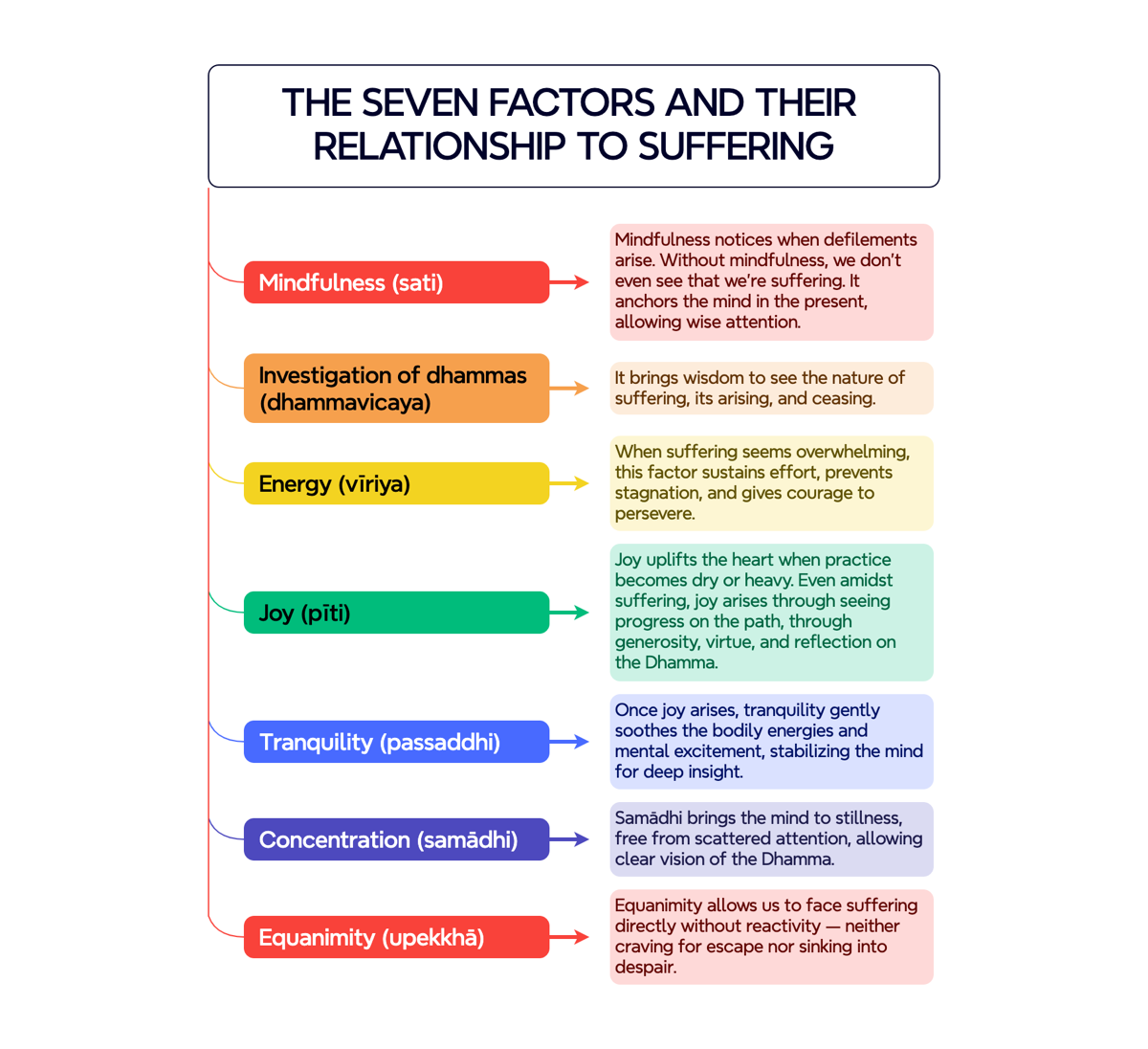
Seven Factors: The Five Spiritual Faculties
The Five Faculties are the "engine" that powers the Seven Factors of Enlightenment. They regulate and balance the development of the factors according to your personal tendencies.
Faith: supports Joy, Tranquility, and Equanimity. Faith brings confidence and trust in the path, in the Tathāgata, and in our capacity to awaken. It uplifts the mind when doubt or discouragement arises. For those prone to excessive skepticism or dryness, developing faith directly supports the arising of Joy (pīti) and softens the heart.
Energy: directly powers Investigation and Effort. This is the same energy as one of the Seven Factors. For those prone to laziness or sluggishness, energy must be emphasized. Without energy, investigation and mindfulness do not sustain.
Mindfulness: is both a faculty and a factor. It governs the balance between faith and wisdom, energy and concentration. Mindfulness is always useful.
Concentration: supports Tranquility and Equanimity. For those prone to restlessness or distraction, developing concentration helps steady the mind. Concentration allows insight to go deep.
Wisdom: guides Investigation and Equanimity. Wisdom knows what is skillful and unskillful. It understands dependent origination, impermanence, and not-self. For those prone to blind faith or emotional overwhelm, wisdom must be emphasized to guide investigation wisely.
“When faith is too strong and wisdom weak, one becomes gullible.
When wisdom is too strong and faith weak, one becomes skeptical.
When energy is too strong and concentration weak, one becomes restless.
When concentration is too strong and energy weak, one becomes lazy.
MN152
- When there is doubt or discouragement, apply Faith which results in Joy, Tranquility.
- When there is laziness sluggishness, apply Energy which results in Investigation, Energy.
- When there is distraction, restlessness, apply Concentration which results in Tranquility, Equanimity.
- When there is Blind faith, emotional overwhelm apply Wisdom which results in Investigation, Equanimity.
Mindfulness is useful under all circumstances.
Purifying the Mind: Using the Four Elements
The Tathāgata taught that all forms, whether gross or subtle, internal or external, are ultimately composed of the Four Great Elements: earth, water, fire, and air. These elements, when wisely contemplated, offer powerful antidotes to the Five Hindrances and serve as a way to develop the Seven Factors of Enlightenment.
The five hindrances—desire, ill-will, sloth, restlessness, and doubt—do not always appear as distinct, easy-to-identify obstacles. Often, they are embedded within experience itself: in the way we see the world, how we hold our breath, our posture, how we relate to pain, crave control, or resist discomfort. They shape perception from within, like a hidden lens we're unaware we're looking through. They are subtle impressions. We don't always see them directly; instead, we see through them.
Just as a doctor uses contrast dye in an X-ray or MRI scan to reveal what’s hidden in the body, so we apply one of the four elements to perception to reveal what is hidden in the mind. When we perceive everything as the earth element, for example, we create a contrast. It is a way of perceiving, of simplifying the field of experience so that what is impure becomes obvious. What sticks out is the clinging, resistance, and the making of "me, myself, or mine."
In the same way that a physician chooses a specific contrast dye to highlight different systems in the body—blood vessels, bones, or tissues—we can use the perception of the different elements (earth, water, fire, and air) to highlight different types of clinging, aversion, and delusion. Each element has its distinct energetic quality, and when brought into focus, it allows distorted perception to stand out clearly—so it can be known, understood, and ultimately released.
The Tathāgata taught us to contemplate the four great elements not only as a way to recognize the hindrances when they arise, but also as a way to purify perception at its root. When we perceive everything as the earth element, for example, we have purified perception. By doing this continually, the mind becomes more and more purified.
When we purify perception, we unify the field of experience. The mind becomes collected and unified (concentrated), no longer scattered among different perceptions. This results in a bright and clear mind, with perception no longer stained by craving or aversion. The mind is pliable and steady and is now ready for profound insight.
This is why contemplation of the elements is so potent: it both exposes the hindrances and develops the Seven Factors of Enlightenment.
Just as a goldsmith can fashion gold into any ornament: a ring, a bracelet, an earring, or a crown, so too a disciple can use the four elements: earth, water, fire, and air, in any skillful way to highlight the hindrances and purify perception.
Keep in mind, however, that the following are just examples. Just as the four great elements—earth, water, fire, and air—can come together to create all forms, we too can use them skillfully, flexibly, and creatively to highlight the hindrances and purify perception.
Let us now look at each element and some examples to understand how it can counter a particular hindrance and foster a corresponding Enlightenment Factor.
The Earth Element
- Counteracts: Ill-will, restlessness, and worry.
- Develops tranquility and equanimity.
The earth element, which represents stability, hardness, and groundedness, helps still the agitated mind and ill will. When one contemplates and perceives all experiences as grounded in the earth, with a mountain-like steadiness, restlessness fades. This stability develops the tranquility factor, bodily and mental calm. Just as the Earth is unmoved by storms or anything else, the tranquil mind is undisturbed by agitation with anything in experience
Just as people throw what is clean and what is unclean on the earth, feces, urine, spit, pus, or blood, and the earth is not horrified, humiliated, or disgusted because of this; in the same way, you should develop a mind like the earth, vast, exalted, and measureless. You should develop this perception for the removal of anger.
AN5.161
Just as a rock mountain is unwavering, immovable.. even so, when one dwells with a mind imperturbable by contacts
AN6.55
Just as, Rahula, the earth is not repelled, humiliated, or disgusted by anything clean or unclean placed on it; similarly, Rahula, develop mindfulness that is like the earth.
For, Rahula, for one who is developing the mindfulness that is like the earth, agreeable and disagreeable sensory impressions that have arisen will not overpower his mind.
MN62
.


Contemplating the Earth Element
To practice, we are not merely observing things as earth, but we immerse ourselves in the earth, realizing unity of perception, seeing everything as earth itself:
My experience, this very body and mind, is earth. And all experiences, without exception, rise and fall back into earth. Nothing stays in experience. From this earth-element, thoughts arise, feelings arise, memories arise, but none of them remain suspended. Each one, no matter how high or bright, falls back to earth.
Joy rises, it is earth. Fear rises, it is earth. Craving rises, it too is earth. All formations arise from earth and dissolve into earth.
Nothing escapes this gravity. All formations return. Like ashes falling on ashes, like dust settling on dust, all experience returns to where it all came from, earth.
So what is there to cling to? Where is the 'me, myself, or mine' in all of this?
When I place my mind on the unshakable, my mind does not waver, does not become agitated, does not settle, becomes liberated. Thus, one should be mindful there.
MN122
The Water Element
- Counteracts: Ill-will
- Fosters: Loving-kindness & Joy
The water element represents cohesion, softness, and fluidity. It counters ill-will by washing away hardness of heart. Contemplating the water element, or visualizing gentle flowing water melting away all experience, dissolves rigidity and hostility.
We use the water element to purify our awareness by seeing it as a lens through which to view all experience. Through this lens, everything is fluid, nothing is solid, everything flows, and nothing is static. There's nothing to cling to, which naturally leads to non-attachment, equanimity, and insight into impermanence.
Contemplating the Water Element
We see the entire body, mind, and world of experience as immersed in the water element, observing all phenomena as flowing, dissolving, disappearing, and ultimately being swallowed by the great ocean of emptiness, non-clinging, and cessation.
All of experience is water. Thoughts surge like waves. Emotions rise like the tide. Memories swirl like eddies. Desires ripple and then fade.
We immerse ourselves in this water, no longer standing apart, no longer trying to resist the current. We become the stream.
Each perception is a droplet. Each contact is a ripple. Each 'I am' is a fragile foam on the surface. And where do they go?
These aggregates, these appearances, they arise like ripples, float like foam, burst like bubbles, vanish like illusions, and all of it flows away.
They disappear into the great ocean, where names, forms, and perceptions vanish, where there is no more coming and going.
When you see form as foam, feeling as bubbles, and perception as a mirage, there is nothing to hold, nothing to resist, and the clinging mind dissolves.
For everything is already flowing. Already dissolving. Already being swallowed by the great ocean.
What are you trying to hold together that wants to flow?
Fire Element
- Counteracts: Sloth and torpor (thīna-middha)
- Fosters: Energy (vīriya-bojjhaṅga)
Fire is the element of heat, transformation, and illumination. When the mind is dull, invoking inner warmth or meditating on the dynamic nature of heat in the body rekindles vitality.
Just as a smith blows up his fire, so should a disciple torpor by arousing energy.
SN46.53
The Tathāgata praised the energy Enlightenment factor as a counter to mental sluggishness. Fire inspires motion and action, igniting the torch of wakefulness.
Contemplating the Fire Element
The body is on fire, the eyes are on fire.
But this fire does not hold. It does not preserve. It does not cling. It burns away.
Thoughts arise, and already they are burning away. Feelings swell, only to dissipate. Pleasure flickers, and then it's gone. Grief arises, and it dissolves in the heat.
There is no need to control. Everything is burning away on its own.
What remains when nothing is held back, when all formations are surrendered to the great fire of time?
Let it burn away. Let it pass. Let it vanish, naturally, gently, truly. No self is lost, only the illusion of permanence.
There is just this moment, this warmth, this flickering, this releasing.
This is not annihilation, this is clarity. This is not destruction, this is the law of nature.
All is burning… burning with the fire of lust, with the fire of hate, with the fire of delusion… burning with birth, aging, and death.
SN35.28
Air Element
- Counteracts: Sensual desire (kāmacchanda)
- Fosters: Mindfulness (sati-bojjhaṅga)
Air represents motion, breath, and expansion. When caught in sensual craving, attention is drawn outward. By observing the breath—the expression of the air element—one can recollect the body and cultivate sati, clear mindfulness.
Just as a skilled turner… trains himself breathing in and breathing out… mindful, he breathes in… mindful, he breathes out.
MN118
Seven Factors: Brahmavihāras
The Brahmavihāras: mettā (good-will), karuṇā (compassion), muditā (empathetic joy), and upekkhā (equanimity)—are traditionally practiced toward living beings. However, their highest potential is realized when they are applied inwardly, toward one's own mind and its formations. This inner direction not only purifies the heart but also fosters the direct development of the Seven Factors of Enlightenment by transforming our relationship with experience itself.
Whatever mental fabrications there are that are rooted in desire, all are abandoned through the mind released in loving-kindness...
AN8.63
Let's look at how each Brahmavihāra can be inwardly applied toward our own mental states to cultivate each of the seven bojjhaṅgā:
1. Mettā: Good-Will Toward Our Mind States
Instead of directing mettā outward, we turn it inward toward our own mind, especially when observing unwholesome thoughts, irritation, or fear. Rather than resisting or condemning these formations, we meet them with an unconditional kindness or good-will. This practice softens the resistance that prevents mindfulness and unifies the mind, preparing it for both rapture (pīti) and concentration (samādhi).
Whatever thought arises, one understands: ‘This is a mental formation.’ With kindness, the mind does not cling.
SN47.10
The utility of mettā lies in its ability to counter not only overt hatred or anger but also refined layers of aversion, such as:
- Frustration at the mind wandering during practice ("Why is this happening again?")
- Irritation toward tiredness, dullness, or sluggish effort ("I should be doing better.")
- Judgmental thoughts toward mental distractions ("This thought is unworthy. This state is wrong.")
- Impatience with emotional pain or sorrow ("This shouldn’t still be here.")
- Harsh striving masked as discipline ("I’ll push through this, whether or not it hurts.")
All of these are subtle versions of ill-will toward one's own mind. They perpetuate the cycle of suffering not by aggression, but by resistance.
For example, during practice, when a difficult mental formation arises, see it with good-will. Repeat gently. Do not expect immediate transformation—but watch how the resistance softens and mindfulness stabilizes.
As we refine our practice, mettā is no longer something we do but a way of seeing. It is not a phrase, not a feeling, not even a deliberate attitude; it becomes the very lens through which the mind regards its own processes.
2. Karuṇā: Compassion for Painful Mind States
Compassion, inwardly directed, is the ability to hold your own suffering states—grief, anger, and regret—with tenderness and wisdom. Rather than pushing these away or falling into aversion, karuṇā sees the dukkha in the formation. This clarity supports mindfulness and investigation.
You can silently see, “This is suffering; this too is a part of my condition,” thereby stabilizing awareness and opening a gentle space for exploration.
Seeing the danger in unwholesome states, the mind inclines to compassion toward its own wounded tendencies.
MN19
3. Muditā: Joy in Recognizing Wholesome States
Joy, or muditā, becomes a powerful force when applied to our own skillful thoughts and inclinations. When a wholesome intention arises, like renunciation, patience, or clarity, we rejoice! Take joy in the arising of wholesome states. This inner joy becomes energy and rapture, sustaining the practice and counteracting dullness or dissatisfaction.
Rather than focusing on what's wrong in the mind, recognize what’s working. Let the joy of the path feed itself.
One recollects their own virtue, and joy arises… from joy, rapture; from rapture, tranquility…
AN11.2
4. Upekkhā: Equanimity with All Arising and Passing Formations
Equanimity, or upekkhā, when inwardly directed, means regarding every arising mental fabrication, pleasant or painful, with deep equanimity. Not apathy, but clear seeing: "This too is conditioned. This too arises and ceases." Such equanimity naturally supports mindfulness, concentration, and the factor of equanimity itself.
Equanimity allows you to see the composite nature of all experience, neither clinging to delight nor recoiling from distress.
He regards feeling as feeling… mind as mind… he dwells independent, not clinging to anything in the world.
MN10
The Brahmavihāras, inwardly directed, become a compassionate frame for observing impermanence. They protect against self-judgment, energize wholesome qualities, and balance the extremes of indulgence and aversion.
Seven Factors: Liberation
With the destruction of the taints (āsava), one’s mind is liberated. Knowing: ‘Birth is destroyed, the holy life has been lived, what had to be done has been done, there is no more coming to any state of being.
MN72
At LiberationEnlightenment:
Mindfulness (sati) holds steady, fully present, not wavering. The mind clearly sees what is happening without confusion.
Investigation of Dhammas (dhammavicaya): fully penetrates the three characteristics: Anicca: All formations are impermanent. Dukkha: All formations are unsatisfactory. Anattā: All phenomena are not-self.
Energy (vīriya): is unwavering but balanced — no more striving, but fully alert.
Joy (pīti): has matured into deep gladness at the nearness of release.
Tranquility (passaddhi): allows the mind to remain serene in the face of profound insights.
Concentration (samādhi): holds the mind unified like a steady flame undisturbed by wind.
Equanimity (upekkhā): allows total surrender: No clinging. No aversion. No fear. The mind fully lets go.
“There is, disciples, that base where there is no earth, no water, no fire, no air... no this world, no other world... neither this nor that — this is the end of suffering.
ud1
The Seven Factors themselves are not Nibbāna. They are the conditions that lead to seeing Nibbāna. Once full liberation occurs, even the Seven Factors are no longer actively cultivated. The arahant lives with a purified mind that naturally abides without effort.
Here a disciple frequents a secluded lodging: a forest, the root of a tree, a mountain, a ravine, a hillside cave, a charnel ground, a jungle grove...
He sits down cross-legged after his meal, having returned from his alms round, setting his body erect and establishing mindfulness on itself. He lives with a mind free from covetousness for the world, cleansing his mind of covetousness; free from ill-will and harm, compassionate for the welfare of all living beings, cleansing his mind of ill-will; free from sloth and torpor, alert and mindful, cleansing his mind of sloth and torpor; free from restlessness and remorse, calm in mind, cleansing his mind of restlessness and remorse; free from doubt, having crossed over doubt, confident in skillful qualities, cleansing his mind of doubt.
Just as a person would take a loan for a venture, and the venture succeeds, he would then repay his old debts and still have surplus for supporting his family, thinking, I took a loan for a venture, it succeeded, I repaid my debts and have surplus for my family, and he would be joyful and happy.
Similarly, a sick person, suffering and severely ill, unable to eat and lacking strength, later recovers, can eat and regains strength, thinking, I was sick, suffering, unable to eat, now I am recovered, can eat, and have regained strength, and he would be joyful and happy.
Just as a person imprisoned would later be released safely without loss of property, thinking, I was imprisoned, now I am released safely without loss of property, and he would be joyful and happy.
Just as a slave would later be freed, becoming independent and free to go where he wishes, thinking, I was a slave, now I am free and independent, and he would be joyful and happy.
Just as a wealthy person traveling through a dangerous road would emerge safely without loss of property, thinking, I traveled through a dangerous road and emerged safely without loss of property, and he would be joyful and happy.
In the same way a disciple sees these five hindrances un-abandoned in himself as debt, sickness, imprisonment, slavery, and a dangerous road. When these five hindrances are abandoned, he sees himself as debt-free, healthy, released from prison, freed from slavery, and in a safe place.
Having abandoned these five hindrances, impurities of the mind that weaken wisdom, secluded from sensual pleasures, secluded from unskillful qualities, he enters and remains in the first jhana, which is accompanied by directed and sustained attention, with rapture and pleasure born of seclusion...
MN39
Sutta Study
AN5.23: The Impurities Sutta discusses the concept of impurities in both gold and the mind, drawing parallels between the two. In gold, impurities such as iron, copper, tin, lead, and silver prevent it from being pliable, workable, and radiant, hindering its use in craftsmanship. Similarly, the mind has five impurities: sensual desire, ill will, sloth and torpor, restlessness and worry, and doubt. These impurities make the mind inflexible, unworkable, and dull, obstructing concentration and the ability to achieve higher states of knowledge. When these mental impurities are removed, the mind becomes capable of extraordinary feats, such as recalling past lives, understanding the minds of others, and perceiving the karmic destinies of beings with the divine eye. The sutta emphasizes the importance of purifying the mind to attain deep concentration and spiritual powers.
AN10.61: The Avijjāsutta explains the causal relationships that lead to ignorance and liberation. Ignorance is sustained by the five hindrances, which in turn are fueled by three kinds of misconduct. These misconducts are influenced by lack of sense restraint, which is affected by deficient mindfulness and clear comprehension. This deficiency stems from unwise attention, which is a result of faithlessness, itself caused by not hearing the true Dhamma. This lack of exposure to true teachings is due to associating with bad people. Conversely, liberation is nourished by the seven factors of enlightenment, which are supported by the four foundations of mindfulness. These foundations are upheld by three kinds of good conduct, which are influenced by proper sense restraint. This restraint is enhanced by mindfulness and clear comprehension, which are nourished by wise attention. Wise attention comes from faith, which is fostered by hearing true teachings, and this is facilitated by associating with good people. This Sutta uses the metaphor of rainwater flowing down a mountain to illustrate how these elements are interconnected, emphasizing the importance of good associations for achieving true knowledge and liberation.
SN46.2: The Sutta explains how both the body and mental states depend on nourishment. It likens the sustenance of the body by food to the sustenance of mental hindrances and enlightenment factors by their respective nourishments. Sensual desire is nourished by focusing on beauty, ill-will by focusing on repulsiveness, sloth and torpor by boredom and lethargy, restlessness and remorse by an unsettled mind, and doubt by ambiguous situations. Conversely, enlightenment factors like mindfulness, investigation of dhamma, energy, joy, tranquility, concentration, and equanimity are nourished by appropriate attention to conducive states and qualities. This analogy emphasizes the importance of proper mental nourishment for spiritual growth.
SN46.3: The Silasutta emphasizes the profound benefits of associating with noble disciples skilled in virtue, concentration, and liberation. Engaging with such individuals—through seeing, listening, and following them—leads disciples to experience both bodily and mental satisfaction. This satisfaction fosters mindfulness, which in turn triggers a series of awakening factors: investigation of Dhamma, energy, joy, tranquility, concentration, and equanimity. As these factors are developed, they culminate in significant spiritual achievements. Depending on the extent of their cultivation, disciples can expect one of seven outcomes, ranging from enlightenment in this life to various states of liberation after death, highlighting the transformative power of diligently practicing the Dhamma.
SN46.4: Venerable Sāriputta, while in Sāvatthī at Jeta's Grove, taught the disciples about the seven factors of enlightenment: mindfulness, investigation of the Dhamma, energy, joy, tranquility, concentration, and equanimity. He explained his ability to dwell in any chosen enlightenment factor at different times of the day, describing each as 'boundless' and 'well cultivated'. He compared this mastery to a king choosing garments to wear, emphasizing his deep understanding and control over these spiritual states.
SN46.6: The Blessed One, while in Sāketa's Añjanavana Deer Park, was approached by the wanderer Kuṇḍaliya. Kuṇḍaliya inquired about the benefits of the Tathagata's teachings. The Tathagata explained that he lives for the benefit of knowledge and liberation, achievable through the development of the seven factors of enlightenment. These factors are cultivated by practicing the four foundations of mindfulness, which in turn are fulfilled by the three kinds of good conduct, underpinned by sense restraint. Sense restraint involves guarding the senses to prevent unwholesome states and maintain mental stability. This practice leads to good conduct, which supports mindfulness, fostering the factors of enlightenment essential for ultimate knowledge and liberation. Impressed, Kuṇḍaliya expressed his admiration and declared his commitment to the Tathagata, the Dhamma, and the Sangha as a lay follower.
SN46.26: The Udāyivagga Taṇhakkhayasutta teaches that the path to the cessation of craving is through developing the seven factors of enlightenment, as explained by the Blessed One to the venerable Udāyi. These factors, including mindfulness and equanimity, are cultivated based on seclusion, dispassion, cessation, and relinquishing attachment. This development leads to the abandonment of craving, action, and consequently, suffering, illustrating a direct path to the cessation of suffering through the cessation of craving and action.
SN46.35: The Ayonisomanasikārasutta discusses the effects of improper and proper attention. Improper attention leads to the emergence and growth of negative states like sensual desire, ill will, sloth, torpor, restlessness, remorse, and doubt. Conversely, proper attention fosters the development and fulfillment of positive qualities such as the mindfulness and equanimity enlightenment factors, enhancing spiritual growth.
SN46.38: When a noble disciple attentively listens to the Dhamma, fully engaged and focused, the five hindrances—sensual desire, ill will, sloth and torpor, restlessness and worry, and doubt—are absent. Concurrently, the seven factors of enlightenment, including mindfulness and equanimity, are fully developed. This state of focused engagement and absence of hindrances allows for the deepening of spiritual understanding and progress.
SN46.41: Originating in Sāvatthi, the discourse emphasizes that ascetics and brahmins across all times—past, present, and future—successfully abandon the threefold due to their development and cultivation of the seven factors of enlightenment. These factors range from mindfulness to equanimity, underscoring their essential role in spiritual abandonment and enlightenment.
SN46.49: The Tathagata emphasizes the importance of wise attention in cultivating the seven factors of enlightenment. He states that no other single factor is as crucial for the development of these enlightenment factors as wise attention. A disciple with wise attention is expected to develop and cultivate these factors, particularly mindfulness and equanimity, both of which are rooted in seclusion, dispassion, cessation, and mature through relinquishment.
SN46.51: The Sākacchavagga Āhārasutta teaches about the nourishment and non-nourishment for the five hindrances and the seven factors of enlightenment. Sensual desire is nourished by frequent improper attention to the sign of beauty, while ill-will is fueled by the sign of repulsiveness. Sloth and torpor grow from discontent and lethargy, restlessness and remorse from non-quietude of the mind, and doubt from uncertain things. Conversely, the enlightenment factors such as mindfulness, investigation of states, energy, joy, tranquility, concentration, and equanimity are nourished by frequent proper attention to conducive states and signs. Non-nourishment involves applying wise attention to counteract the arising and development of hindrances, such as perceiving unattractiveness to combat sensual desire, and cultivating loving-kindness against ill-will.
SN46.52: Some wanderers tell some desciples that they, too, teach the five hindrances and the seven awakening factors, so what is the difference? The Tathagata explains by giving a detailed analytical treatment that he says is beyond the scope of the wanderers.
SN46.54: Some wanderers tell some desciples that they, too, teach the five hindrances and the four Brahmā dwellings, so what is the difference? The Tathagata explains the detailed connection between the Brahmā dwellings and the awakening factors, which taken together lead to liberation.
SN54.2: The Bojjhaṅgasutta teaches that mindfulness of breathing, when developed and cultivated, offers significant benefits. It involves developing seven enlightenment factors—mindfulness, investigation-of-states, energy, joy, tranquility, concentration, and equanimity—each accompanied by mindfulness of breathing. These practices are rooted in seclusion, dispassion, cessation, and lead to letting go, culminating in substantial spiritual rewards.
SN54.12: Venerable Lomasavaṅgīsa explains to Mahānāma that the difference between a trainee and the Realized One is that the trainees practice to give up the hindrances, whereas the Realized One has already ended all defilements.
SN54.13: In Sāvatthī, Venerable Ānanda asked the Blessed One if a single practice could fulfill multiple spiritual developments. The Blessed One confirmed that mindfulness of breathing, when properly cultivated, fulfills the four foundations of mindfulness, which in turn fulfill the seven factors of enlightenment, leading to true knowledge and liberation. This practice involves a disciple being fully aware and mindful while breathing, focusing on the body, feelings, mind, and phenomena, thereby cultivating mindfulness, investigation, energy, joy, tranquility, concentration, and equanimity. These factors, developed through seclusion, dispassion, and cessation, ultimately lead to enlightenment and liberation.